What are the current data? Describe recent federal and state - - PDF document

what are the current data
SMART_READER_LITE
LIVE PREVIEW

What are the current data? Describe recent federal and state - - PDF document

CPS 2014 Annual Meeting 8/8/2014 Conflict of Interest Disclosure Legislative Solutions to the Opioid Crisis: For this talk, I have no conflicts of interest to disclose. New Developments in the U.S. and Colorado I have (in the past, on


slide-1
SLIDE 1

CPS 2014 Annual Meeting 8/8/2014 1

Office of the Governor

Legislative Solutions to the Opioid Crisis:

New Developments in the U.S. and Colorado

Robert Valuck, PhD, RPh, FNAP

Departments of Clinical Pharmacy, Epidemiology, and Family Medicine Director, Colorado Consortium for Prescription Drug Abuse Prevention

Colorado Pharmacists Society Annual Meeting June 22, 2018

Office of the Governor

Conflict of Interest Disclosure

  • For this talk, I have no conflicts of interest to disclose.
  • I have (in the past, on other topics) received federal, state,

municipal, foundation, and industry funding (research grants, speaker honoraria for single talks, advisory boards).

Office of the Governor

Objectives

  • Summarize the scope and impact of the opioid crisis in the

United States and Colorado.

  • Describe recent federal and state legislative solutions that

have been passed to address the crisis.

  • Discuss opportunities for pharmacists to get involved in the

legislative process and implementing solutions.

Office of the Governor

What are the current data?

Office of the Governor

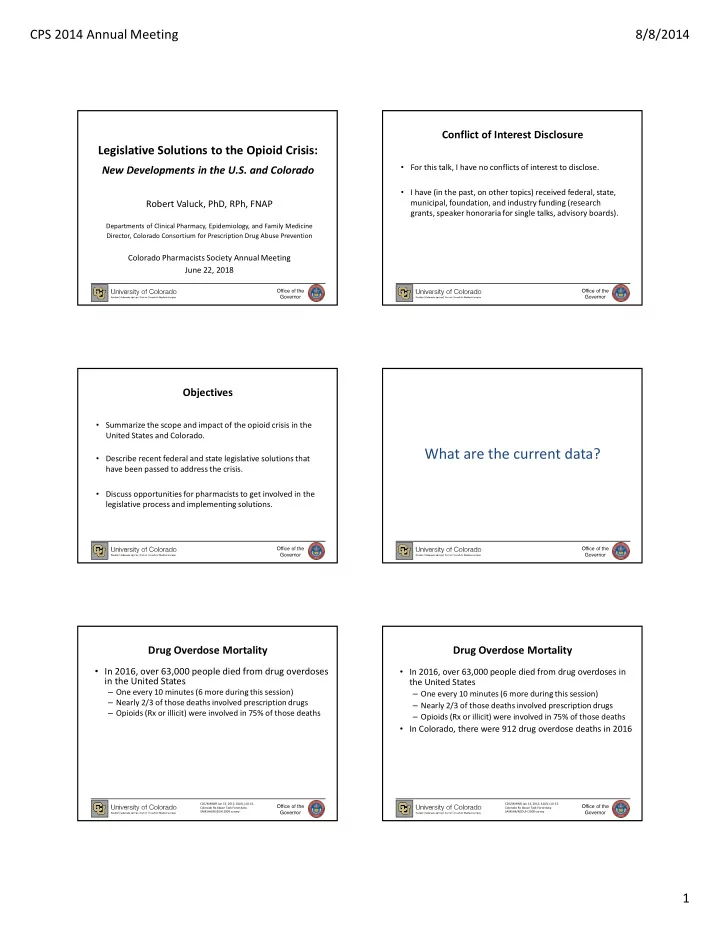
Drug Overdose Mortality

  • In 2016, over 63,000 people died from drug overdoses

in the United States

– One every 10 minutes (6 more during this session) – Nearly 2/3 of those deaths involved prescription drugs – Opioids (Rx or illicit) were involved in 75% of those deaths

  • In Colorado, there were 912 drug overdose deaths in 2016
  • Of these 912, 504 were opioid involved (Rx or illicit, combined)

– Good news: Rx opioid deaths down slightly (329 in 2015, 300 in 2016) – Bad news: Heroin deaths (160 in 2015, 228 in 2016), Fentanyl deaths (41 in 2015, 49 in 2016) and Methadone deaths (34 in 2015, 56 in 2016) are all up sharply [Net Gain for all Opioids: 472 in 2015, 504 in 2016]

  • The problem knows no regional, gender, age, income, or other

bounds: it is truly an epidemic (CDC: top four)

CDC/MMWR Jan 13, 2012; 61(01):10-13. Colorado Rx Abuse Task Force data SAMSHA/NSDUH 2009 survey .

Office of the Governor

Drug Overdose Mortality

  • In 2016, over 63,000 people died from drug overdoses in

the United States

– One every 10 minutes (6 more during this session) – Nearly 2/3 of those deaths involved prescription drugs – Opioids (Rx or illicit) were involved in 75% of those deaths

  • In Colorado, there were 912 drug overdose deaths in 2016
  • Of these 912, 504 were opioid involved (Rx or illicit, combined)

– Good news: Rx opioid deaths down slightly (329 in 2015, 300 in 2016) – Bad news: Heroin deaths (160 in 2015, 228 in 2016), Fentanyl deaths (41 in 2015, 49 in 2016) and Methadone deaths (34 in 2015, 56 in 2016) are all up sharply [Net Gain for all Opioids: 472 in 2015, 504 in 2016]

  • The problem knows no regional, gender, age, income, or other bounds: it is

truly an epidemic (CDC: top four)

CDC/MMWR Jan 13, 2012; 61(01):10-13. Colorado Rx Abuse Task Force data SAMSHA/NSDUH 2009 survey .

slide-2
SLIDE 2

CPS 2014 Annual Meeting 8/8/2014 2

Office of the Governor

Drug Overdose Mortality

  • In 2016, over 63,000 people died from drug overdoses in

the United States

– One every 10 minutes (6 more during this session) – Nearly 2/3 of those deaths involved prescription drugs – Opioids (Rx or illicit) were involved in 75% of those deaths

  • In Colorado, there were 912 drug overdose deaths in 2016
  • Of these 912, 504 were opioid involved (Rx or illicit,

combined)

– Good news: Rx opioid deaths down slightly (329 in 2015, 300 in 2016) – Bad news: Heroin deaths (160 in 2015, 228 in 2016), Fentanyl deaths (41 in 2015, 49 in 2016) and Methadone deaths (34 in 2015, 56 in 2016) are all up sharply [Net Gain for all Opioids: 472 in 2015, 504 in 2016]

  • The problem knows no regional, gender, age, income, or other bounds: it is

truly an epidemic (CDC: top four)

CDC/MMWR Jan 13, 2012; 61(01):10-13. Colorado Rx Abuse Task Force data SAMSHA/NSDUH 2009 survey .

Office of the Governor

Drug Overdose Mortality

  • In 2017 (provisional), 558 were opioid involved (11% increase)

– Rx Opioid deaths rising again (329 in 2015, 300 in 2016, 372 in 2017) – Heroin deaths (160 in 2015, 228 in 2016, 223 in 2017) – Fentanyl deaths (41 in 2015, 49 in 2016, 81 in 2017) – Methadone deaths (34 in 2015, 56 in 2016, 58 in 2017)

  • The problem knows no regional, gender, age, income, or other

bounds: it is truly an epidemic (CDC: top four)

CDC/MMWR Jan 13, 2012; 61(01):10-13. Colorado Rx Abuse Task Force data SAMSHA/NSDUH 2009 survey .

Office of the Governor

Drug Overdose Mortality in Colorado

CDC/NCHS National Vital Statistics System, CDC Wonder. Updated 2010..

Office of the Governor

Drug Overdose Mortality in Colorado

CDC/NCHS National Vital Statistics System, CDC Wonder. Updated 2010..

Office of the Governor

Drug Overdose Mortality in Colorado

CDC/NCHS National Vital Statistics System, CDC Wonder. Updated 2010..

Office of the Governor

Drug Overdose Death Rates in the US

CDC WONDER data file, Nov 21, 2014; 63(46);1095.

slide-3
SLIDE 3

CPS 2014 Annual Meeting 8/8/2014 3

Office of the Governor

13

Prescription Drugs: primary driver of Overdose Deaths in United States

Jones et al. JAMA 2013; and CDC/NCHS 2010.

2,000 4,000 6,000 8,000 10,000 12,000 14,000 16,000 18,000 Number of Deaths Drug or Drug Class

Office of the Governor

14

Deaths are the Tip of the Iceberg

For every opioid overdose death in 2014 there were…

SAMHSA NSDUH, DAWN, TEDS data sets Coalition Against Insurance Fraud. Prescription for Peril. http://www.insurancefraud.org/downloads/drugDiversion.pdf 2007.

Office of the Governor

15

Deaths are the Tip of the Iceberg

For every opioid overdose death in 2014 there were…

SAMHSA NSDUH, DAWN, TEDS data sets Coalition Against Insurance Fraud. Prescription for Peril. http://www.insurancefraud.org/downloads/drugDiversion.pdf 2007.

Office of the Governor

16

Deaths are the Tip of the Iceberg

For every opioid overdose death in 2014 there were…

SAMHSA NSDUH, DAWN, TEDS data sets Coalition Against Insurance Fraud. Prescription for Peril. http://www.insurancefraud.org/downloads/drugDiversion.pdf 2007.

Office of the Governor

17

Deaths are the Tip of the Iceberg

For every opioid overdose death in 2014 there were…

SAMHSA NSDUH, DAWN, TEDS data sets Coalition Against Insurance Fraud. Prescription for Peril. http://www.insurancefraud.org/downloads/drugDiversion.pdf 2007.

Office of the Governor

18

Deaths are the Tip of the Iceberg

For every opioid overdose death in 2014 there were…

SAMHSA NSDUH, DAWN, TEDS data sets Coalition Against Insurance Fraud. Prescription for Peril. http://www.insurancefraud.org/downloads/drugDiversion.pdf 2007.

slide-4
SLIDE 4

CPS 2014 Annual Meeting 8/8/2014 4

Office of the Governor

Altarum Research Institute. Economic Toll of Opioid Crisis in U.S. Exceeded $1 Trillion Since 2001. Feb 13, 2018. Viewed at: www.altarum.org/about/news-and-events/

Costs of the Epidemic: Past and Projected

Office of the Governor

Substance Abuse Treatment Gap: 90%

SAMHSA/NSDUH 2011 survey

Office of the Governor

Access to Medication Assisted Treatment (MAT) in Colorado: April 2017

Colorado Health Institute. Miles Away from Help: The Opioid Epidemic and Medication-Assisted Treatment in Colorado. May 2017. Accessed at: www.coloradohealthinstitute.org

Office of the Governor

How does this problem start?

Office of the Governor

Sales of Opioid Pain Relievers and Nonmedical Opioid Use (2010-11)

#37 in U.S.

SAMHSA/NSDUH 2011 survey

Office of the Governor

Sales of Opioid Pain Relievers and Nonmedical Opioid Use (2010-11)

#2 in U.S.

(Oregon = 6.4) SAMHSA/NSDUH 2011 survey

slide-5
SLIDE 5

CPS 2014 Annual Meeting 8/8/2014 5

Office of the Governor

Sources of Opioids among Nonmedical Users

CDC/MMWR Jan 13, 2012; 61(01):10-13. SAMHSA/NSDUH 2009 survey .

Office of the Governor

Sources of Opioids among Nonmedical Users

CDC/MMWR Jan 13, 2012; 61(01):10-13. SAMHSA/NSDUH 2009 survey .

Over 70% obtain

  • pioids from friends
  • r relatives…the

“Medicine Cabinet” problem (most common starting point to Nonmedical use and Addiction)

Office of the Governor

Sources of Opioids among Nonmedical Users

CDC/MMWR Jan 13, 2012; 61(01):10-13. SAMHSA/NSDUH 2009 survey .

Also significant: 17%

  • f patients who are

started on opioids legitimately, but begin nonmedical use with the “leftovers” (after their acute pain has subsided)

Office of the Governor

New Persistent Opioid Users after Surgery

Brummett et al, JAMA Surg. 2017: 152(6)

After surgery, major or minor, 6% of people started on opioids for post surgical pain are new, persistent users 1 year later

Office of the Governor

29

Majority of Heroin users in past year reported Nonmedical use of Opioids before heroin initiation (US, 2002-2004 and 2008-2010)

Jones, C.M. Drug Alcohol Depend., 2013. 32.8 12.4 10.1 16.9 10.5 11.2 16.8 12.9 2.1 18.4 15.2 6.7 25.4 6.2 16.4 9.7 65.1 69.1 74.7 76.4 64.1 82.6 66.8 77.4

10 20 30 40 50 60 70 80 90 100 2002-2004 2008-2010 2002-2004 2008-2010 2002-2004 2008-2010 2002-2004 2008-2010 1-29 Days PYNMU 30-99 Days PYNMU 100-365 Days PYNMU Any PYNMU Percent Frequency of Past Year Nonmedical Use

Age first use OPR same as heroin Age first use heroin before OPR Age first use OPR before heroin

Office of the Governor

What is being done?

slide-6
SLIDE 6

CPS 2014 Annual Meeting 8/8/2014 6

Office of the Governor

31

President’s Commission

https://www.whitehouse.gov/opioids/

Office of the Governor

President’s Commission: Recommendations

  • Declare national public health emergency (done)
  • Treatment Expansion: eliminate Medicaid IMD

exclusion, create incentives for delivery of MAT, enforce MHPAEA (mental health/SUD parity)

  • CME: mandatory CME for DEA registered prescribers
  • Naloxone: equip law enforcement, create standing
  • rders laws at state level, require coprescribing for at

risk patients

  • PDMPs: fund interstate data sharing, require federal

facilities to participate/report data

  • Other: Address 42 CFR Part 2 consent issues, develop

fentanyl detection sensors/systems, review rules/regs

https://www.whitehouse.gov/opioids/

Office of the Governor

Recent Federal Agency Initiatives

  • CDC: named Prescription Drug Abuse as one of the top four

epidemics facing the U.S.; issued Guideline for Prescribing Opioids for Chronic Pain (March 2016)

  • CMS: stated “will adopt” CDC guidelines for Medicare patients
  • FDA: issued Black Box Warning for opioids (risk of addiction,

OIRD and death); guidance for abuse deterrent formulations; and recommended Opana ER (oxymorphone HCl) be pulled from the market (MFR complied)

  • DEA: tougher scheduling (Tramadol; Hydrocodone

combination products); National Drug Take Back days (most recent was 4/28); new rules allowing pharmacies and law enforcement departments to be “reverse distributors” (i.e., collect and take back medications)

Office of the Governor

Pending Federal Legislation

  • Previous legislation: CARA (2015), 21st Century Cures (2016)
  • House Energy & Commerce committee held hearings over the

past 6-8 months, drafted a package of opioid bills

  • After two markups…

– 57 bills advanced to the House of Representatives – 56 advanced with bipartisan votes (53 by voice vote, 4 by roll call)

  • Topics range from treatment access, to workforce

development, to incentives for development of non opioid medications, to safe disposal, to required CME for prescribers, and many others

  • Follow along at: https://energycommerce.house.gov/opioids/
  • President has pledged ~$13 Billion to opioid crisis over the

next two fiscal years (up from $144M in CARA, $1.1B in 21CC)

Office of the Governor

https://leg.colorado.gov/committees/opioid-and-

  • ther-substance-use-disorders-study-committee/

Office of the Governor

  • Committee met between July and October 2017, drafted 6 bills, 5 passed/signed:
  • Prevention/Education

⦁ Workforce Development

  • Clinical Practice Improvement

⦁ Treatment (Inpatient/Residential)

  • Harm Reduction

⦁ Payment Reform (prior auth)

https://leg.colorado.gov/committees/opioid-and-

  • ther-substance-use-disorders-study-committee/
slide-7
SLIDE 7

CPS 2014 Annual Meeting 8/8/2014 7

Office of the Governor

HB18-1003: Opioid Misuse Prevention

“Concerning measures to prevent opioid misuse in Colorado, and, in

connection therewith, making an appropriation.” Key Components: ⦁ Extend Interim Study Committee on Opioid and Other Substance Use Disorders for two more years (interim sessions) ⦁ Fund Consortium (CU) to do provider education on safe opioid prescribing, and L.E. and community based naloxone training ⦁ Fund continuation/expansion of Screening, Brief Intervention, and Referral to Treatment (SBIRT) program through CDPHE Fiscal Note: $2.25 Million (one time funding) Relevance for Pharmacists: indirect, but important (prescribing, naloxone)

Office of the Governor

SB18-022: Clinical Practice for Opioid Prescribing

“Concerning clinical practice measures for safer opioid prescribing.”

Key Components: ⦁ Prescribers may only issue prescriptions of opioids for an initial supply of seven days or less (for opioid naïve, non-chronic pain, non-provider transfer, non-end of life or palliative care patients) ⦁ Prescribers must check the PDMP prior to issuing a second opioid prescription for a patient, as per above rules and exceptions ⦁ Restrictions repeal automatically in September 2021 (3 years) Fiscal Note: None Relevance for Pharmacists: indirect, but important (awareness of new requirements for prescribers)

Office of the Governor

SB18-040: Substance Use Disorder Harm Reduction

“Concerning measures to address the opioid crisis in Colorado, and, in connection therewith, providing immunity for individuals who provide clean syringes through a clean syringe exchange program, creating a supervised injection facility pilot program, allowing school districts to develop policies for the supply and administration of opiate antagonists, and requiring the commission on criminal and juvenile justice to study certain topics related to sentencing for opioid-related offenses.” Key Components: ⦁ Allow (not require) Supervised Injection Facility (SIF) pilot program ⦁ Allow school districts to create naloxone policies & procedures Fiscal Note: None [This bill failed in Senate State, Veterans and Military Affairs Committee]

Office of the Governor

SB18-024: Expand Access to Behavioral Health Care Providers

“Concerning modifications to the Colorado health service corps program administered by the department of public health and environment to expand the availability of behavioral health care providers in shortage areas in the state, and, in connection therewith, making an appropriation.” Key Components: ⦁ Have CDPHE use existing shortage designation system, add Behavioral Healthcare Providers (BHPs) ⦁ Create loan repayment and scholarship programs for those seeking training as BHPs (addiction counselors) Fiscal Note: $2.5 Million (annually) Relevance for Pharmacists: indirect, but important (growth of MAT capacity)

Office of the Governor

HB18-1136: Substance Use Disorder Treatment

“Concerning treatment for individuals with substance use disorders, and, in connection therewith, adding residential and inpatient treatment to the Colorado medical assistance program and making an appropriation.” Key Components: ⦁ Have HCPF (Medicaid) residential and inpatient substance use disorder services and medical detoxification services to the Colorado medical assistance program ⦁ Apply for federal 1115 waiver, seek input from stakeholders Fiscal Note: $35 Million (annually) Relevance for Pharmacists: indirect, but important (growth of Tx capacity)

Office of the Governor

HB18-1007: Substance Use Disorder Payment and Coverage

“Concerning payment issues related to substance use disorders.” Key Components: ⦁ Requires all payers to provide, without Prior Authorization, coverage for at least one 5-day supply of FDA-approved medication for treatment of opioid dependence (buprenorphine or methadone) ⦁ Prior authorization requests for MAT are ‘urgent’ requests ⦁ Pharmacists/pharmacies working under collaborative practice agreement may administer injectable opioid antagonist medication, and receive enhanced dispensing fee (Medicaid or Commercial) Fiscal Note: None Relevance for Pharmacists: direct (can now do naltrexone administration)

slide-8
SLIDE 8

CPS 2014 Annual Meeting 8/8/2014 8

Office of the Governor

How can Pharmacists get more involved?

Office of the Governor

Three Things Pharmacists Can Do

  • Join the Colorado Consortium for Prescription Drug

Abuse Prevention (www.corxconsortium.org)

  • Make your voice heard in the legislative process

– Via the Consortium and its work groups – Via CPS and its leadership and lobbyists – Via the Interim Study Committee process

  • Implement meaningful changes: patient education,

safe disposal, naloxone, injectable naltrexone

Office of the Governor

Thank You!

Email: robert.valuck@ucdenver.edu Website: www.corxconsortium.org Phone: 303-724-2890