
SLIDE 1
ABOUT MINERAL SANDS
AIM:SAV
What are Heavy Minerals? Most sand on the beach consists of grains - - PowerPoint PPT Presentation
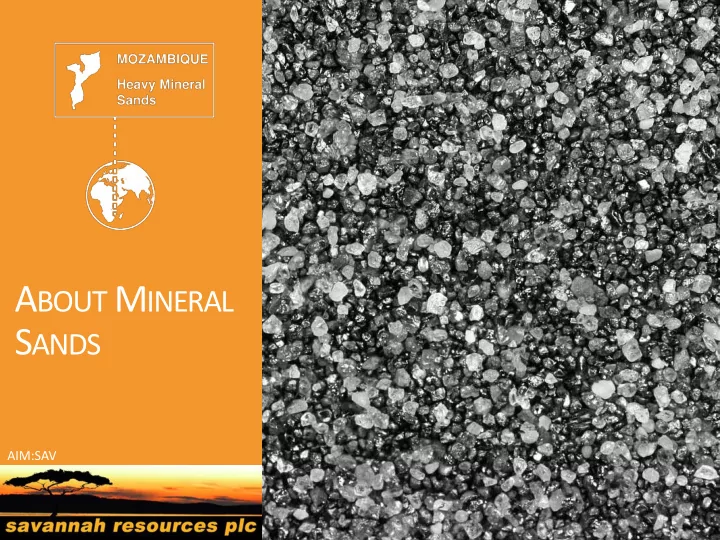
A BOUT M INERAL S ANDS AIM:SAV 2 What are Heavy Minerals? Most sand on the beach consists of grains of the mineral quartz (SiO2) Mineral sands are old beach sands that contain concentrations of the important minerals, rutile, ilmenite,
AIM:SAV
Mineral sands are old beach sands that contain concentrations of the important minerals, rutile, ilmenite, zircon and monazite. These minerals are heavy and are also called 'heavy minerals'
Zircon Over 50% of the zircon supplied to industry is consumed in the production of ceramics, including tiles, sanitary ware and tableware where it is used in the glazes. Zircon is also used in a range of other applications including zirconium chemicals, refractories, fused zirconia, catalytic fuel converters, foundry applications as well as water and air purification applications. Titanium Minerals The Titanium material is used in pigment production to make a pure white additive, which is light refractive, and used to produce materials such as plastics, paints and paper. Other applications for titanium products include TiO2 sponge for the production of Titanium metal, and welding rod applications.
Rutile, ilmenite and zircon originally grew as crystals in igneous rocks such as granite, pegmatite and basalt and some metamorphic rocks.
Over millions of years, these igneous and metamorphic rocks were weathered and eroded, and the grains of quarts and other minerals in the rock, including rutile, ilmenite, zircon and monazite, were washed down to the sea by heavy rainfall and fast flowing streams.
The heavy minerals are then carried back up onto the beach by waves. As the waves washed up and down on the beach, they carried the lighter quartz grains with them back into the sea, leaving the grains of the heavy minerals rutile, ilmenite, zircon and monazite behind on the
sand.
These processes were repeated many times over millions of years, eventually creating a large deposit of mineral sands on the beach.
As the sea level rose and fell over geological time, the shoreline moved further inland and then back again. As this happened, the deposits of mineral sand were covered by more sand and built up or eroded and redeposited elsewhere.
9
The start of the process comes from the generation
ideas, which are based on the geology
models, geophysics and the broad scoping
potential resources that might suit a current commodity market
Low impact exploration, or ‘early’ exploration as it is often referred to, generally results in minimal ground disturbance with limited rehabilitation requirements
impact exploration conducted and any land access requirements
<1km2
the volume, quality and shape of the mineral resource
shape and volume of the resource, along with information on chemical assays and mineral concentrations
below
transported to processing plant Mining Processing Plant Heavy Mineral Concentrate
mineral concentrate split into products
transported to market for sale
www.resource-finance.com
Rehabilitation during mining is progressive with the tailings material returned to the pit from where it was mined and the area is rehabilitated as the mining continues.
For further information on Savannah’s corporate social responsibility programme, please email: community@savannahresources.com