SLIDE 1
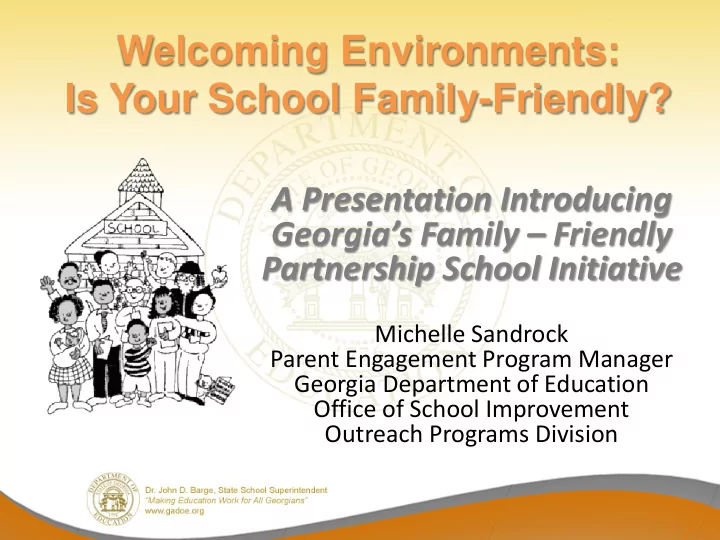
Welcoming Environments: Is Your School Family-Friendly?
A Presentation Introducing Georgia’s Family – Friendly Partnership School Initiative
Michelle Sandrock Parent Engagement Program Manager Georgia Department of Education Office of School Improvement Outreach Programs Division
SLIDE 2
- Had three little children and
no child care?
- Didn’t have a car or cash
for the bus?
there was not an interpreter at the school?
- Were a grandparent raising a
child and found the school environment intimidating?
- Had a husband/partner who expects
you to be at home in the evening?
- Did poorly in school and think your
child’s problems are your fault?
- Had to work Monday nights when
the PTA always has its meetings?
- Saw the PTA as a snobby “in crowd”
that ignores people who don’t dress a certain way, speak English well,
- r live in a “nice “neighborhood?
Switching Places: What if You…
SLIDE 3
- The school is difficult to find
within the community?
- The parking is limited and
there are not designated parent/visitor spaces?
- It is difficult to get an
appointment with the principal?
treated rudely by the school secretary?
- The school does not encourage
parents to volunteer?
- There is not a person designated
to work with parents and address their concerns?
- The building does not reflect the
diversity of the school population?
- There is not a system in place to
communicate school news and events with families regularly?
Switching Places: What if You Found…
SLIDE 4
- Why
- Family-Friendly Self-Assessment
- Statistics and Research
- What
- Partnership Schools Overview
- National PTA Standards for Family-School Partnerships
- How
- Georgia’s Virtual Family-Friendly Partnership Schools
- Georgia Family-Friendly Partnership Schools Award
- Questions
Today’s Agenda
SLIDE 5
How Family–Friendly Is Your School?
SLIDE 6
- According to the National Center
for Children in Poverty at Columbia University, more than 74 million children (birth to age eighteen) live in the United States.
- Of those more than 74 million
children, about 42% live in low- income families.
that these are the children in your schools?
SLIDE 7
- Low-income = unable to afford basic necessities
- 31
31 MI MILLI LLION = Lo Low-In Income
- me
- Poverty can impede a child’s ability to learn and contribute
to social, emotional and behavioral problems.
5.5 5 MI MILLI LLION = Pove verty
- Sadly, the number of children in poverty has been rising
steadily since 2000.
What Does That Mean?
SLIDE 8
Change the MINDSET! HOW DO WE GET FAMILIES INVOLVED?
SLIDE 9
- Parents have dreams for their
children and want the best for them.
- All parents have the capacity to support
their children’s learning.
- Parents and school staff should be
equal partners.
- Responsibility for building partnerships
between school and home rests primarily with school staff, especially school leaders.
Core Beliefs
*Beyond the Bake Sale: The Essential Guide to Family-School Partnerships, by Anne T. Henderson, Karen L. Mapp, Vivian R. Johnson, and Don Davies (New York, NY: The New Press, 2007).
SLIDE 10 Parents Are More Likely to Become Involved When:
they SHOULD be involved.
making a contribution.
their school and children.
(Hoover-Dempsey and Sandler, 1997)
SLIDE 11
Why Welcoming Environments?
According to the book, Beyond the Bake Sale: The Essential Guide for Family- School Partnerships by Anne Henderson, Karen Mapp, Vivian Johnson, and Don Davies (2007), welcoming environments provide parents with a reciprocal relationship where not only do they feel that they belong to the school, but the school belongs to them.
SLIDE 12 When it comes to partnering with families and the community, how does your school rank? There are four levels of achievement when defining schools based on partnership: * Partnership School * Open-Door School * Come-if-We-Call School * Fortress School
Beyond the Bake Sale: The Essential Guide for Family-School Partnerships (2007)
SLIDE 13 Bridging the Gap and Connecting to the Parents of Children in Your Schools…
Partnership School
All families and communities have something great to
- ffer—we do whatever it takes to work closely
together to make sure every single student succeeds.
Beyond the Bake Sale: The Essential Guide for Family-School Partnerships (2007)
SLIDE 14
- 1. Building Relationships
- 2. Linking to Learning
- 3. Addressing Differences
- 4. Supporting Advocacy
- 5. Sharing Power
Five Categories
There are five categories that help indicate your particular type of school:
Beyond the Bake Sale: The Essential Guide for Family-School Partnerships (2007)
SLIDE 15
- 1. Building Relationships
- Family center is always open and full
- f interesting learning materials to
borrow
- Home visits are made to new families
- Activities honor families’ contributions
- Building is open to community use
and social services are available to families
Partnership School:
Beyond the Bake Sale: The Essential Guide for Family-School Partnerships (2007)
SLIDE 16
- 2. Linking to Learning
- All family activities connect to what
students are learning
- Parents and teachers look at student
work and test results together
- Community groups offer tutoring and
homework programs at the school
- Students’ work goes home every
week, with a scoring guide
Partnership School:
Beyond the Bake Sale: The Essential Guide for Family-School Partnerships (2007)
SLIDE 17
- 3. Addressing Differences
- Interpreters are readily
available
materials about families’ cultures
- PTA includes all families
- Local groups help staff
reach parents
Partnership School:
Beyond the Bake Sale: The Essential Guide for Family-School Partnerships (2007)
SLIDE 18
- 4. Supporting Advocacy
- There is a clear, open
process for resolving problems
- Teachers contact families
each month to discuss student progress
- Student-led parent-teacher
conferences are held three times a year for thirty minutes
Partnership School:
Beyond the Bake Sale: The Essential Guide for Family-School Partnerships (2007)
SLIDE 19
- 5. Sharing Power
- Parents and teachers research issues
such as prejudice and tracking
- Parent group is focused on improving
student achievement
- Families are involved in all
major decisions
- Parents can use the school’s office equipment (i.e. phone)
- Staff work with local organizations to improve the school
and neighborhood
Partnership School:
Beyond the Bake Sale: The Essential Guide for Family-School Partnerships (2007)
SLIDE 20
The focus is not what schools should do to involve parents – it is what parents, schools, and communities can do
together to support
student success.
PTA’s National Standards for Family-School Partnerships
SLIDE 21
Families are active participants in the life of the school, and feel welcomed, valued, and connected to each other, to school staff, and to what students are learning and doing in class.
Welcoming All Families into the School Community
SLIDE 22
Georgia’s Family-Friendly Partnership Schools
SLIDE 23
Where to Start: Data Based Decision Making
SLIDE 24
Let’s Put the Tool to Use!
SLIDE 25
Are you a Georgia Family – Friendly Partnership School? Apply for the Award!
SLIDE 26 Georgia Family Friendly Partnership School Awards
Eligibility
- The school must be identified as a schoolwide Title I school.
- The school must not be designated as a Priority School or Focus
School under the Georgia Waiver for ESEA requirements.
- The school may not have been a Family-Friendly Partnership
School Award recipient within the last five years.
SLIDE 27 Selection
assesses the written applications.
are announced.
school site visits to determine winners.
announced as winners.
Winners
Georgia Family Friendly Partnership School Awards
- Georgia Family – Friendly
Partnership School title of distinction
- A welcome mat and plaque
- Press release from the GaDOE
- Letter of Recognition from State
School Superintendent
- Recognition in spotlight award
publication
- Special professional learning
- pportunity provided by the
Ritz-Carlton
SLIDE 28
Timeline
Georgia Family Friendly Partnership School Awards
August
Application Released
November
Finalists Announced
December thru March Surprise School Site Visits
April
Winners Annouced
SLIDE 29 Application
- 1. Section A: School Information
- 2. Section B: School Data
- 3. Section C: Parent Survey
- 4. Section D: Short Answer
- 5. Section E: Attachments
- 6. Section F: Essay
Georgia Family Friendly Partnership School Awards
SLIDE 30
It’s On the Website…
Click the First Search Option: Parent Engagement Program www.gadoe.org
SLIDE 31
It’s On the Website…
Family – Friendly Partnership School
SLIDE 32
It’s On the Website…
Handouts & Downloads!
SLIDE 33
Michelle Sandrock Program Manager Parent Engagement Program 404-232-1148 msandrock@doe.k12.ga.us
Contact Information
Nate Schult Specialist Parent Engagement Program 404-463-1956 nschult@doe.k12.ga.us
SLIDE 34
Questions