
SLIDE 1
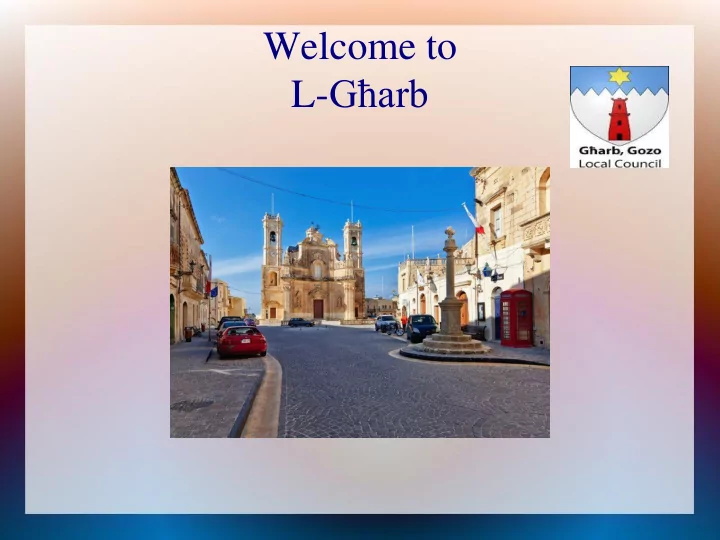
Welcome to L- Garb Agriculture Manufacturing Rural Tourism The - - PowerPoint PPT Presentation
Welcome to L- Garb Agriculture Manufacturing Rural Tourism The Natural Rural Housing and Cultural and services Changing the Craft and service New income Heritage emphasis from industries: revival Modern quantity of food
Agriculture
emphasis from quantity of food to quality of food
Manufacturing
industries: revival
economies
Rural Tourism
The Natural and Cultural Heritage
amenities vs respecting local traditions of building
Rural Housing and services
amenities vs respecting local traditions of building
municipalities.
field of rural localities, education, culture, creative communities, sustainability and citizenship.
formation of EU policies at European level.
Municipalities / Local Councils’ representatives
business activity through the use of culture and arts,
SME’s
practices,
funds and how these can be translated into tangible projects, and
and the Europe for Citizens Program,
experiences / dreams and
atmosphere!!!
spaces, a peaceful pace of life.
villages.
concentrate to make villages smarter.
Rural development is more than ever before linked to entrepreneurship.
❑
Institutions and individuals promoting rural development now see entrepreneurship as a strategic development intervention that could accelerate the rural development process.
❑
Furthermore, institutions and individuals seem to agree on the urgent need to promote rural enterprises.
❑
Development agencies see rural entrepreneurship as an enormous employment potential.
❑
Politicians see it as the key strategy to prevent rural unrest.
❑
Farmers see it as an instrument for improving farm earnings.
❑
Women see it as an employment possibility near their homes which provides autonomy, independence and a reduced need for social support.
❖ The entrepreneurial orientation to rural development
accepts entrepreneurship as the central force of economic growth and development.
❖ Without it other factors of development will be wasted or
frittered away.
❖ However, the acceptance of entrepreneurship as a central
development force by itself will not lead to rural development and the advancement of rural enterprises.
❖ firstly, it sets out the reasons why promoting entrepreneurship is a
force of economic change that must take place if many rural communities are to survive;
create an environment in rural areas conducive to entrepreneurship;
development.
❑ entrepreneurship means primarily innovation, ❑ it means risk-taking? ❑ a market stabilising force ❑ means starting
a small business.
appropriate for the rural area context
needed to improve the quality of life for individuals, families and communities and to sustain a healthy economy and environment.
factors and not exclusively to innovations that are on the technological or organizational cutting edge.
such as education, health, social services, housing, transport facilities, flow of information and so on, cannot be developed and sustained in the area in the long run.
❖L-Għarb is one of Gozo’s oldest villages. ❖Archaeological excavations have revealed the remains of Neolithic and Bronze Age settlements (not visible today). ❖The Phoenicians were here followed by the Romans and Byzantines. ❖The name L-Għarb, though, is Arabic, suggesting the establishment of an organised community here during Arab domination between 870 and 1090 AD.
L-Għarb is a traditional village. ❖Its character is distinctly rural and until very recently it was populated almost exclusively by people who worked the surrounding fields in this fertile area of Gozo. ❖They retained an old Maltese dialect, with a rich vocabulary of
❖The people of l-Għarb are also renowned craftsmen mostly famous for the manufacture of the unique “l-Għarb blade”, a tradiitonal sharp knife popularly known as the “Sikkina ta’ l- Għarb”. ❖Even today, L-Għarb is home to blacksmiths, locksmiths, cotton weavers and lace makers, carpenters and masters in cane- work. ❖Gharb is also known for producing able fishermen and shepherds produce the best Gozo Cheese on the Island.
l-Għarb Folklore Museum ❖ occupies an historic house in the heart of the village. ❖ The 28 rooms contain all sorts of curiosities linked with traditional trades, crafts and daily life. ❖ The building that houses the museum was once home to Frenc Mercieca (1892-1967), popularly known as Frenc ta’ l- L-Għarb, a saintly ‘wise man’ who cured many people with a mix of medicinal herbs and prayer to Our Lady. ❖ He left doctors perplexed by his successes and his reputation spread rapidly throughout the Maltese Islands and even abroad.
Also open to visitors is the former home of another saintly resident, Karmni Grima, the woman who heard the voice of Our Lady at Ta’ Pinu and began the devotions that have turned it into Malta’s most important shrine. ❖ Ta’Pinu , today a large and important church, lies
❖ The hill opposite which has a steep but pleasant path leading to the top, adorned with white marble statues of the stations of the cross.
❖ Historically, Gharb played an importrant role in safeguarding Malta. ❖ Gharb’s coastal lookouts were, for example, the first to signal the arrival from Sicily of reinforcements for the beleaguered Maltese under the Knights of St. John in the Great Siege of Malta in 1565. ❖ During that time of constant threat from the Ottoman Turks and marauding Berbers, the L-Għarb lookouts were crucial, sending smoke signals to Malta to warn of approaching peril.
❖ L-Għarb is the second oldest village parish in Gozo, established in 1679. ❖ The old church, known today as “Taż-Żejt”, served as the parish church for fifty years. ❖ It is called ‘Taz-Zejt’ (zejt meaning oil) because of a legend that says that an old woman found oil
her body and was cured of her ills.
❖ Today’s impressive Parish Church and Collegiate Basilica that dominates the pretty square at the heart of the village, was built in 1699 and consecrated in 1729. ❖ It is dedicated to the Visit of Our Lady to her cousin
year and the festa is held on the first weekend of July.
❖ A short and pleasant walk out of the village towards the coastal cliffs is the tiny chapel of St.Demetrius. ❖ Legend has it that Turkish raiders once stole the young son of a local lady called Sgugina. ❖ After the poor mother wept her distress in front of the sacred altar painting of St Demetrius in the chapel, the story goest that the saint was seen riding his horse out of the painting, charging the Turks and returning Żgugina’s son safely to his mother. The area around Gharb and St Demetrius’ Chapel is delightful for walking and enjoying the countryside.
❖ If you follow the little road along the Wied il- Mielaħ (valley) you will have a lovely meander through fertile Gozitan countryside before reaching the sea and a dramatic natural rock ‘window’ very much less visited than the iconic Azure Window at Dwejra. ❖ Alternatively, you could just sit peacefully in Gharb’s picturesque village square, admiring the view of the church and the unique hand-carved stone balconies that adorn the village’s oldest homes, and watching the Gozitan world go by.