
SLIDE 1
Welcome to
Process Communication Model Taibi Khaler, PhD
Are you Talking or are you Communicating?
Christine Sterpetti - Certified PCM Trainer
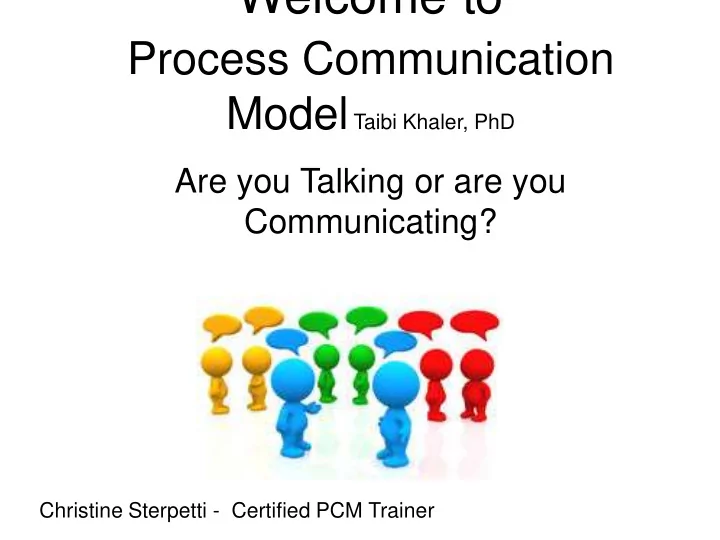
Welcome to Process Communication Model Taibi Khaler, PhD Are you - - PowerPoint PPT Presentation
Welcome to Process Communication Model Taibi Khaler, PhD Are you Talking or are you Communicating? Christine Sterpetti - Certified PCM Trainer 1) Helps us to know ourselves better 2) How we interact with the world 3) A useful tool to help us
Christine Sterpetti - Certified PCM Trainer
Sender Recipient
Message
Feedback What I Mean What I Understand
Every person views the world around them in 6 different ways which correspond to 6 fundamentally different perceptions.
url
25% of population 75% men 25% women Physcological Needs:
Recognition of work Structure of time
I think... What options... Does that mean... Who, what, when, where... ...facts ...information Logical, Responsible, Organized pointslogicallllllo
logical,respnsir
rl
Recognition of work/contribution Recognition of conviction
Dedicated Observant Conscientious
30% of population 25% men 75% women Physcological Needs:
Recognition of person sensory
Spontaneous Creative Playful
10% of population 40% men 60% women Psychological Need: Solitude I imagine... ...I see... It comes to mind... I need to reflect... Reflective Imaginative Calm
Psychological Need: Excitement
IMAGINER (imagination)
PERSISTER (opinions)
PROMOTER (actions)
HARMONIZER (emotions) THINKER (thoughts) REBEL (reactions)
IN-ACTION
0 10 20 30 40 50 60 70 80 90 100
1) We are born with our base. This does not change 2) by 7 years old a persons condominium is structured
3) In the beginning Base and Phase are the same (1/3 of population base/phase) Long term (6 mo -2 years) intensive stress can cause a Phase change. Therefore our psychological needs change.
Ok, but did it start this morning or did it start a week ago?
What do you mean... how can you not remember when it started?
2nd Degree - Becomes frustrated and critical around time and those who do not
1st Degree - starts using big words, hyper detailed. Manager - stops delegating 3rd Degree - Not able to think
2nd Degree - Starts “preaching”. Becomes suspicious and critical of those that don’t believe like them.
1st Degree - starts using big words, starts asking complicated questions. Manager - notices only what is wrong 3rd Degree - Doesn’t trust
2nd Degree - Starts to make silly mistakes. Starts to self criticize and invites criticism from others.
1st Degree - Wants to
needs, loses self confidence Manager - Does not make firm decisions as needed 3rd Degree - Their environment becomes dirty or disheveled. They “let themselves go.” Gets rejected
2nd Degree - Starts to blame. Becomes negative and
vengeful
1st Degree - Makes effort to understand. Manager - Inappropriately delegates 3rd Degree - “I’ll show them”
2nd Degree - Stops giving
not finished. Feels inadequate
1st Degree - Isolates from the rest. Believes things will get done by themselves. Says, “yes” generically. Manager - No longer concentrates on what needs to be done 3rd Degree - Gets isolated
2nd Degree - Starts to
Ignores or breaks the rules.
1st Degree - Stops helping
figure it out themselves’ Manager - No longer offers support - on your own 3rd Degree - Abandons others
Type
(thoughts) Recognition
Competence Structure of time
(actions)
(imagination)
(reactions)
(opinions)
(emotions) Incident Solitude Playful Contact Recognition
Sensory Recognition
Recognition