Welcome to LyncoUrt Lyncourt U is for you as parents/guardians to - - PowerPoint PPT Presentation

welcome to lyncourt
SMART_READER_LITE
LIVE PREVIEW

Welcome to LyncoUrt Lyncourt U is for you as parents/guardians to - - PowerPoint PPT Presentation

Welcome to LyncoUrt Lyncourt U is for you as parents/guardians to come together to discuss and learn about what is important to your childs growth and development. Our belief is that students succeed when the family, school, and


slide-1
SLIDE 1

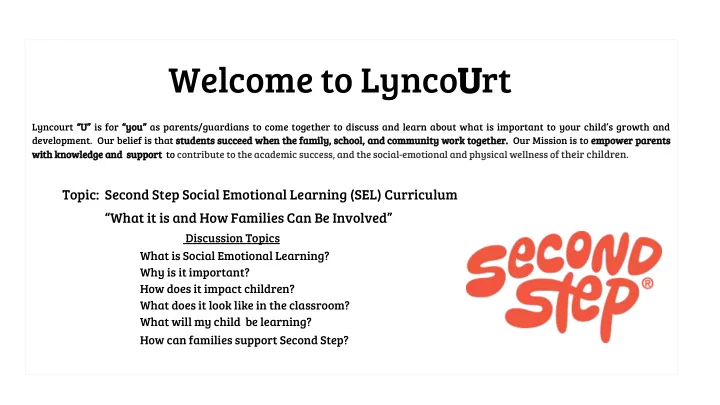
Welcome to LyncoUrt

Lyncourt “U” is for “you” as parents/guardians to come together to discuss and learn about what is important to your child’s growth and

  • development. Our belief is that students succeed when the family, school, and community work together. Our Mission is to empower parents

with knowledge and support to contribute to the academic success, and the social-emotional and physical wellness of their children. Topic: Second Step Social Emotional Learning (SEL) Curriculum

“What it is and How Families Can Be Involved” Discussion Topics

What is Social Emotional Learning? Why is it important? How does it impact children? What does it look like in the classroom? What will my child be learning? How can families support Second Step?

slide-2
SLIDE 2

Research Organization: Collaborative for Academic, Social, and Emotional Learning (CASEL)

CASEL was formed in 1994 with the goal of establishing high-quality, evidence-based social and emotional learning (SEL) as an essential part of preschool through high school education. From the beginning, CASEL was comprised of a distinguished national leadership team that identified key issues to advance the science and practice of SEL. Both CASEL and the term “social and emotional learning” emerged from a meeting in 1994 hosted by the Fetzer Institute. Meeting attendees included researchers, educators, and child advocates involved in various education-based efforts to promote positive development in children. These SEL pioneers came together to address a concern about ineffective school programming and a lack of coordination among programs at the school level.

https://casel.org/history/

slide-3
SLIDE 3
slide-4
SLIDE 4

What is Social Emotional Learning?

Introduction to the Second Step Social Emotional Curriculum Video : https://youtu.be/ikehX9o1JbI

slide-5
SLIDE 5

Second Step Focuses on Essential Skills UPK-5

slide-6
SLIDE 6
slide-7
SLIDE 7

How Can Families Support Second Step?

Ask questions? New skills are introduced every Monday and reinforced throughout the week.

UPK-20 minutes K- 20-25 minutes Grade 1-25-30 minutes Grade 2 30-35 minutes Grade 3 30-35 minutes Grade 4 35-40 minutes Grade 5 35-40 minutes

DAY 2-5

10-20 minutes

slide-8
SLIDE 8

6th Grade Units of Study

Unit 1 Mindsets & Goals Unit 2 Values and Friendships Unit 3 Thoughts, Emotions and Decisions Unit 4 Serious Peer Conflict

slide-9
SLIDE 9

What does the week look like??

https://www.youtube.com/watch?v=0UNv2dF7O6c&t=84s

slide-10
SLIDE 10

What is Executive Function?

Flexible Attention, Inhibitory Control, Working Memory

https://www.youtube.com/watch?v=FZLXggsK6oA Brain Builders (yellow copies)

Executive Function Activities (Blue, Orange, purple copies) Memory Games Reading a short story & ask questions Checkers/Chess Card Games Car rides: I went to the store and I bought an Apple..B...C

slide-11
SLIDE 11

SELF REGULATION- The ability to monitor and manage emotions,

thoughts, and behaviors

https://www.youtube.com/watch?v=t4okAfKCwRk&index=1&list=PL2 yRU0zqN4egNbYiqXrl_m2i9uH554CuV

slide-12
SLIDE 12

CALMING STRATEGIES

The purpose of this activity is to help your child begin to learn: Ways to calm their bodies down when they have strong feelings. We suggest the following home activity: Using the “How to Calm Down” poster, help your child practice calming their body down. Remember to place your hands on your belly and say “STOP”. Name your feeling by saying “I am feeling sad, happy, frustrated, or angry”. After encouraging your child to name their feeling, together practice breathing in through your nose and slowly breathing out through your mouth. FOR Early Learners: Use the feelings poster to help your child identify their feelings.

https://www.crisisprevention.com/Blog/May-2015/Breathe

slide-13
SLIDE 13

Joining In- Grade 4 http://www.secondstep.org/Streaming-Media/Second-Step/grade-4/Lesson-8

slide-14
SLIDE 14

PROBLEM SOLVING - Grade 4

http://www.secondstep.org/Streaming-Media/Second-Step/grade-4/Lesson-17

slide-15
SLIDE 15

Use the Home Links to talk with your children.

slide-16
SLIDE 16

Why is Self Care Important?When parents aren’t able to take care of themselves, it can make the job of

parenting that much more stressful and can lead to exhaustion, illness, and resentment. By taking small steps toward caring for yourself, you’ll notice a change in how you feel and cope with the unique challenges of parenting. Physical : Eating healthy food regularly; fitting in exercise; getting preventive and medical care; getting enough sleep; turning off or putting away electronic devices (TV, phone, tablet) for portions of the day and at bedtime. Spiritual: Visiting a place of personal spirituality or worship; meditation; journaling. Social: Keeping in touch with family or friends (this could be electronic, by phone, or in person); trying a new hobby. Emotional: Expressing your emotions to a supportive person; not taking

  • n too much.

This list may seem overwhelming, but the good news is that doing even

  • ne small thing for yourself will make a difference. Here are some ways to

integrate self-care into your daily routine: Prioritize: Your time is already scarce, so don’t feel guilty about saying “no” to, or postponing, additional commitments. Commit to one non-negotiable self-care act: Schedule time into your daily/weekly routine for this activity and let your family know what the time is for. Your non-negotiable self-care does not have to take a lot of time or

  • energy. It may mean getting up a few minutes earlier so you have time for a

quiet cup of coffee, asking a caregiver to stay 15 extra minutes so you can take a walk around the block, or setting your phone to “do not disturb” at a specific time each evening. Ask for or enlist help: Schedule a qualified sitter or ask a family member

  • r friend. Set aside that time to connect with friends or schedule a date

with your spouse or partner.

https://www.youtube.com/watch?v=1Evwgu369Jw&list=PLsMbK Kq0n9d0E2M3vNBrzW5voZwXyWxNt&index=2
slide-17
SLIDE 17

Upcoming LyncoUrt Events November 13th: Prevention Network Simulation December 11th- Social Media Awareness Thank you for coming this evening. Hope to see you at the next event! Bring a friend.