Welcome What Employers Need To Know to todays webinar Paul Byrne - - PowerPoint PPT Presentation

welcome
SMART_READER_LITE
LIVE PREVIEW

Welcome What Employers Need To Know to todays webinar Paul Byrne - - PowerPoint PPT Presentation

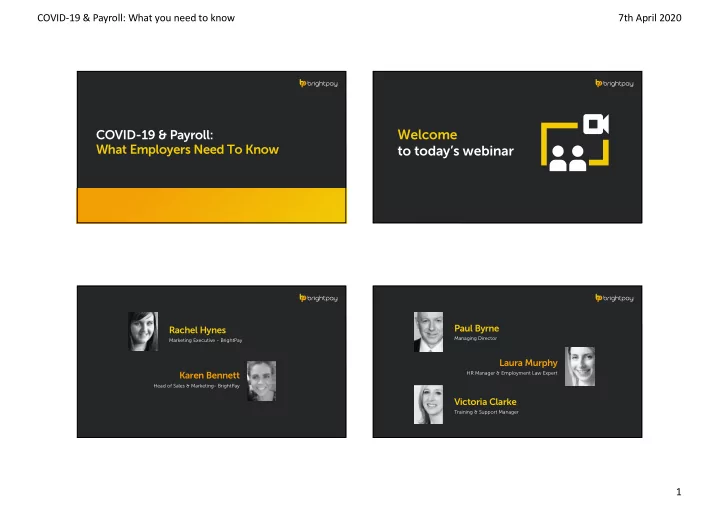
COVID-19 & Payroll: What you need to know 7th April 2020 COVID-19 & Payroll: Welcome What Employers Need To Know to todays webinar Paul Byrne Rachel Hynes Managing Director Marketing Executive - BrightPay Laura Murphy HR


slide-1
SLIDE 1

COVID-19 & Payroll: What you need to know 7th April 2020 1

COVID-19 & Payroll: What Employers Need To Know

Welcome to today’s webinar

Rachel Hynes

Marketing Executive - BrightPay

Karen Bennett

Head of Sales & Marketing- BrightPay

Paul Byrne

Managing Director

Laura Murphy

HR Manager & Employment Law Expert

Victoria Clarke

Training & Support Manager

slide-2
SLIDE 2

COVID-19 & Payroll: What you need to know 7th April 2020 2

Questions Recording Email Handouts Resources

COVID-19 & Payroll: What Employers Need To Know

Number of confirmed cases and deaths are rising Strict guidelines in a bid to reduce the impact of COVID-19 Everyone who can work from home must work from home

COVID-19 Coronavirus

Employer & Employee Rights

People’s health and well-being should be at the heart

  • f every employer’s response to COVID-19.
slide-3
SLIDE 3

COVID-19 & Payroll: What you need to know 7th April 2020 3

Engage all employees to use basic but effective ways to help prevent the spread of COVID-19

COVID-19 & Employer Rights

Be aware of what happens if employees do have COVID-19 symptoms Keep up to date with Government and public health advice

COVID-19 & Employer Rights

  • Coronavirus Job Retention Scheme
  • Deferred VAT and Self-Assessment payments
  • Self-employment Income Support Scheme
  • Statutory Sick Pay relief package for SMEs
  • Coronavirus Business Interruption Loan Scheme
  • HMRC Time To Pay Scheme
  • 12-month business rates holiday for all retail,

hospitality, leisure and nursery businesses in England

  • Small business grant funding of £10,000 for all

business in receipt of small business rate relief or rural rate relief

  • Grant funding of £25,000 for retail, hospitality and

leisure businesses with property with a rateable value between £15,000 and £51,000

  • New lending facility from the Bank of England to help

support liquidity among larger firms

Additional Resource

COVID-19 & Employer Rights

Support for businesses through deferring Income Tax payments Coronavirus Job Retention Scheme Additional Resource Short term cash flow support: Coronavirus Business Interruption Loan

COVID-19 & Employee Rights

Employees with COVID-19 symptoms cannot leave their home Businesses and workplaces should encourage their employees to work at home If an employee lives with someone who has symptoms – can get an isolation note for their employer Additional Resource
slide-4
SLIDE 4

COVID-19 & Payroll: What you need to know 7th April 2020 4 COVID-19 & Employee Rights

Annual leave rules have been temporarily relaxed More information on employee rights throughout the webinar Employees may carry over up to 4 weeks paid holidays into the next two leave years Additional Resource

COVID-19: How to handle SSP

COVID-19 related sick pay differs from normal Statutory Sick Pay.

COVID-19 & SSP

BrightPay 20/21 - new option for COVID-19 Related Sick Leave Employees are entitled to Statutory Sick Pay from day one Check existing sick leave policies – some businesses pay over the SSP amount A temporary scheme that is designed to support employers whose operations have been severely affected by COVID-19.

Coronavirus Job Retention Scheme & Furlough Leave

slide-5
SLIDE 5

COVID-19 & Payroll: What you need to know 7th April 2020 5

A way of preventing layoffs and redundancies

Job Retention Scheme & Furlough Leave

Furloughed employee – an employee who has been placed

  • n a leave of absence

Designed to support employers whose operations have been severely affected by COVID-19 Claims can be backdated to 1 Mach

Job Retention Scheme & Furlough Leave

Employers can claim for: 80% of usual monthly wage costs (capped at £2,500) Associated Employer National Insurance contributions Minimum auto enrolment employer pension contributions

Job Retention Scheme & Furlough Leave

It’s available to all employees: Must have been on your PAYE payroll

  • n 28th February 2020

Full-time employees Part-time employees Employees on agency contracts Flexible / zero-hour contracts Furloughed employees cannot undertake work for or on behalf of the organisation

Job Retention Scheme & Furlough Leave

If an employee is working on reduced hours, they will not be eligible Not all employees need to be placed

  • n furlough
slide-6
SLIDE 6

COVID-19 & Payroll: What you need to know 7th April 2020 6

Sick leave / self-isolating - SSP, but can be furloughed afterwards

Job Retention Scheme & Furlough Leave

Shielding / living with vulnerable – can be furloughed if they are unable to work from home Unpaid leave – cannot be furloughed unless after 28 February Maternity, adoption, paternity, shared parental pay - normal rules apply

Job Retention Scheme & Furlough Leave

Caring responsibilities, e.g. childcare – can be furloughed More than one employment – can be furloughed for each job No income-generating work while

  • n furlough, but they can continue

to run the business from a statutory perspective

Job Retention Scheme & Furlough Leave

Also applies to salaried individuals who are directors of their own PSC Directors – can claim for PAYE salary Can be furloughed multiple times

Job Retention Scheme & Furlough Leave

When the scheme ends, employees can remain furloughed – no subsidy Minimum of 3 consecutive weeks Maximum furlough – 3 months from 1 March

slide-7
SLIDE 7

COVID-19 & Payroll: What you need to know 7th April 2020 7

HMRC must be notified of any furloughed employees & details

  • f their earnings

Job Retention Scheme & Furlough Leave

At a minimum – whichever is lower: HMRC Portal – make a claim for wage costs – not yet available 80% of their regular wage £2,500 per month

Job Retention Scheme & Furlough Leave

Employer top-up – Employer NI and AE contributions not subsidised Employees – subject to Income tax, National Insurance, AE contribution Employers – still liable for Employer NI & AE contributions but will receive a subsidy from HMRC to cover this Variable pay, higher of:

Job Retention Scheme & Furlough Leave

Full-time & part time employees – salary before tax as of 28 February Same month’s earning from the previous year Average monthly earnings from 2019/20 tax year Employees only entitled to NMW / NLW for the hours they are working

Job Retention Scheme & Furlough Leave

Fees, commission and bonuses should not be included Furloughed employees pay can fall below NMW / NLW Time spent training – must be paid the appropriate minimum wage

slide-8
SLIDE 8

COVID-19 & Payroll: What you need to know 7th April 2020 8

An employee can be placed on furlough if contract contains a layoff or short-term clause

Furlough Leave & Employment Legislation

Where there is no such clause, it’s best advised to get agreement from the employee Must provide written notice and keep a record of this for 5 years Additional Resource Furloughed employee’s retain their rights – SSP, maternity, unfair dismissal, redundancy payments

Furlough Leave & Employment Legislation

When the scheme ends – redundancy may be necessary Deciding who to furlough – equality and discrimination laws apply The Self-Employed Income Support Scheme is designed to protect the jobs of self-employed workers across the UK.

Self-Employed Income Support Scheme

Taxable grant for self-employed individuals – 80% (capped at £2,500) Recipients can continue their normal trading activity

Self-Employed Income Support Scheme

Average monthly trading profit over the last 3 years Paid in June - a single lump sum installment covering all 3 months

slide-9
SLIDE 9

COVID-19 & Payroll: What you need to know 7th April 2020 9

Businesses need to identify where they are and where they need to be to ensure safety and enable business continuity.

Business Continuity Plan & Communication

Working from home – consider which processed and tools will make flexible work productive Keep on touch with employees with video conferencing calls Have a clear communication strategy to ensure everyone is aware of policies and actions

Business Continuity

Bring business functions in-house to prevent supply chain breakdowns Unable to work from home – implement measures that support social distancing requirements

Business Continuity

Flexible working hours / rosters Staggered lunch breaks Reducing group activities Employees may be suffering from anxiety, increased stress, feeling insecure and the uncertainty about what the future holds.

Supporting Employees through COVID-19

slide-10
SLIDE 10

COVID-19 & Payroll: What you need to know 7th April 2020 10

Reinforce internal peer support or employee assistance programmes Pay attention to employees needs & feelings

COVID-19 & Supporting Employees

Useful tips from our HR Manager – really positive response from all employees COVID-19 is having a massive impact on payroll. Here at BrightPay, we’re trying to do everything we can to help our customers.

The Challenge of Coronavirus & Processing Payroll

Keeping customers up-to-date with help guide, blogs, emails, webinars Development team consistently making changes to the software as new changes are announced

BrightPay’s COVID-19 Preparedness

Customer support – Over 1149 calls and 815 emails in one day Website – COVID-19 Resources Hub Additional Resource Although BrightPay is a desktop solution, it is very flexible and can facilitate working from home.

How BrightPay can facilitate remote working

slide-11
SLIDE 11

COVID-19 & Payroll: What you need to know 7th April 2020 11

Payroll files can be accessed remotely through cloud environments such as Dropbox or Google Drive BrightPay can be installed on up to 10 different PCs

Remote Working with BrightPay

Allows you to continue to process the payroll as normal Additional Resource Accessing the payroll files: If working off a different PC, the software will need to be installed

Remote Working with BrightPay

Using your work computer Using a remote desktop Using a shared drive environment Using an external drive, e.g. USB Using BrightPay Connect Bureaus can assign payroll staff as a user to access certain clients In your payroll software, login to Connect and restore the payroll

Remote Working with Connect

Make sure to synchronise the payroll after the payroll has been completed BrightPay Connect is proving to be hugely beneficial and enables full business continuity with secure communications.

How BrightPay Connect’s

  • nline portals can help
slide-12
SLIDE 12

COVID-19 & Payroll: What you need to know 7th April 2020 12

Remotely manage employee’s leave, upload employee documents and send communications to employees Automatic cloud backup – access payroll info anywhere, anytime

How Connect can help

Track COVID-19 related sick leave which flows through to the online employee and employer calendar Distribute mission critical documents employee entitlements and updated contracts and policies Upload documents and resources to distribute to employees

How Connect can help

Notify employees of important announcements which can be viewed

  • n the employee’s smartphone app

Long term changes?

Flexible working is a growing as more people seek that ideal work-life balance instead of work-life burnout. 1 in 4 of the UK workforce have flexible working arrangements

Benefits of flexible / remote working

More time to see family & exercise Less stressed Happier employees Increased productivity Attract & retain talented employees Reduced office space costs

slide-13
SLIDE 13

COVID-19 & Payroll: What you need to know 7th April 2020 13

65% - the current situation changed their views in a positive way on the effectiveness of working from home Could it be an eye-opener for many businesses to recognise the benefits?

Long Term Changes?

84% - seen a positive shift in company culture, with improved team spirit and creativity

Guidance for employers and businesses on coronavirus: https://www.gov.uk/government/publications/guidance-to-employers-and-businesses-about-covid- 19/guidance-for-employers-and-businesses-on-coronavirus-covid-19 COVID-19 Support for Businesses: https://www.gov.uk/government/publications/guidance-to-employers-and-businesses-about-covid-19/covid- 19-support-for-businesses COVID-19 & Annual Leave: https://www.brightpay.co.uk/blog/2020/03/carry-over-of-annual-leave-government-relaxes-rules/ Template Furlough Letter: https://www.brightpay.co.uk/guides/Letter_Regarding_Furlough_Leave.docx BrightPay’s COVID-19 Resources Hub: https://www.brightpay.co.uk/pages/covid-19-resources Working Remotely with BrightPay: https://www.brightpay.co.uk/guides/BrightPay%20Covid-19.pdf

Additional Resources

Questions & Answers

Paul Byrne – Managing Director Laura Murphy – HR Manager & Employment Law Expert Victoria Clarke – Training & Support Manager