
SLIDE 1
Welcome
@philanthropyOH #OHphilTalks
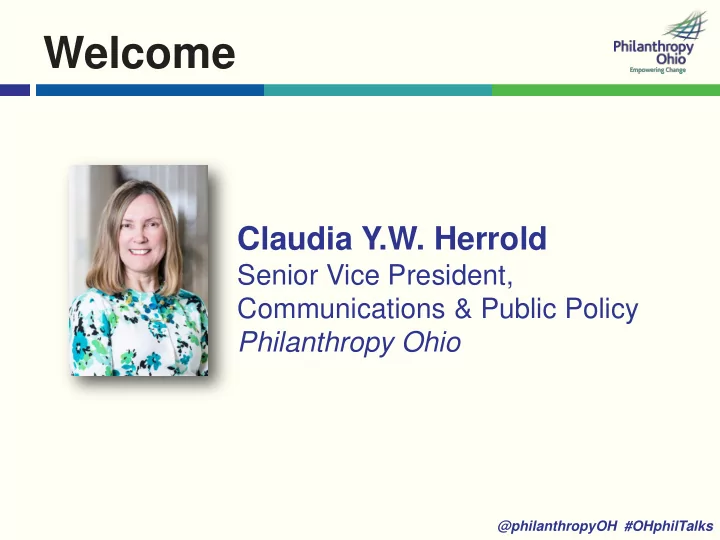
Claudia Y.W. Herrold
Senior Vice President, Communications & Public Policy Philanthropy Ohio
Welcome Claudia Y.W. Herrold Senior Vice President, Communications - - PowerPoint PPT Presentation
Welcome Claudia Y.W. Herrold Senior Vice President, Communications & Public Policy Philanthropy Ohio @philanthropyOH #OHphilTalks Background John Mullaney Executive Director The Nord Family Foundation @philanthropyOH #OHphilTalks
@philanthropyOH #OHphilTalks
Claudia Y.W. Herrold
Senior Vice President, Communications & Public Policy Philanthropy Ohio
@philanthropyOH #OHphilTalks
John Mullaney
Executive Director The Nord Family Foundation
@philanthropyOH #OHphilTalks
Elaine Maag
Senior Research Associate The Urban Institute/Tax Policy Center
How Tax Policy for Low-Income Families Fits into Tax Reform
Understanding the Earned Income Tax Credit (EITC) and Child Tax Credit (CTC) in the Context of Charitable Giving
June 26, 2015 Elaine Maag Philanthropy Ohio Webinar
www.taxpolicycenter.org 4
Federal Income Tax System Tax system serves two functions
Earned Income Tax Credit Child Tax Credit Badly in need of reform
government at legislated levels
www.taxpolicycenter.org 5
Why is Tax Reform So Hard? Goal is to have a tax system that is fair, efficient, and simple
Fairness is often measured in terms of the distribution of the tax benefit
effects, e.g., who benefits from the charities being supported by a charitable deduction
www.taxpolicycenter.org 6
Charitable Deduction Gets Attention Third most expensive itemized deduction Tax benefit is not progressive “Tax provisions favoring one activity or another or providing benefits to a limited number of taxpayers create complexity and instability, impose large compliance costs, and can lead to an inefficient use of resources” Tax Reform Panel, 2005
www.taxpolicycenter.org 7
Understanding the Distribution of the Charitable Deduction
www.taxpolicycenter.org 8
10 20 30 40 50 60 70 80 90 100 $0 $500 $1,000 $1,500 $2,000 $2,500 $3,000 $3,500 Lowest Quintile Second Quintile Middle Quintile Fourth Quintile Top Quintile All
Charitable Deduction: Average Benefit and Proportion of Tax Units with Benefit (2015)
Average Benefit Average Benefit for Tax Unit with Benefit Percentage with Benefits
Source: Tax Policy Center Table T13-0079.
www.taxpolicycenter.org 9
Future of Charitable Deduction Expansion of any program in the current environment difficult Need to look for allies even to protect the deduction from elimination Might find those allies among low-income advocates Distribution of EITC much more progressive, so expansions to it can offset less progressive changes
www.taxpolicycenter.org 10
Tax Credits for Low-Income Families Substantial assistance provided to low-income families with children via the EITC EITC benefits are on par with SNAP (formerly Food Stamps)
penalty relief after 2017) Also benefit from CTC
not very expensive – Reduced refundability threshold (expires after 2017)
www.taxpolicycenter.org 11
How the EITC Works
www.taxpolicycenter.org 12
Distribution of EITC
www.taxpolicycenter.org 13
Distribution of Child Tax Credit
www.taxpolicycenter.org 14
Any Expansion to the Charitable Deduction Likely Linked to Offsetting Reform
Little appetite to expand benefits by many in Congress without offsetting changes Has happened in the past – e.g., discussion of carbon tax Notable in recent reform efforts – look to low- income policies to make distribution tables more neutral Advocates for low-income programs have supported saving charitable deduction in past when elimination was proposed
THANK YOU
For more information please contact:
Elaine Maag EMaag@urban.org View many studies on tax expenditures at www.taxpolicycenter.org
ABC L ITE S EPTEMBER 9 1:00
PM ET David Lindberg, Chief Financial Officer, Council of Michigan Foundations Terri Johnson, Associate Director, GIFT, Indi ana Philanthropy Alliance Steve Phallen, Vice President of Finance and Administration, Philanthropy Ohio
@philanthropyOH #OHphilTalks
Facebook.com/philanthropyohio @philanthropyOH Linkedin.com/company/philanthropyohio
@philanthropyOH #OHphilTalks
Monday, June 29 | Cleveland
communities for a lasting impact
Thursday, July 9 | Webinar
Tuesday, July 14 | Webinar
Wednesday, July 22 | Webinar
philanthropyohio.org/events
September 16-18, 2015 The Westin Cincinnati Hotel