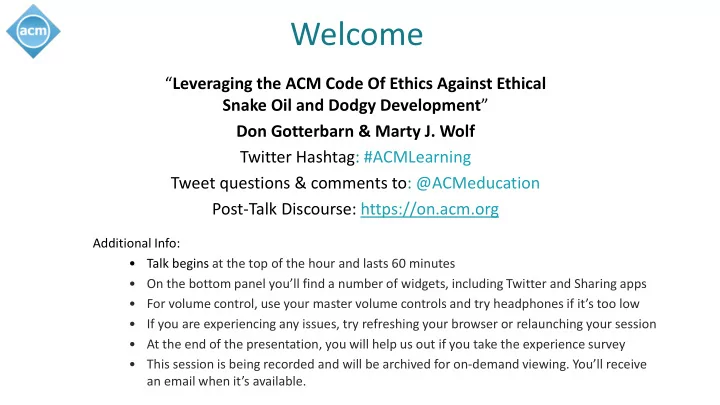
Welcome Leveraging the ACM Code Of Ethics Against Ethical Snake Oil - - PowerPoint PPT Presentation

welcome
SMART_READER_LITE
LIVE PREVIEW

Welcome Leveraging the ACM Code Of Ethics Against Ethical Snake Oil - - PowerPoint PPT Presentation

Welcome Leveraging the ACM Code Of Ethics Against Ethical Snake Oil and Dodgy Development Don Gotterbarn & Marty J. Wolf Twitter Hashtag: #ACMLearning Tweet questions & comments to: @ACMeducation Post-Talk Discourse:


slide-1
SLIDE 1

Welcome

“Leveraging the ACM Code Of Ethics Against Ethical Snake Oil and Dodgy Development” Don Gotterbarn & Marty J. Wolf Twitter Hashtag: #ACMLearning Tweet questions & comments to: @ACMeducation Post-Talk Discourse: https://on.acm.org

Additional Info:

  • Talk begins at the top of the hour and lasts 60 minutes
  • On the bottom panel you’ll find a number of widgets, including Twitter and Sharing apps
  • For volume control, use your master volume controls and try headphones if it’s too low
  • If you are experiencing any issues, try refreshing your browser or relaunching your session
  • At the end of the presentation, you will help us out if you take the experience survey
  • This session is being recorded and will be archived for on-demand viewing. You’ll receive

an email when it’s available.

slide-2
SLIDE 2

Leveraging the ACM Code Of Ethics Against Ethical Snake Oil and Dodgy Development

Speakers: Don Gotterbarn & Marty J. Wolf

Moderator: Keith W. Miller

slide-3
SLIDE 3

For Scientists, Programmers, Designers, and Managers:

  • Learning Center - https://learning.acm.org
  • View past TechTalks & Podcasts with top inventors, innovators, entrepreneurs, & award winners
  • Access to O’Reilly Learning Platform – technical books, courses, videos, tutorials & case studies
  • Access to Skillsoft Training & ScienceDirect – vendor certification prep, technical books & courses
  • Ethical Responsibility – https://ethics.acm.org

ACM.org Highlights

Popular Publications & Research Papers

  • Communications of the ACM - http://cacm.acm.org
  • Queue Magazine - http://queue.acm.org
  • Digital Library - http://dl.acm.org

Major Conferences, Events, & Recognition

  • https://www.acm.org/conferences
  • https://www.acm.org/chapters
  • https://awards.acm.org

By the Numbers

  • 2,200,000+ content readers
  • 1,800,000+ DL research citations
  • $1,000,000 Turing Award prize
  • 100,000+ global members
  • 1160+ Fellows
  • 700+ chapters globally
  • 170+ yearly conferences globally
  • 100+ yearly awards
  • 70+ Turing Award Laureates
slide-4
SLIDE 4

Welcome

“Leveraging the ACM Code Of Ethics Against Ethical Snake Oil and Dodgy Development” Don Gotterbarn & Marty J. Wolf Twitter Hashtag: #ACMLearning Tweet questions & comments to: @ACMeducation Post-Talk Discourse: https://on.acm.org

Additional Info:

  • Talk begins at the top of the hour and lasts 60 minutes
  • On the bottom panel you’ll find a number of widgets, including Twitter and Sharing apps
  • For volume control, use your master volume controls and try headphones if it’s too low
  • If you are experiencing any issues, try refreshing your browser or relaunching your session
  • At the end of the presentation, you will help us out if you take the experience survey
  • This session is being recorded and will be archived for on-demand viewing. You’ll receive

an email when it’s available.

slide-5
SLIDE 5

Leveraging the ACM Code Of Ethics against ethical snake oil il and dodgy development

ACM Committee on Professional Ethics Don Gotterbarn and Marty J. Wolf ACM TechTalk 08 June 2020

slide-6
SLIDE 6

AI ethics codes- Great Idea

  • No one has ever thought of this before, so I must do it myself
  • Standards are great; Every one should have one
slide-7
SLIDE 7

You can trust US

  • Snake oil cures all! (mostly alcohol)
  • Voting machines, avionics, automobiles
  • We know the system, so we are best equipped to test it.
  • We have tested it and can ASSURE that it passed with flying colors.
  • NO! you can’t see the tests. Our systems are proprietary.
  • South Carolina ++ ++ +
  • More votes recorded than voters who cast ballots

7

Computing professionals' actions change the world. To act responsibly, they should reflect upon the wider impacts of their work, consistently supporting the public good.

slide-8
SLIDE 8

We are not like THEM

  • Want to get things done right.
  • Want to be proud of what we do.
  • Make a positive impact
  • Family
  • Community
  • Society
  • Employer

8

Computing professionals' actions change the world. To act responsibly, they should reflect upon the wider impacts of their work, consistently supporting the public good.

slide-9
SLIDE 9

ACM is not like THEM

  • “Dedicated to ... serving both professional and public interests ... by

promoting the highest professional and ethical standards.”

  • Has multiple committees and interactions designed to mitigate

dodgy development and snake oil

  • The Code of Ethics articulates the highest ideals of the profession.
  • Why is there still computing rubbish??

9

The Code is designed to inspire and guide the ethical conduct of all computing professionals …

slide-10
SLIDE 10

Computing confounds ethics

  • Discrete vs. continuous systems
  • One bolt doesn’t matter, but a comma does.
  • System complexity
  • Often addressed by narrow focus on functional specifications
  • Getting it to work is what matters: Competent Completion
  • We focus on technical complexity and lose sight of broader range of

stakeholders.

10

1.2 Avoid Harm.

slide-11
SLIDE 11

COVID-19 Contact Tracing App

  • The technical complexity is immediately apparent.
  • Do privacy concerns or technical complexity come first?
  • Should it be implemented at all?
  • Who might be harmed?
  • Qatari government is enforcing its installation.
  • There is an essential connection between technology and ethics.
  • The relationship to stakeholders is an essential part of every system.
  • Human interface systems

11

1.6 Respect privacy.

slide-12
SLIDE 12

Airbus 320

Airport

  • 3.3
slide-13
SLIDE 13
slide-14
SLIDE 14

Error message during surgery!

14

slide-15
SLIDE 15

Competent Completion

  • Manufacturing mindset: Get it done! Rats in a race
  • Faster and cheaper
  • Academic experiences facilitate this approach.
  • Minimize testing to get the system out the door.
  • Challenge for us all: Undo this mindset!

15

3.1 Ensure that the public good is the central concern during all professional computing work.

slide-16
SLIDE 16

Quality is Quantity

  • Manufacturing Mindset: More is better.
  • Lines of code written, number of errors found, verbose

documentation

  • Game the system: minimum work/maximum benefit
  • 1,000 lines of buggy code versus 100 lines of easy-to-use code
  • Do more insignificant things, avoid the tough problems.
  • Using these metrics does not result in faster or cheaper code
  • Testing is a waste of time in a rush to quantity.

16

3.6 Use care when modifying or retiring systems.

slide-17
SLIDE 17

Employee Evaluations

  • Manufacturing Mindset: Perverse incentives
  • Don’t waste your time!
  • One test is enough.
  • Don’t fix it, mention it as a “feature” in the user manual, Patriot Missile,

CMAX 737

  • Good, Fast, Cheap: Pick 2 out of 3
  • Creates a negative culture
  • Not proud of what you do
  • Just earning some money not contributing to the world

17

3.2 Articulate, encourage acceptance of, and evaluate fulfillment of social responsibilities by members of the organization or group.

slide-18
SLIDE 18

Ethics: What? Why? The answer matters

  • Mistakenly equate law and ethics
  • Mere compliance with business rules is easy.
  • “Learn Ethics” means signing off on “I listened to the ethics training.”
  • Ethics is irrelevant to my coding or project management plan.
  • Feigning interest in ethics (ethics theater)
  • Create a list and post it on a wall or use as a coaster for your coffee cup.
  • Brag about having once created a list

18

1.1 Contribute to society and to human well-being, acknowledging that all people are stakeholders in computing.

slide-19
SLIDE 19

Ethics: Not science but a matter of opinion

  • Merely comes from someone’s religious upbringing
  • Merely a subject of endless irrelevant philosophical debate
  • Pick your formal ethical system
  • Ethics is okay to ignore except for the philosophers
  • Merely a flag our company waves to make customers feel good.

19

3.4 Articulate, apply, and support policies and processes that reflect the principles of the Code.

slide-20
SLIDE 20

A workable approach to “Ethics”

  • Any behavior with a Positive or Negative impact on society, its

citizens, or the environment (cultural and natural)

  • Ethical decision making requires the ability to imagine the effects of

a behavior.

  • Professional computing ethics is:
  • Any behavior of computing professionals during the design, development,

construction, and maintenance of computing artifacts that affects other people.

20

Professional competence also requires skill in communication, in reflective analysis, and in recognizing and navigating ethical challenges. Upgrading skills should be an ongoing process …

slide-21
SLIDE 21

Ethics versus Ethicking

  • Academic study
  • Applied ethics – Ethicking (Terry Winograd)
  • Applying values to make proactive ethical decisions
  • Having done a thing does not necessarily make it a good thing
  • Ethicking distinguishes what is done versus what should be done.
  • Just how do we do that?? Its should be easy!

21

Professional competence also requires skill in communication, in reflective analysis, and in recognizing and navigating ethical challenges. Upgrading skills should be an ongoing process …

slide-22
SLIDE 22

Ethical decisions are easy

  • Second nature:
  • Trained by parents on how to

interact

  • Training in school
  • Training by religious

institutions

  • Training by government and

legal rules

  • Societal norms

22

  • Socio-technical concerns:
  • Electronic stalking
  • Rights regarding images and

content

  • Who can record and store what?

and when?

  • How are these rules set?
  • What ancient holy book

mentions Twitter?

3.7 Recognize and take special care of systems that become integrated into the infrastructure of society.

slide-23
SLIDE 23

Fatal Premise

  • I am a good person.
  • “Evil is done by evil people.” QED
  • I don’t need to worry about ethics. Let me get on with real work!!
  • New situations require extra time. Yeah, right!
  • People miss the obvious because of the Fatal Premise and only focus
  • n the technology.

23

1.5 Respect the work required to produce new ideas, inventions, creative works, and computing artifacts.

slide-24
SLIDE 24

Japanese bidet: On target

  • Functions
  • Water on and off
  • Water temperature control
  • All via a Bluetooth app
  • Met functions, on schedule, within budget
  • Butt it was a failure.

2.9 Design and implement systems that are robustly and usably secure.

slide-25
SLIDE 25

Technical progress and the Fatal Premise

  • Psychological studies show the Fatal Premise very common.
  • We think we are basically good.
  • Business focus on technical training exemplifies the Fatal Premise.
  • Technology first. Ethical impacts if there is time.
  • But there is never time!
  • Professionals and organizations need to identify how systems

impact others.

25

Computing professionals should be fully aware of the dangers

  • f oversimplified approaches …
slide-26
SLIDE 26

Ethics has nothing to do with $ PROFIT $

  • Employees
  • Pride in work and loyalty
  • Better retention reduces turnover and training costs
  • Reduced internal conflict and tension
  • Customers
  • Increased trust and loyalty
  • Reduced advertising cost
  • Time spent on ethics pays dividends

26

2.7 Foster public awareness and understanding of computing, related technologies, and their consequences.

slide-27
SLIDE 27

Framing Out

  • Divide and conquer gets the job done.
  • It helps frame out distractions.
  • Put a frame around the context we are focusing on
  • Only winning matters- use of performance enhancing drugs in sports
  • Only profit matters- save money (in the short term) by minimize safety
  • Framing Out is sometimes missed
  • We do things that we think have nothing to do with ethics.

27

3.1 Ensure that the public good is the central concern during all professional computing work.

slide-28
SLIDE 28

Frame out context and stakeholders!

slide-29
SLIDE 29

Anatomy of an ethical decision

  • First an immediate intuitive reaction
  • Second is slower, more conscious, and uses more cognitive attention

and energy

  • Consider stakeholders and ethical elements.
  • Analyze the impact.
  • Review responsibilities and alternative approaches.
  • Evaluate the trade-offs.
  • Our work affects others. The interaction should not be haphazard.

29

2.5 Give comprehensive and thorough evaluations of computer systems and their impacts, including analysis of possible risks.

slide-30
SLIDE 30

Organizational Framing Out

  • “Business ethics” versus “ethics”: a false dichotomy
  • “Business decisions versus ethics”
  • Business ethics frequently frames things out, including ethics
  • Framing everything in terms of the “bottom line”
  • Safety, quality, honesty are outside consideration.
  • There is no time for ethics.
  • New situations require extra time to think outside the Frame.

30

3.2 Articulate, encourage acceptance of, and evaluate fulfillment of social responsibilities by members of the organization or group.

slide-31
SLIDE 31

A tool for ethicking: The Code

  • Built a taskforce
  • Computing ethics scholars, practitioners
  • ACM SIGs, regional organizations, committees, USACM, ACM Council, SIGCAS…
  • Commercial organizations (internationally): Google, TATA, Intel, and Oracle…
  • Other IT societies: ACS, BCS, IFIP Deutsche Gesellschaft, IEEE-CS, and CIPPS…
  • Three drafts in an open and transparent process
  • Described what changed and why for each draft
  • Circulated drafts to stakeholders
  • Their feedback was incorporated into the next draft
  • ACM members gave their overwhelming assent
  • Sometimes “disagree” meant the position was not stated strongly enough

31

2.7 Foster public awareness and understanding of computing, related technologies, and their consequences.

slide-32
SLIDE 32

The Code: a basis for decision making

  • People bring diverse experiences to ethics.
  • Professional ethics has
  • Common values for the ideal computing professional.
  • The Code as a support for decision making.
  • Need to organize our ethical reasoning: CARE
  • Leverage the Code to develop better computing systems and a better

world.

32

Questions … can best be answered by thoughtful consideration of the fundamental ethical principles, understanding that the public good is the paramount consideration.

slide-33
SLIDE 33

Proactive CARE

Consider alternatives, actors, stakeholders, anticipated effects, context. Analyze obligations to stakeholders, the affect of alternatives, technical facts, relevant Code Principles, values. Review relevant responsibilities, policies, choices,

  • utcomes, creative alternatives, methods for evaluating the

decision, and loop back to “Consider” and “Analyze” before proceeding. Evaluate to identify the best option and know its trade-offs.

slide-34
SLIDE 34

Proactive CARE: ethically on guard

  • Consider broadly who is affected.
  • Whose behavior and work process will be affected?
  • Whose circumstances or job will be affected?
  • Whose experiences will be affected?
  • Consider a range of plausible alternatives addressing different stakeholder

needs and impacts.

  • Who is needed to pursue these alternatives?

34

2.2 Maintain high standards of professional competence, conduct, and ethical practice.

slide-35
SLIDE 35

Proactive CARE: ethically on guard

  • Analyze obligations to and rights of stakeholders.
  • How do alternative solutions meet function and meet ethical obligations?
  • Review the Code to help identify stakeholder rights.
  • What technical facts are most relevant to your system?
  • What Principles of the Code are most relevant?
  • What personal, institutional, or legal values should be considered?

35

2.1 Strive to achieve high quality in both the processes and products of professional work.

slide-36
SLIDE 36

Proactive CARE: ethically on guard

  • Review potential actions that might make a difference.
  • What responsibilities, authority, practices, or policies seem to be most

important in your analysis?

  • Are there creative alternatives to the options you’ve considered so far?
  • Apply the Code’s international professional values.
  • Reconsider Care and Analyze.

36

2.3 Know and respect existing rules pertaining to professional work.

slide-37
SLIDE 37

Proactive CARE: ethically on guard

  • Evaluate your work so far.
  • Which of the options considered seems to be the best?
  • What are the trade-offs?
  • Are there creative alternatives to the options you’ve considered so far?
  • Are there now other Principles in the Code that are more relevant to your

deliberations about this action?

  • Monitor the decision.

37

4.1 Uphold, promote, and respect the principles of the Code.

slide-38
SLIDE 38

App feature considerations

  • Select font and write font enlargement function
  • Proactive CARE: Who are “non-standard” stakeholders?
  • Skills: Rust and Mutation testing … related to task
  • Other skills are needed.
  • Stakeholders: What are your best options for someone with

dyslexia?

38

2.6 Perform work only in areas of competence.

slide-39
SLIDE 39

Teams

  • Systems are socio-technical creations.
  • We need to involve others with appropriate technical and ethical

expertise.

  • Systems improve with continuous testing.
  • Use technical tests to proactively identify and remove faults throughout the

process.

  • Use ethical tests to proactively identify and remove faults throughout the

process.

39

2.2 Maintain high standards of professional competence, conduct, and ethical practice.

slide-40
SLIDE 40

Proactive CARE: an ethically on guard team

  • Consider broadly who is affected collectively.
  • Consider the complexity of the system.
  • Identify needed expertise.
  • Consider a range of plausible options to stakeholder needs.

40

2.2 Maintain high standards of professional competence, conduct, and ethical practice.

slide-41
SLIDE 41

Proactive CARE: an ethically on guard team

  • Analyze obligations to and rights of stakeholders.
  • Avoid the march to mere competent creation.
  • What technical facts and moral solutions are available?
  • What Principles of the Code are most relevant?
  • View the process as a way to improve the product.

41

2.5 Give comprehensive and thorough evaluation of computer systems and their impacts, including analysis of possible risks.

slide-42
SLIDE 42

Proactive CARE: an ethically on guard team

  • Review the product, the plan, and actions of the team.
  • Review questions suggested by the Code of Ethics.
  • What assumptions are we making about stakeholders?
  • How might the systems be used by users with a disability?
  • Review Code Principles to suggest design alternatives.
  • How do the alternatives support the Code’s international professional

values?

42

2.3 Know and respect existing rules pertaining to professional work.

slide-43
SLIDE 43

Proactive CARE: an ethically on guard team

  • Evaluate good options and know their trade-offs.
  • Beware the negative influence of ego in final evaluations.
  • Which of the options considered seems to be the best? Why?
  • Select a technically and ethically workable alternative.
  • Has the paramountcy of the public good been upheld?
  • Clearly articulate the ethical trade-offs of the alternative.
  • Monitor the decision.
  • A team decision reduces the need for a Moral Hero.

43

4.1 Uphold, promote, and respect the principles of the Code.

slide-44
SLIDE 44

Management and leadership

  • “Leader” means any member of an organization or group who has

influence, educational responsibilities, or managerial responsibilities.

  • Stakeholders to be considered include the developers.
  • In hiring
  • In the review and promotion processes

44

3.3 Manage personnel and resources to enhance the quality

  • f working life.
slide-45
SLIDE 45

Hiring the best person

  • Be careful not to assume the Fatal Premise
  • Quality requires a broad skill set
  • Technical skills
  • Mental flexibility
  • Alertness to potential ethical issues
  • When do you seek advice from a supervisor or colleague?
  • How do you learn about people who will use the software you write?
  • Think about developing an application such as a timer for a ventilator so that it turns off

for 3 hours after 22 hours of continuous operation. What concerns would you have about doing so?

45

1.3 Be honest and trustworthy.

slide-46
SLIDE 46

Reward the socio-technical problem solver

  • In performance reviews, ask about being ethically on guard.
  • Who are the critical stakeholders you addressed in this project?
  • Is there anything you noticed that we should worry about in the

system?

  • In what ways can we improve the project you are working on?

46

3.2 Articulate, encourage acceptance of, and evaluate fulfillment of social responsibilities by members of the

  • rganization or group.
slide-47
SLIDE 47

Frequent performance reviews by line manager

  • Encourage interaction.
  • Show respect for the problem solvers insight.
  • Separate these reviews from financial incentives.
  • Support ethicking through coaching by immediate supervisor.
  • Ethics is more relevant when not taught by an outsider.
  • This is part of the technical and social testing of a product.

47

3.5 Create opportunities for members of the organization or group to grow as professionals.

slide-48
SLIDE 48

Whistleblowing: Out and In

  • Tell on evil people doing evil things.
  • Proactive “internal whistleblowing”
  • Gives voice without retribution.
  • Facilitates giving voice to concerns.
  • If the concern is reasonable it may help improve the final product.

48

1.7 Honor confidentiality.

slide-49
SLIDE 49

The exposure notification API

  • Notification function
  • Stakeholders, community, individual, heath care workers,…
  • Effective system needs to be used, eliminate fear of privacy violation,

and misuse of geolocation data

  • Work with public health, individuals control personal information
  • Designed to reduce unethical use of the API
  • Multiple Code Principles apply. There are trade-offs.

49

2.8 Access computing and communication resources only when authorized or when compelled by the public good.

slide-50
SLIDE 50

Supporting Proactive CARE

  • Good Practices
  • Develop proactive techniques to mitigate impact of fatal premise
  • Pre-commitment devices: reminders to think about ethics
  • Ask what would you be proud of in this project?
  • What would stakeholders say was your contribution to the project?

50

3.5 Create opportunities for members of the organization or group to grow as professionals.

slide-51
SLIDE 51

Organizations supporting Proactive CARE

  • Regular reminders rather than annual 15 minute training
  • Add Ethics principles to the Planning Document.
  • Serves as proactive alert while executing the plan
  • Ask team to identify relevant principles for their project.
  • Place them in the requirements.
  • Encourage employee activism
  • Corporate public service hackathon
  • Comp time for socially responsible volunteer work
  • Leverage the Code and its international support to do positive things

51

3.4 Articulate, apply, and support policies and processes that reflect the principles of the Code.

slide-52
SLIDE 52

Miscreants do exist 

  • What do you do when bad people ask you to do a bad thing.
  • Be a Moral Bailout: Quietly resign, or, yikes, do the evil deed!
  • Be a Moral Hero: Blow the whistle and lead the public outrage.
  • Recognize that there is a range of options, e.g.
  • Point out the value to company to not do the deed.
  • Ask “Would the company get sued if somebody found out?”
  • Get rewarded for helping the company.

52

2.4 Accept and provide appropriate professional review.

slide-53
SLIDE 53

Ethicking

  • The complexity of the work, lack of awareness of the Fatal Premise,

and the tendency to frame out “distractions” contribute to the unintentional harm.

  • Leverage the Code to address these issues for better software and a

better world.

53

2.4 Accept and provide appropriate professional review.

slide-54
SLIDE 54

Grady Booch has said “Every line of code has a moral and ethical implication.” We say “Every decision we make that affects other people has a moral implication.” THE CODE GIVES VOICE TO VALUES It is the voice of the computing professional ACM: Advancing computing as a science and profession. We see a world where computing helps solve tomorrow’s problems – where we use our knowledge and skills to advance the profession and make a positive impact.

slide-55
SLIDE 55
slide-56
SLIDE 56

An aspirational Code

  • Strive to follow the conscience of the profession
  • Identifies what the positive values of the profession
  • Provides guidance in constantly changing complex environment
  • The Code is designed to inspire and guide the ethical conduct of all computing

professionals, (Preamble)

  • Aspiration (dynamic) vs canonical (static) not Aspiration versus real
  • and can provide a starting point for education and discussion.
  • Provide some hierarchy when clauses appear to compete.
slide-57
SLIDE 57

Paramountcy clause the guiding aspiration

  • Situations alter which Principles may be important.
  • An open ethical decision making process helps identify those

Principles.

  • A transparent ethical decision making process bolsters the

profession’s standing with the public.

  • Computing professionals should understand “that the public good

is the paramount consideration.”

  • Principle 1.1 sets the Public Good as a significant moral principle.
  • Principle 3.1 brings this to bear on leaders: Ensure that the public

good is the central concern during all professional computing work.

slide-58
SLIDE 58

The Learning Continues…

TechTalk Discourse: https://on.acm.org TechTalk Inquiries: learning@acm.org TechTalk Archives: https://learning.acm.org/techtalks Learning Center: https://learning.acm.org Professional Ethics: https://ethics.acm.org Queue Magazine: https://queue.acm.org