SLIDE 1 Creating Internet-Based Learning Modules 1
Welcome!
Technical Housekeeping
Email: hrollins@mphi.org Phone: 517-204-9403
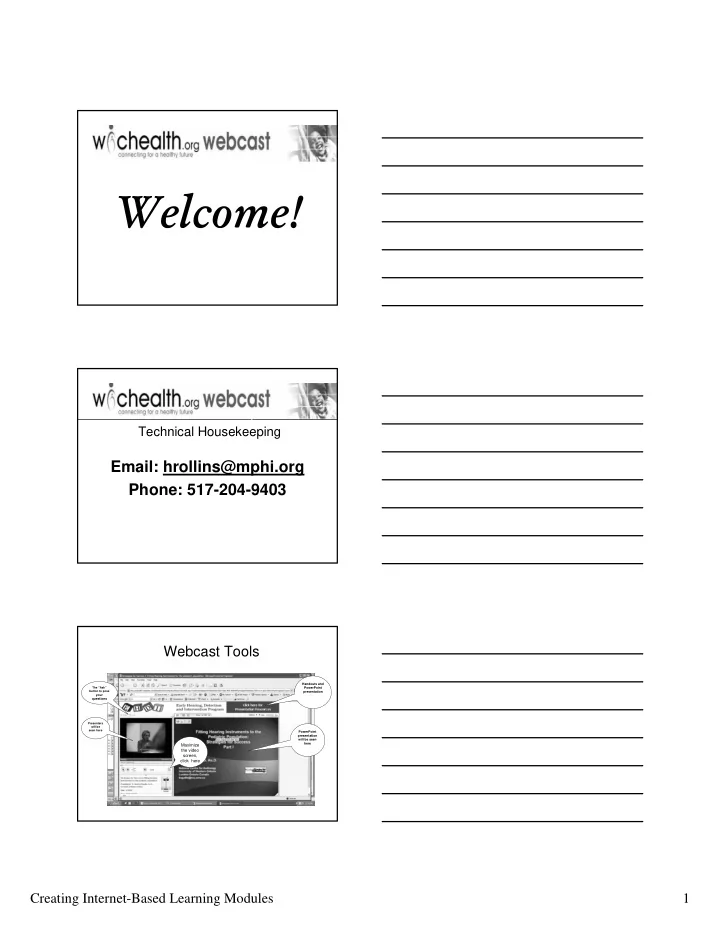
Webcast Tools
PowerPoint presentation will be seen here The “Ask” button to pose your questions Presenters will be seen here Handouts and PowerPoint presentation
Maximize the video screen, click here
SLIDE 2 Creating Internet-Based Learning Modules 2
Please submit questions using the following subjects, at any point during the presentation:
CLINIC PARTICIPANT COST IMPACT IMPLEMENTATION
Reminders
- Evaluation Survey (administered through
Survey Monkey) has been sent to all pre- registrants of today’s event
- Today’s broadcast and meeting materials
will be posted at the same url link starting tomorrow for one full year.
Robert J. Bensley, PhD
Professor Community Health Education Western Michigan University
SLIDE 3
Creating Internet-Based Learning Modules 3
The great aim of education is not knowledge but action.
Herbert Spencer
Project Purpose
Innovative behavioral approach to
nutrition education
Provide education specific to WIC
client needs and interests
Benefits of Internet Approach
Serve large numbers at low cost Access to stage specific education Access 24/7
SLIDE 4
Creating Internet-Based Learning Modules 4
Benefits of Internet Approach
Easy – Fun – Convenient Target interest, needs, and readiness
to change
Adhere to VENA
Benefits of Internet Approach
Utilize staff resources Enhances follow-up with clients Reinforces educational strategies
using stage-appropriate educational information
Theory-Driven Approach
Stages of Change Persuasive Communication Behavioral Intent Division of Responsibility
SLIDE 5
Creating Internet-Based Learning Modules 5
Program Features
Screen messaging/algorithms
Staging question Feedback Empowering statement
Clients are directed to existing online
stage-based information
Program Features
Use of existing web sites Ability to advance in intent toward
stage of change
12 modules (8 available in Spanish)
SLIDE 6
Creating Internet-Based Learning Modules 6
SLIDE 7
Creating Internet-Based Learning Modules 7
SLIDE 8
Creating Internet-Based Learning Modules 8
Certificate of Completion
Module title Starting and ending stage Action to be taken Use at next counseling session
SLIDE 9
Creating Internet-Based Learning Modules 9
Stephanie Bess
MS, RD, LDN, CLC Nutrition Services Coordinator Illinois Department of Human Services
Susan Rhein
MS, RD WIC Nutrition Education Coordinator Macomb County Health Department Michigan
Stephanie Bess MS, RD, LDN, CLC
Nutrition Services Coordinator Illinois Department of Human Services
SLIDE 10
Creating Internet-Based Learning Modules 10
Susan Rhein, MS, RD
WIC Nutrition Education Coordinator Macomb County Health Department Michigan
Macomb County (MI) WIC
Location and demographics 10,000 clients Staffing
Benefits
Easier than expected Client satisfaction
SLIDE 11
Creating Internet-Based Learning Modules 11
Implementing in an Agency
Step 1: Internet access Step 2: Promotional materials Step 3: Implementation—How is it offered?
Quick WIC in clinic for nutrition education wichealth.org—online nutrition education and bypass Quick WIC Huge time savings = Happy clients!
Step 4: Completion and follow-up
Benefits
Decreases foot traffic Promotes self-directed nutrition
education All staff can play a role in promoting wichealth Most importantly, a positive attitude is contagious and is the key to successful implementation!
SLIDE 12
Creating Internet-Based Learning Modules 12
Robert J. Bensley, PhD
Professor Community Health Education Western Michigan University
wichealth Evaluation FY 2008
Total participants: + 200,000 (2002-
2008)
Youth age correlated with use
(younger= higher use)
Child < 2 years old (63%) Consistent results across 5 years
Access
Easy computer access: 83% Computer access from home: 58% Access from WIC clinic: 7% Access from Library: 6%
SLIDE 13
Creating Internet-Based Learning Modules 13
Preferred method for nutrition
education
wichealth 78% Counseling 12% Self-guided 7% Group education 3%
Education Preference
Most users:
Find the website easy to use/helpful (97%) Learned something to help child feeding (92%) Believe they can change using what was learned (94%) Want to use the web to learn about other WIC eating topics (87%)
User Beliefs
Most frequent beginning stages:
Maintenance, Action, and Preparation
98% in Preparation moved to Action 70% in Contemplation moved to
Action
Implications for use: Action oriented
clients
Stage Movement
SLIDE 14 Creating Internet-Based Learning Modules 14
- Number of end nodes visited related to stage
movement
- Time spent on end nodes visited related stage
movement
MyPyramid (22% ) Physical activity (12% ) Healthy drinks (12%) Making meals and snacks simple (10%)
End Node Use Judith V. Anderson, DrPH, RD
Michigan WIC Nutrition Coordinator Michigan Department of Community Health
FV Internet Education Study
Overview of FV project
Process used for Project
SLIDE 15
Creating Internet-Based Learning Modules 15
FV Internet Education Study
USDA Special Project Grant
2004 Develop two FV modules using
wichealth.org
Purpose
Increase FV consumption Effectiveness of traditional and
Internet nutrition education
Counseling effect of Motivational
Negotiation
Goals
Expand wichealth to include modules on
increasing FV consumption
Impact participant movement toward
sustainable behavior change
Improve impact of counseling in actively
changing FV consumption
SLIDE 16
Creating Internet-Based Learning Modules 16
Objectives
Compare effectiveness of wichealth to
traditional education
Determine impact of motivational
negotiation counseling in moving behavioral intent to commitment
Internet Education Modules
Meet USDA Internet nutrition
education guidelines
Address emerging health issues that
improve healthy client behavior for life
Traditional Education Modules
Local MI agencies surveyed about
current FV education
Types of traditional education
Self-directed educational lessons Group education classes
Agencies provided objectives and
lesson plan if needed
SLIDE 17
Creating Internet-Based Learning Modules 17
Internet Module Content
Same objectives as traditional
education
Stage of change based wichealth format
Clinic Selection
Clinic invitation based on population
demographics representative of Michigan WIC clients
Clinic staff trained to collect client
questionnaires
Internet Education Timeline
2004-5: Adult FV consumption module developed 2006: Testing with WIC clients compared to traditional education begun 2007: Parent-child feeding issues (relating to FV consumption) module developed
SLIDE 18
Creating Internet-Based Learning Modules 18
Project Partners
MI 5 A Day Program Farmers’ Market Nutrition Project MSU Extension IL Dept Of Human Services OH Department of Health University of MN Western Michigan University
Process and Reporting
Project team assessed module content &
met quarterly through project
Progress reported quarterly to USDA Revising final USDA report Add modules to wichealth once USDA
approved
John J. Brusk, MPH
Evaluator Science and Mathematics Program Improvement Western Michigan University
SLIDE 19
Creating Internet-Based Learning Modules 19
Impact Evaluation
Educational Intervention
wichealth.org modules Traditional education
Counseling Intervention
Counselor self-report of MN skills
Evaluation Method
Quasi-experimental SOC movement Belief in ability to change FV consumption (BRFS items) Effect of MN counseling
Data Collection
Baseline onsite for both groups 1st post-survey onsite for traditional education or online for wichealth 2nd post survey at recert with counseling skills self-report (~3 mos) 3rd post survey at next visit (~6 mos)
SLIDE 20
Creating Internet-Based Learning Modules 20
Project Phases
Phase 1: Adult FV Consumption Phase 2: Child FV Consumption
Recruitment & Follow-up
1,564 WIC participants enrolled 220 (14%) chose wichealth 500 (32%) chose traditional ed 54% lost to follow-up 264 (17%) completed final survey
Participant Characteristics
Similarities:
Internet use (92% v 86%) wichealth prior use (23% v 15%) Exposure to WIC FV ed (32% v 37%)
Differences:
Frequency of Internet use (64% v 32%) Computer ownership (80% v 50%)
SLIDE 21
Creating Internet-Based Learning Modules 21
SOC Movement
96% of wichealth participants advanced from Preparation to Action 70% of traditional ed participants advanced from Preparation to Action
FV Consumption
With counseling:
Fruit juice, fruit, and vegetables increased by 0.60 to 0.81 servings per day
Without counseling:
Servings per day increased by 0.34 to 0.77
FV Consumption
wichealth
FV consumption increases were similar regardless of counseling exposure
Traditional education
Fruit juice and vegetable servings significantly (p<.05) improved with counseling
SLIDE 22
Creating Internet-Based Learning Modules 22
FV Consumption
Onsite counseling was not necessary for wichealth user success Traditional education users with no exposure to counseling had significantly less improvement
User Satisfaction
wichealth Traditional ed Easy to use 98% 91% Easy to understand 99% 96% Helpful 97% 95% Help eating habits 91% 88% Learned to change 85% 82% Believe can change 91% 89%
Study Limitations
Retention without compensation Design cons:
Generalizing to other populations Measurement of baseline differences between volunteers
Design pros:
Evaluation of real programmatic impact More cost-effective
SLIDE 23
Creating Internet-Based Learning Modules 23
Robert J. Bensley, PhD
Professor Community Health Education Western Michigan University
Next Steps
State/agency partnering Onsite training Participate in development Access to all wichealth products
wichealth Products
wichealth.org wichealthsupport.org wichealthstats.org wichealthmn.org