Welcome from 4. Family experiences of the NDIS Mr Bobby Pate 5. - - PDF document

welcome from
SMART_READER_LITE
LIVE PREVIEW

Welcome from 4. Family experiences of the NDIS Mr Bobby Pate 5. - - PDF document

6/11/2020 Acknowledgement of country Down Syndrome Research Program @UQ 2020 Research update Our partners The Academy particularly strives to: Further the knowledge of disability professionals around the world. Address the


slide-1
SLIDE 1

6/11/2020 1

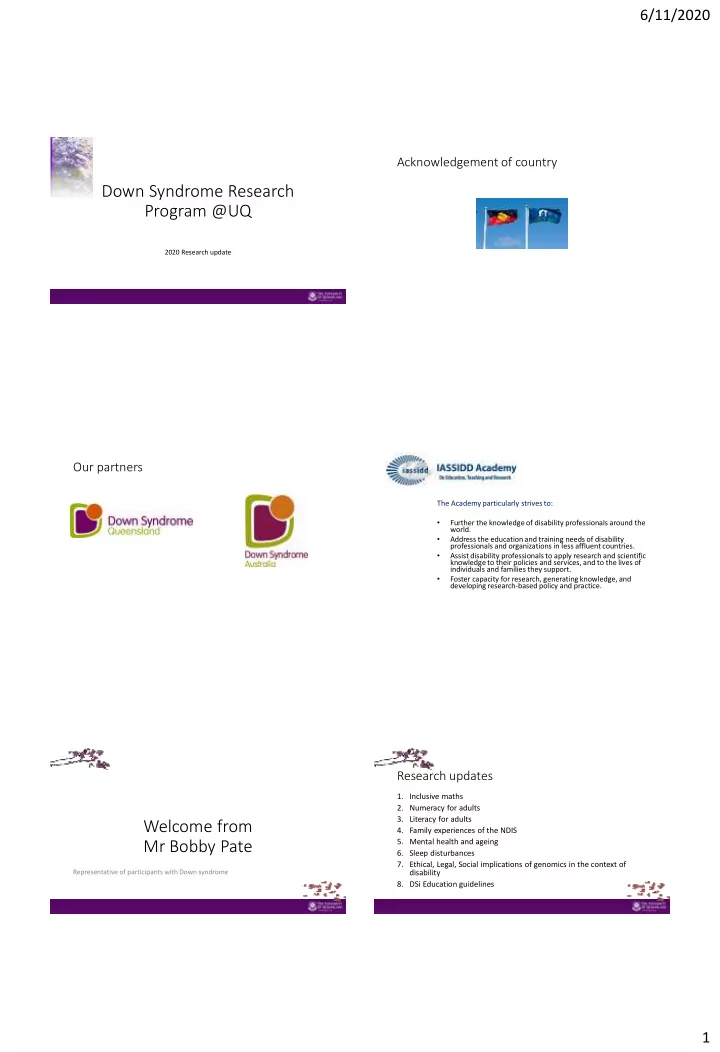
Down Syndrome Research Program @UQ

2020 Research update

Acknowledgement of country Our partners

The Academy particularly strives to:

  • Further the knowledge of disability professionals around the

world.

  • Address the education and training needs of disability

professionals and organizations in less affluent countries.

  • Assist disability professionals to apply research and scientific

knowledge to their policies and services, and to the lives of individuals and families they support.

  • Foster capacity for research, generating knowledge, and

developing research-based policy and practice.

Welcome from Mr Bobby Pate

Representative of participants with Down syndrome

Research updates

  • 1. Inclusive maths
  • 2. Numeracy for adults
  • 3. Literacy for adults
  • 4. Family experiences of the NDIS
  • 5. Mental health and ageing
  • 6. Sleep disturbances
  • 7. Ethical, Legal, Social implications of genomics in the context of

disability

  • 8. DSi Education guidelines
slide-2
SLIDE 2

6/11/2020 2

Inclusive secondary mathematics

Associate Professor Rhonda Faragher

R.Faragher@uq.edu.au

It’s possible!

Monari Martinez, E., & Benedetti, N. (2011). Learning mathematics in mainstream secondary schools: experiences of students with Down’s syndrome. European Journal

  • f Special Needs Education, 26(4), 531-540.

R.Faragher@uq.edu.au

Before and after

R.Faragher@uq.edu.au

Learning Year Level Adjusted Mathematics

  • The germ of an idea
  • The problem
  • Looking for solutions in

classrooms

10

R.Faragher@uq.edu.au

Looking for a solution …

  • … and running with it
  • A GRAPHICS calculator!!!

R.Faragher@uq.edu.au

The student’s view?

R.Faragher@uq.edu.au

slide-3
SLIDE 3

6/11/2020 3

Findings (so far)

  • Students can learn maths from the year level curriculum – and they love it!
  • Individual student characteristics affect learning outcomes but in surprising ways e.g.

some are very studious.

  • Teachers expected that their students could be successful at year level mathematics. If

there were barriers, they worked to find ways around through adjustments to learning materials or approaches to the topics.

  • Small suggestions were taken up by the teachers in creative and reflective ways, leading

to new approaches in their classrooms or different responses from students.

  • Teachers’ planning is affected before the lesson and during as teachers think and

problem solve and make decisions in the moment.

  • Creative, reflexive teachers respond to learner characteristics through changing,

adjusting and developing the mathematics learning activities offered not just to the students with Down syndrome, but to all learners in the class.

  • As a way out of low attainment, this is a critical aspect of mathematics education and an

imperative of mathematics education research to further explore its possibilities.

13

R.Faragher@uq.edu.au R.Faragher@uq.edu.au

Numeracy for adults

Dr Lorraine Gaunt

L.Gaunt@uq.edu.au

I didn’t think he could do it!

Max’s support worker

L.Gaunt@uq.edu.au

Literacy for adults

Dr Anne Jobling

a.jobling@uq.edu.au

Evid idence-based pro rogram of lit iteracy learn rning

  • Recent longitudinal evidence – 1998 to 2003 – two year program
  • Participants = 191 adults with intellectual disabilities
  • Used standardized assessments: receptive language, single word

reading and reading comprehension – twice each year.

  • Using growth trajectory model - all participants showed statistically

significant evidence of increased progress across all 3 assessments. Conclusion – evidence-based program such as Latch-On has potential to enhance language and literacy development in young adults with intellectual disabilities

a.jobling@uq.edu.au

slide-4
SLIDE 4

6/11/2020 4

Parent re responses from Irish Latch-On On

  • It made an enormous difference... I was starting to believe

that maybe he was as good as he was ever going to be and sure I was doing too much for him. Now he is reading the paper, now not the whole paper, but he can pull out what he needs and picking up the paper makes him feel good.

  • More questions from her and you know appropriate ones.

No nonsense or attention seeking. She is more interested in the other lads at home and ourselves I think”

  • “He is out of the bed, quick as a cat on Latch-On mornings"

a.jobling@uq.edu.au

Literacy necessary ry part rt of

  • f life lon
  • ng learning
  • Essential component in adult education
  • Adds to capacity for employment
  • Enhances social interaction and inclusion

a.jobling@uq.edu.au

Family experiences of the NDIS

Jan Lloyd

j.lloyd@uq.edu.au

An An Explorati tion of the NDIS Plannin ing Proce rocess from rom the Pers rspecti tives of Ad Adults lts wi with th Inte telle lectual Disabil ility ty an and their ir Fam amil ilies.

Focus

  • NDIS plan creation
  • NDIS plan implementation
  • Outcomes for the adult

Four connected qualitative studies

  • Family questionnaire
  • Two semi structured interviews
  • Two case studies
  • A focus group with adults with intellectual disability

j.lloyd@uq.edu.au

Findings

  • New opportunities
  • A time to re think what was happening in the adults’ lives
  • Challenges in both planning and implementation
  • There were extra challenges for adults and their families living in rural

and remote areas

  • Views stakeholders held of disability affected planning process and
  • utcomes of plans
  • Lack of inclusion of adults in the planning process
  • Added workload and stress for families

j.lloyd@uq.edu.au

Implications for r adults and families

Engagement of adults in planning process

  • Recognise the importance of their engagement in the planning
  • Need to find ways to include adults
  • Help them become more informed about the planning process
  • What is their role?

Building knowledge and skills

  • Build adult’s skills in choice making
  • Build knowledge on what is available
  • Find advocacy groups

Creating an ordinary life for adults with intellectual disability

  • Remember all elements of an ordinary life
  • Friendships/independence/ making choices
  • Not a one size fits all- service providers- need to be catering to individual needs
  • How to work with support workers to help adult build friendships

j.lloyd@uq.edu.au

slide-5
SLIDE 5

6/11/2020 5 Longitudinal Down Syndrome Study Mental health and ageing

Professor Monica Cuskelly

Monica.cuskelly@utas.edu.au

Down Syndrome Lo Longit itudinal Study

  • 40 years in 2018
  • Original purpose – mother-baby interaction (Cohort 1)
  • Re-oriented purpose (1) –impact of early intervention (Cohort 2)
  • Re-oriented purpose (2) – longitudinal tracking (natural history)
  • Re-oriented purpose (3) – address issues relevant to families and individuals

Monica.cuskelly@utas.edu.au

Research into me mental health lth of ad adult lts wi with th Down syndrome

  • Rate of mental health disorder have typically reported that between 22 & 35%

(Määttä et al., 2011; Prasher, Glenn, Cunningham, & Glenholmes, 2012),

  • Depression is generally identified to be the most common diagnosis

(Dykens, 2007).

  • Mallardo, et al., 2014; 45% met ‘caseness’ criteria using the Mini – PAS ADD
  • 30% had a diagnosis – 50% of these with Depression

Monica.cuskelly@utas.edu.au

De Dementia

  • Vulnerability to Alzheimer Disease – due to trisomy 21
  • Diagnosis rates increases after approx. 50 years of age
  • Identified by loss of function, especially memory
  • Process likely to begin substantially earlier than diagnosis

Monica.cuskelly@utas.edu.au

Results re re mental health

  • 42% met threshold criteria
  • 1/3 Depression
  • 1/3 Psychosis
  • I/3 OCD
  • Mood was reported to be relatively positive
  • Results related to dementia
  • Only 1 individual met criteria for dementia on the ABDQ
  • 4 individuals were above the threshold for the IQCODE.
  • All four met screening criteria for at least one psychiatric diagnosis.

Monica.cuskelly@utas.edu.au

Sleep disturbances

Dr Jas Chawla

j.Chawla@uq.edu.au

slide-6
SLIDE 6

6/11/2020 6

Wh Why Study Sleep in Chil ildren wi with th Down syndrome?

Sleep disorders are VERY common in children with Down syndrome (DS)

  • Obstructive sleep apnoea (OSA)- 6 times more common
  • Joint study from QCH & Sydney just published
  • Over 3.5yrs 152 children who had sleep studies – only 9% never diagnosed with OSA
  • Non-respiratory “behavioural” sleep problems also very common

(bedtime resistance, sleep anxiety, night wakings, parasomnias)

Why is this SO important?

  • Small studies have shown that children with DS and sleep problems (OSA) have slower

language development, worse cognitive outcomes and poorer accomplishment of daily life functions

  • Sleep is modifiable- if we improve sleep this could help to improve outcomes for individuals

with DS

j.Chawla@uq.edu.au j.Chawla@uq.edu.au

Key Findings So Far….

Q1: Does treatment of sleep problems improve functional outcomes?

  • Currently analysing 12-month f/up data- final results end 2021
  • Cohort of 45 children with DS attending sleep clinic
  • Recruitment of controls without active sleep problems ongoing

Q2: What is the prevalence of sleep problems in Australian Children with DS?

  • Two groups recruited- sleep clinic group & community group
  • Prevalence of sleep problems measures with Child Sleep Habits Questionnaire (CSHQ)
  • Very high in both groups – 85.7% in sleep clinic, 90.9% in community
  • 73.7% of parents in community group had concerns about their child having a sleep disorder- but none

were actively under sleep clinic and less than half had been previously seen j.Chawla@uq.edu.au

Key Findings So Far….

Q3/4: What is the impact on families of caring for a child with DS and sleep problems? What do children with DS think about their sleep?

  • Qualitative arm to study – key component to get families perspective
  • Novel methods – collaboration with ISSR
  • Ethics & governance approved, funding applications – start Jan 2021

Q5: Is home sleep monitoring possible for children with DS to diagnose OSA?

  • Ethics and governance approved, seeking funding
  • Sonomats have arrived- aim to start Jan 2021

Q6: Can we improve behavioural sleep problems in children with DS?

  • Comparison study of sleep problems in children with DS and Autism completed- suggests can

adapt current interventions available for ASD children to DS children j.Chawla@uq.edu.au

Future Plans

  • To set up a longitudinal birth cohort study to evaluate sleep from

birth in children with DS across Australia & ?? Internationally

  • Track health, educational and functional outcomes over time

j.Chawla@uq.edu.au

“We need to talk”: Social and ethical dialogue around genomics and disability

A Medical Research Future Fund Genomic Health Futures Mission Project Grant

Professor Karen Nankervis

k.Nankervis@uq.edu.au

slide-7
SLIDE 7

6/11/2020 7

Aims: a) articulate the ethical, social and legal issues of genomics for people with disabilities and their families, and, b) implement a collaborative, co-design model to inform the design and conduct of human genetic research as well as genomics policy, research, education and practices.

“I am a man with Down syndrome and my life is worth living” – Frank Stephens Editing the gene code will make us happier, but less human – Jamie Walker, The Australian, 31/12/16

Pr Proje ject Stages and nd Ac Activities

Stage 1: Discovery and Engagement

  • Development of a green paper
  • Large scale survey across stakeholder groups

Stage 2: Collaboration and Design

  • Generation of shared knowledge (Delphi method)
  • National roundtables

Stage 3: Capability Development

  • Development of “white” paper
  • Guidelines, tools and other resources, including best practice

standards

k.Nankervis@uq.edu.au

Education Guidelines for DSi

Associate Professor Rhonda Faragher

r.faragher@uq.edu.au

How the guidelines were developed

  • DSi invited established experts in

the field to co-author the guidelines.

  • The writing team met to establish

a process and locate the guidelines within the Policy <-> Research <-> Practice triangle.

  • DSi invited international

stakeholders to provide feedback

  • n this process work in order to

make the information the guidelines contain as globally useful and relevant as possible

  • The result is documented in the

Background section.

r.faragher@uq.edu.au

How the guidelines were developed

  • Draft Guidelines were presented to a

senior representative of UNICEF at the World Down Syndrome Day conference at the UN in 2019.

  • Stakeholder feedback sought
  • Approximately 200 DSi Representative

and Affiliate Organisations from approximately 120 countries.

  • Other international and national

disability or education establishments, education professionals, experts and researchers

  • 35 DSi registered stakeholders

provided feedback, including a representative from each of UNICEF, UNESCO and Inclusion International.

r.faragher@uq.edu.au

Feedback

The guide is very complete and covers the main themes of inclusion. It's clear, straightforward and mostly purposeful. The basis for the UNCRPD is fundamental. Situating all topics in scientific research conveys security and expands the possibility of deepening the

  • subject. Anyone who reads it and puts it into

practice can learn, make changes, and qualify its inclusive process. The guidelines are accessible and provide references to research that can be further

  • explored. I haven't come

across a document that is as concise and thorough at the same time.

As a UN Organization, the

guidelines will be very useful. They could be used within countries to review/develop their national education policies in a more inclusive way. The up to date referencing will be particularly useful. The guidelines document should be used in teacher training; we should aim for this, targeting Universities and training networks.

The guidelines will help 'guide' at all levels, from top level (policy, national training) to implementation at the classroom level.

r.faragher@uq.edu.au
slide-8
SLIDE 8

6/11/2020 8

Guidelines are available

  • The guidelines were published in

July 2020 and are available to download from the DSi website.

  • https://www.ds-int.org/blog/launch-of-our-

education-guidelines r.faragher@uq.edu.au

How research fits with DSQ

Darryl Steff, CEO

Giving to the Down Syndrome Research Program

Weston Bruner

46

The Michael Cameron Fund

Support the Michael Cameron Fund: https://www.uq.edu.au/giving/donations/fund/Michael_Cameron_Fund The Down Syndrome Research Program has been generously supported by the Michael Cameron Fund, established in 1985 by the family of Michael Cameron, who passed away at age seven, after being recruited at birth for the program. The Michael Cameron Fund has ensured that the Down Syndrome

Research Project continues to change the lives of individuals with Down Syndrome. Giving Enquiries: advancement@hass.uq.edu.au

Time for questions Thank you!

  • R.Faragher@uq.edu.au
  • J.Lloyd@uq.edu.au