- :REL
APPALACHIA
Regional Educational Laboratory At SRI International
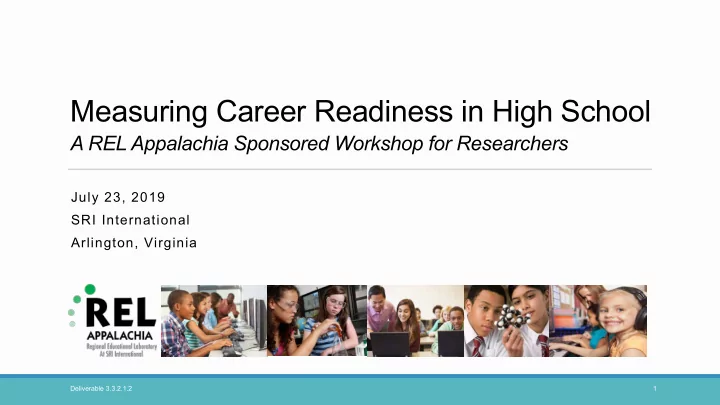
Measuring Career Readiness in High School
A REL Appalachia Sponsored Workshop for Researchers
July 23, 2019 SRI International Arlington, Virginia
Deliverable 3.3.2.1.2 1
Welcome and Introductions MIYA WARNER Collaboration and - - PowerPoint PPT Presentation
Measuring Career Readiness in High School A REL Appalachia Sponsored Workshop for Researchers July 23, 2019 SRI International Arlington, Virginia : REL APPALACHIA Regional Educational Laboratory At SRI International Deliverable 3.3.2.1.2
APPALACHIA
Regional Educational Laboratory At SRI International
A REL Appalachia Sponsored Workshop for Researchers
July 23, 2019 SRI International Arlington, Virginia
Deliverable 3.3.2.1.2 1
, ....,~~
MIYA WARNER Collaboration and Coordination Lead Regional Educational Laboratory: Appalachia @SRI International
Deliverable 3.3.2.1.2 2
tREL
APPALACHIA r....,.iu.i..,..~RESTROOM
Deliverable 3.3.2.1.2 3
tREL
APPALACHIA r....,.iu.i..,..~Welcome, int roductions, ov erview
goals and
Literature scan discussion
REL staff presentations
Lunch
Expert Panel
Discussion
next steps
Adjourn
Deliverable 3.3.2.1.2 4
tREL
APPALACHIA r....,.iu.i..,..~5
tREL
APPALACHIA r....,.iu.i..,..~readiness.
career readiness for different purposes and identify gaps.
measurement.
researchers.
Deliverable 3.3.2.1.2 6
, ....,~~
JULIE HARRIS Senior Researcher Regional Educational Laboratory: Appalachia @SRI International
Deliverable 3.3.2.1.2 7
tREL
APPALACHIA r....,.iu.i..,..~The literature scan is organized around two questions related to career readiness measurement:
Deliverable 3.3.2.1.2 8
tREL
APPALACHIA r....,.iu.i..,..~Scope Framework College knowledge/ career path navigation Academic content knowledge Technical knowledge & skills* Cognitive competencies Intrapersonal competencies Interpersonal competencies Institional supports Council of Chief State School Officers (CCSSO), Innovation Lab Network (ILN) Framework for College, Career, and Citizenship Readiness David Conley, Four Keys to College and Career Readiness CCRSC, College and Career Readiness Success Organizer P21 Framework for 21st Century Learning NASDCTEc Common Career Technical Core Career Readiness Partner Council (CRPC), What it Means to be Career Ready National Research Council, 21st Century Skills U.S. Department of Edcuation (U.S. DOE), Employability Skills Framework National Network of Business and Industry Associations (National Network), Common Employability Skills Measures of Human Achievement (MHA) Labs, The Building Blocks The Organisation for Economic Co-operation and Development (OECD), Definition and Selection of Key Competencies (DeSeCo) SkillsUSA, Employability Framework Joyce Foundation, Personal Success Skills Framework Total Frameworks 4 5 10 13 13 13 2 Career Readiness College and Career Readiness
Source: Authors' calculations *The category Technical Knowledge and Skills includes applied academic knowledge. Deliverable 3.3.2.1.2 9
tREL
APPALACHIA r....,.iu.i..,..~Intrapersonal
attitude
conscientiousness
Interpersonal
Communication Teamwork
Leadership Respect for differences
Empathy/social awareness
Cognitive
solving.
skills
skills
10
tREL
APPALACHIA r....,.iu.i..,..~reasonably well researched in terms of their ability to predict college success.
competencies and technical knowledge and skills and their relationship to either college or workforce success.
Deliverable 3.3.2.1.2 11
tREL
APPALACHIA r....,.iu.i..,..~knowledge and competencies and different purposes
Deliverable 3.3.2.1.2 12
tREL
APPALACHIA I .......Questions? Did we miss anything?
Deliverable 3.3.2.1.2 13
tREL
APPALACHIA r....,.iu.i..,..~measurement?
components of career readiness or how they are measured?
Deliverable 3.3.2.1.2 14
MIYA WARNER Collaboration and Coordination Lead Regional Educational Laboratory: Appalachia @SRI International
Deliverable 3.3.2.1.2 15
tREL
APPALACHIA r....,.iu.i..,..~.....
... IPR
r,..1-dw l
N rt e st n lsk,n
$01,,1 )W
t
Deliverable 3.3.2.1.2 16
tREL
APPALACHIA r....,.iu.i..,..~Education
Deliverable X.X.X.X 17
tREL
APPALACHIA r ...--11"--....i........,Choose a group based on the purpose for measurement most relevant to your stakeholders:
Discuss:
Deliverable 3.3.2.1.2 18
............
Deliverable 3.3.2.1.2 19
tREL
APPALACHIA r....,.iu.i..,..~David Conley Amy Loyd Scott Solberg University of Oregon Jobs for the Future Boston University
Deliverable 3.3.2.1.2 20
DAVID T CONLEY, PHD
Founder, principal partner, EdImagine, an educational strategy consulting organization
Professor Emeritus, University of Oregon
Author of multiple books and articles on college and career readiness
INSIGHTS FROM RECENT WORK
From The Promise and Practice of Next Generation Assessment:
Distinguish among work readiness, occupation readiness, and
career readiness
View self-knowledge as a key skill for career readiness
Who I am, how I learn, what I know Stop looking for a single measure of career readiness Conceptualize career readiness as different for different
students (without tracking students by race, ethnicity, gender,
Work on profiles as tools to understand students in context
GAPS
Between generic measures of career readiness such as a cut
score on a Smarter Balanced exam and a skill-specific certification exam such as those offered by Adobe, Microsoft,
The dichotomy between academic and career-technical
education (CTE) courses in high school
The inherent difference in high school grading practices for
academic and CTE courses
FUTURE NEEDS
Measures of learning skills, particularly learning in context and
ability to transfer learning skills (not content knowledge) to new contexts
Validation of experience-based learning such as internships and
apprenticeships
These are increasingly accepted and offered for credit in higher
ed upper division and graduate programs
Use of more application-based assessment such as problems and
projects
True acceptance of 21st century skills as a goal for schooling Moving content knowledge to a foundational role, not the sole
More opportunities for real exploration of career options
throughout high school
SUPPORTING PRACTITIONERS
Develop multiple-measure tools and systems that incorporate
standardized tests, grades, and experience-based measures
Support project-based assessment that integrates and applies
core academic content in a career context
Create or identify methods for assessing field-based
experiences and incorporating them into accountability systems as an additional valid measure of student achievement
Link practitioners with resources they can use to promote
career exploration throughout high school at varying levels of focus
http://www.edimagine.com david_conley@edimagine.com
THE FUTURE CAN’T WAIT: CAREER READINESS IN HIGH SCHOOL
Amy Loyd | JFF
REL Appalachia Workshop| July 23, 2019
JFF
The promise of education and economic mobility in America is achieved for everyone
WHAT DOES JFF DO?
WE BUILD AND STRENGTHEN PATHWAYS
STRONG WORKFORCE AND VIBRANT ECONOMY
So that all Americans have the opportunity to achieve economic well-being
POSTSECONDARY CREDENTIALS THAT LAUNCH CAREERS
That provide family- supporting wages and clear paths to advancement
K-12 AND THE FUTURE OF LEARNING AND CAREER EXPLORATION
Integrating real-world learning with a leg up on college and career and clear next steps to success
THE PATHWAYS TO PROSPERITY NETWORK
WA OR CA MT ID NV AZ UT WY CO NM TX OK KS NE SD ND MN IA MO AR LA MS AL GA FL SC TN NC IL WI MI OH IN KY WV VA PA NY ME VT NH NJ DE MD Washington D.C. MA CT RI AK HI
JFF
PATHWAYS TO PROSPERITY NETWORK
STRATEGIES FOR IMPLEMENTATION
Career Info Secondary – Integration
College and Career Pathways
Education- Industry Partnerships Work-based Learning Leadership and Policy and Advising Systems Postsecondary Alignment and
JFF
PATHWAYS TO PROSPERITY GOALS
Postsecondary success Career and community success
Pipeline of young professionals Increasing number
and growing in key industry sectors; providing upward mobility
confident in their institution's ability to prepare students for the
workforce
butonly 11%
agree that today's college graduates have the skills and competencies that their business needs JFF
Gallup Poll of provosts and business leaders uncovers an enormous and concerning gap in perceptions of readiness
Inside Higher Ed, 2014. Ready or Not
students
Teamwork
■
Employers Staying current on technologies Ethical judgment & decision-making Locating, organizing, evaluating information Oral communication Working with numbers/statistics Written communication
JFF
Percentages represent the number
college grads are highly prepared in these skill areas upon entering the workforce.
Hart Research Associates, 2015. Falling Short? College Learning and Career Success
JFF
WHY CAREER
PREPARING YOUTH TO BE FUTURE-READY
Most young people get little advice about pathways from education to careers, and about career possibilities. Few people talk about the critical role of productive work in human lives. Few families understand the future labor market—or even the current one. Educators typically have little experience of contemporary high-growth industries and know little about labor market data and shifts in education and workforce.
JFF
WORK- BASED LEARNING MATTERS
And it is a lifelong, iterative process – it is not linear! “College is a very expensive career exploration program” CAREER
Apprenticeship; On-the-job Training
Job Shadows; Internships; Youth Apprenticeship CAHEER
EXP01
SURE
Company Tours CAREER
ENGAGEMENT
WORK-BASED lEARNING
PREPARATION FOR
WORK-BASED LEARNING
CAREER
EXPLORATION
Career Fairs; Industry Projects
https://center4apprenticeship.jff.org/work-based-learning/what-work-based-learning/
JFF
ELEVATING OUR GAZE:
Connected to school learning
Informed choices about their future Multigenerational community including and beyond neighborhood and family Referral network, increased career prospects and economic mobility Lifelong employability and psycho- social skills
Postsecondary & Wo kforce Readiness Ac
Stat, ewide Public Private St1eering Gommi . e1es for
Coll 1ege , and C, are, er Pathw -y Endor- ement ,
Becommended J;echni1c I a 1 nd Ess, ential Emp, l1oy bility Oomp, etenide. s
J.uly20
JFF
WWW.PWRACT.ORG
A COMPREHENSIVE STATEWIDE APPROACH
Illinois’s “Power Act”
Postsecondary and Career Expectations (PACE) Framework High school career pathways diploma endorsements Competency-based education Transitional math
Illinois PaCE Posts, econdary and Car, eer Expectations
Each studem: sho1J!d hav, e an indiv·duali.
ZJecl learning p,an to help,mal!<ie decis·ons about cai-,
eei- and
post-secondary (PS) , eclucatton onra·ning. io plan a -oomse o· f study, and t,
efmancial aid assessments with family membern.
By the end of 8th grade
A students!hou d be supported to:
plete a career clustersurvey 0 atteoo a career exploration day
pl anning
unit in a course or workshop A.stud1mtshou' ld l<inow:
interest
sew ie@/ext r:aourriou lar activities
aoo postsE!'COooary (PS)/ca~r
goals r A student should b11 supported to: 0 revisit career cluster interest survey aoo take a career interest survey
O com plete an orientation to careerclusters
coursewo rk aoo PS/career plans using the ISBE College and Career Readiness Indicators
advanced placement (AP) courses
ity service aoo ext raourrioular . activities related to PS plans
assessment with a fam ily member A studentshourd l know : 0 one or two calt!'E!'r clusters fo r iiurther ex ploration and development
co usewo rk, atteooane@, and grades to PS plans
and extrac urricular activities to PS and c ar@'er plans
A student mould be su1
ppo1 rted to:
visit at least oneworkplaoe aligned with career interest s com plete an orient ation cou rse to a particular career cluster or cluster groupi ng
w ithin a career clusterof interest
courses
st udent t hrough t he PS aoo career selection process
plans in relation to t he ISBE College aoo Career R eadiness Indicators (every year)
w ith a family member A students!hourd kinow:
expe,cted entry level aoo midpoint salary fo r oroupations in select, ed CP
and institutions
exams aoo applications
S access a oo compl, etion
CIIJffr &plontionInd De-wlop1r1ent
JFF
i9?1SAC
<]ccn
.lllin.oii-1 IE.I.INO l 5 D OJL ■ l!o 011 I._.I Julat.-Ml ■ a l?malil !ililli. e &.trd H IGH It EIM!'CKf10!f uf.Edurn1;..,By the end of 11th grade
A student slhould I
ba supported to :
create a resume aoo personal st atement O ident ify an internship oppo
rtunity
related to t he CP
coIlege-level coursework in math/ELA aoo enrollment in either M catoh uf
speed upM course
at least one ea rly college ci;ed it o pportunity
utions
exam A.student shoul ld l k!now:
cost, aoo pi;eparation for
interests
application deadlines, for expected PS prugrams of study
r,each schooIfo r PS program of st udy
PSgoals
PSoptions l By 12/31 of 12th grade a student mou Id have:
re adm iss ions applications to PS institutions
ensure all steps in the PS adm iss ions prooess are
SA completion wo rksho p
SA By the end of 12th grade a student s!ho1.1Td be su~ported 1D:
math/ELA
related to t he CP
if ap
pl ica ble, receive indust ry-based certiftcation(s) related to t he CP
team-based cha
llenges or
projects related to t he CP
wo rksho p A.stud1mt mou ld kinow: how CP cou rses and experiene@s articulate to de!J- programs at PS o ptions
~ lat ion to expected entry-level ca~,ersalary and anticipated debt
scholarship or loan
ISAC j H7M 05/18 (ON XX 05/18) Prnted by authoril)> o f the StateJFF
A student should be supported to:
re1visR career ctus er interes survey and · ta ea career in . eres survey complete an orien ation o career clus ers
a .
end a PS opt·ons workshop
1i ha counselor to discuss
course· ork and PS/ caieer plans using the SBE College and Career Readin.e, ss Indicators
advanced pl1acemen (AP) courses
a plan for commun· y serv·ce and e~ racurr·cufar activirtie· s rel1 a .
ed to PS plans
a financ·a1 aid
assessment wi h a family member
A stud
emrt should know:
te· rs for · further exploration and development
la:tionship be een HS
grade· s to PS plans
and extra.curricular activife,s to PS and care er plans
eneral cost ranges of various PS
grade:·:
A student should be suppo . ed 1 .
visiit a feast one· workpta ce a6gned "th career intere-sts
complete an orienta ·on course·
cluster grouping
select a care. er path ay (CP) within a career duster of interes
efigibi lty for AP courses
adul s ·
student hrough · he PS and career
selection process
v·e, w course olik, and PS/ career
plans in relation to · he· I SBE
College, and Career Re, ad·ness Ind· cators ( every year)
ffordabH
ity orkshop with a family membe· r
A student should Imo :
educa:tional requirements. cost,
expected entfy feve· l and m
·
dpoin
saliary fm occupa ions in sel: ected
CP
type· s of PS crede· ntiaJs and institu ·
iming1
exams and appHcai ·ons
competion
~
PaCE Student Checkl'ist
Career
□
Revisit lrne careers ou we lrn rested
lrn and expand orn your cummtca~eer
careers · at you mlgrnt wan to· explo~e.
□
Explor, e career clusters by going to
stud q.o ta .i
lsac.cng~eso1111ces > Illinois Wo~kNet,. Car,
and T~ends.
D Re sea rem the careers you are
In res ed In to find out
what the
Job respooslbllilies are for each
career, and wrnat kind of education and skills ar, e needed.
□
Consider talkln.g 1D someone wrno works In those careers aboot their favorite and least tavorlte part of
trneir job, as well as how muoh
eduction Is needed for their Job.
JFF
Money
D Talk to your pa~en~s)/ ua.N!llan
about what fmancfal resources
a~e available 'to help you pay
for college. You can use the i=AFSMCaster by , going to
stud ntaid..ed. a,/sa/fafsa/
estimate a d cllckl g on
fAFSA4Caster.
D Research how much It would oost
' a·
llieOO an:
un Ive rslty vs. In-stale 4-yea r
pri vare colleg•e/u lverslty
unive rslty
public oo ll ege/Lllf"llversit
university vs. out-of•srare 4-y, ear private co 11 eg e/un lverslty
stllte year pubJc college/ 1
universlly ar,d in-stare 4-
yeer
pr1'11ete co 11 ege/un lverslty
To compare oo lle,ges and degree
programs by oost you can visit ShJd, entpe:rtaUsac.o g/reso.urces
> College Scorecard.
IDII
College
□
Research what deg~ee/cenlficate programs oo ll eges oiff.er.
□
Make an appoln menl ta mee wflh
a coooselor at your school to ta lk
about what classes you need to take p~epare for , college.
□
Talk to your couns,elor about Adw nc, ed Pl acerne nt (AP) classes: what the courses require as well as hOIN and when you can take ·hem .
□
tdentlfydlffeiient community
service and ex acurricular
actlvllles tha could help you explo~e yoor ca11eer In· rests.
□
Talk your school coonseloror teacher . about how your scoool grades and attendance can affect your full.IN! plans for life aher high school.
□
Talk 'lb your school coonseloror teacher about why ft Is I portant to
t fnvolved in community service and ei( acurricular actlvftfes al'!ld haw It can . affect your futuM,lcol lege plans.
l Through these
experience
a s udent gains es entla employability nd technical
competenc es
·n their
'den lfied e tor.
9th GRADE
10th GRADE
11 th GRADE 11 th & 12th GRADE
Individual Plan: Each student completing an endorsement must have an
individualized plan, which includes college planning linked to early understandings
Career-focused ln, structlonal Sequ nee:
2 years of coursework or equivalent competencies. Includes at least 6 hours of early college credit
Ori entation
Ori ntation or Introduction Advanc d Cou rses Cap ton
Courses
Profe Ion I Le rnln1: Awareness, exploration, and preparation activities that provide opportunities for students to Interact with adults in the workplace
At least 2 60 cumulative hours of paid or credit career exploration activities supervised career development experience
with a professional skills assessment At least 2 team-based challenges with adult mentoring
A- cademic Readiness: Ready for non-remedial coursework
in reading and math by high school graduation through criteria defined by district and loca I community college
District and local
community college
certify articula ion o cerVdegree with
labor marke va,lue
JFF
J F F
WHY DOES THIS MATTER?
SCHOOL SHOULD BE ONE OF MANY LEARNING ENVIRONMENTS
“The more powerful and complete the peer world, the more it is detached from pathways toward adulthood… it makes little sense to take large numbers of inexperienced individuals who are the same age and relative maturity, place them in an isolated setting, and ask them to use that particular setting to grow, mature, and gain knowledge and experience.”
Robert Halpern, Chair, Research Council at Erikson Institute, Youth, Education and the Role of Society (Harvard Education Press, 2013)
JFF
MASLOW’S HIERARCHY OF NEEDS
AND LET US NOT FORGET ABOUT HAPPINESS
JFF
MIHALY CSIKSZENTMIHALYI’S FLOW
OR THE ROLE OF MEANINGFUL AND PRODUCTIVE WORK IN HUMAN LIVES
Hi, gh
ANXII ETY
(Stressedi Al,
ert)
WORRY
(Sad, Stressed)
APAT r rr
(Sad, D·
ep essed)
Low
AROUSAL
(A ert, Focused)
! BOREDOM (Depressed, Contented! )
FLOW
(Focused, Happy)
COi TRO
(Happy, Confide t)
R LAXATIO .
(Confident,
Contented!)
Higlh
CHALLENGE LEVEL SKILL LEVEL
THANK YOU!
Amy Loyd, EdLD Vice President
C O N TA C T AMY LOYD Email aloyd@jff.org Phone 617.603.4436
Boston University Wheelock College of E
ducation
&
Human Development
ssolberg@bu.edu @vsolberg
development
transition age youth
National
Collaborative on Workforce andDlsablllty
NCWD
l!ID!IID Navigating the Road to Work
,...--....._
In tltute for Educational
le der hip le ding Aero
Boundarl
BOSTON
UNIVERSITY
Research Samples and Methods
and 12th grade students from 14 high schools in four states (Louisiana, New Mexico, South Carolina and Washington)
educators and students
from 13 states
i~::~·~~:::;
"'"'""'
NCWD
r~ ~,,,
'f'-'.1/i, . Use of Individualized Learning Plans:
~
?
A Promising Practice for Driving College and Career Efforts V . Scott Solberg • Joan Wms • Klmether Redmon • Laura Skaff~'~ ?
Using Individualized Learning Plans to Produce College and Career Ready High School Graduates
.,....,.;
PROMOTiNG QUALITY INDIVIDUALIZED LEARNING PLANS THROUGHOUT THE LIFESPAN:
A Revised and Updated "ILP HOW TO GUIDE 2.0" by Scott Solbefv, Judith Martin, Mindy ~ Kathryn Nichols. Heidi Booth. Jlnnifer UINs. loo Costa\
THE COUNCIL OF STATE GOVERNMENTS
National Task Force on Workforce Development for People with Disabilities
DECEMBER 2016 I{II\
111111~
NCSL
it')t
~ Arizona
Oeparnnenr of EduutlonArizona ECAP Implementation: Administrative Toolkit
Report and Recommendations of the Advisory Committee Studying The Development and lmplement.ation
OfSix-Year Career Plans
Readiness
Partner C,
ncil
employment to achieve a fulfilling, financially secure, and successful career" (Career Readiness Partner Council, 2012, p. 2)”
dispositions including proactivity, resiliency, adaptability, self-directed learning
Making School Relevant with Individualized Learning Plans
HELPING STUDENTS CREATE THEIR OWN CAREER AND LIFE GOALS
students and families as caring and encouraging?
relevant and meaningful?
student outcomes
whether ILP activities are having the intended impact on the scope
Youth Becoming Career Ready Associated with:
Engaging in ILPs Goal Setting Motivation Academic Self- Efficacy GPA; Career Decision- Making Readiness; Distress
General Sample GPA (std. est. = .027, p < .001). Career decision-making readiness (std. est. = .011, p < .000). Distress (std. est. = -.012, p. < .000)
60
Access to Caring and Encouraging Career Advising Mentors Who Facilitate Quality Career Development Lessons That Enable Youth to Establish Career and Life Goals That Result in a Range
Youth Development Outcomes Including: High School Graduation Postsecondary Completion Entry into High Wage/High Demand Careers Social Emotional Learning Skills Personal Health and Well-Being
Access to Decent Work
Example from Scotland Developing the Young Workforce - 7-Year goal to reduce youth unemployment by 40% which was successfully met 3.5 years into the initiative
Measure
The combined data set, held on CSS, is used to produce the Annual Participation
the 16-19 age group across an entire year, at a national and local authority level.
School Leaver Destinations Annual Participation Measure Participation Measure
Methodology The Annual Participation Measure measures the Status of a young person across an entire year (1st April – 31st March). Each status is allocated to one
and the one with the greatest number of days is taken as their Annual Participation Measure status:
Participating Not Participating Unconfirmed
Informs the National Performance Indicator “to increase the proportion of young people in learning, training and work” Continues terminology move from “destinations” to “participation” School Leaver Destinations reported only on school leavers, approx. 55,000 young people The Participation Measure considers the entire 16-19 age cohort, approx. 200,000 young people
st April3i5t March Participating I Not Participatin, g Participatin,g Overall Status = Participating
.8%
~ _
71_.3
_ %
__
)
V
in Education
7U%in2017A 1a.1%)
~ n Employment
18.1% in 20178
1.9% l
..,.._,.. mlra1 ing&
Personal D evelopment
1.8%in2017211 ,255
individuals The Participation Measure covers the 16-19 year old cohort
,----------
were not participating; those unemployed seeking, employment and others unemployed and not seeking e,g, . economically inactive. A decrease of 0.3 p&rcentage poi nls from 3.7% in 2017.1.7%
U11e11 ployed
)eek, 1
2.1% in 2017Joyed
J
4.7%
with an unconfirmed slaw s with2018 Annual Participation Measure Summary
Key Results (Scotland)
In 20l7
in Tra1ntng &
Personal Development
1..Bin2017
3.4o/o
1.8'1. In 2017
t sms
DBVB1ap111Bn1 &cmlllmd mnt1nuas ID WOik wdn 1119 SGObh eovermIBnl and l-9.l=tC 1D make pugmss In oblaliilllll aqiDylDBRi Rll!ltad dBtll nBIB P"fll:'19 lhotu1 ~
..._
Iha [lgllal BD10n¥ {Ad) 2017. IHIUl'Hiiidiln IIHliy WII mpmva SIIMCa dllllVaiy
and ulner anr.a Iha BnlUII ~
IIIIIIIIBURL ThlS IIKdl bdliy lailllb In
RIOld1D tlB IUdJBf or IIKXll1llllllld slat re, Tha padlaB are In 1119 promss OI cany11g
aul a PmOI OI corr.spl Wllh 1-NFIC ID ta,t Wl'Hllllr aamlllng 'llx <Ilda WII llllhlllCII 1119
alll'aagB or JUUl1II people WhD are In amplOJlnllnt and bl1ng abool: lhasa bllldlls..
Statuses defined as……………
Education
School Pupil Higher Education (Full-Time, Part- Time including distance learning) Further Education (Full-Time, Part- Time including distance learning)
Employment
Full-Time Employment Modern Apprenticeships Part-Time Employment Self-Employment
Training and Other Development
SDS Employability Fund Stages 2, 3 & 4 Activity Agreement Other Formal Training Personal Skills Development (Employability) including DWP Work Programme Personal Skills Development (Social & Health) Voluntary Work
Unemployed seeking (employment or training) Unemployed not seeking
Economically Inactive including those:
employment or training (EET)
Unavailable Ill-Health Custody
Unconfirmed
Personal Information
(Year)
Not at School)
and LA)
Date
Institutional Information
Leaving Date
School
Source
Future Fields
LA Preferred Occupation & Source SDS Preferred Occupation & Source Preferred Route 1 & Source Preferred Route 2 & Source
Status Fields
Source
Date
Source
Name
Level
Status & weeks since
Support & Flagging Fields
with SDS
Source
& Source
Source
Source
Source
tREL
APPALACHIA r....,.iu.i..,..~Discuss:
Deliverable 3.3.2.1.2 67
tREL
APPALACHIA r....,.iu.i..,..~Consider:
Deliverable 3.3.2.1.2 68
, ....,~~
MIYA WARNER Collaboration and Coordination Lead Regional Educational Laboratory: Appalachia @SRI International
Deliverable 3.3.2.1.2 69
tREL
APPALACHIA r....,.iu.i..,..~practitioners?
today’s discussion to practitioners (for example, blog post, white paper, webinar)?
different roles or contexts? If so, how?
Deliverable 3.3.2.1.2 70
tREL
APPALACHIA r....,.iu.i..,..~APPALACHIA
Regional Educational Laboratory Al SRI InternationalThank you!
REL Appalachia
https://ies.ed.gov/ncee/edlabs/ regions/appalachia/ @REL_Appalachia RELAppalachia@sri.com
This presentation was prepared under Contract No. ED-IES-17-C-0004 by Regional Educational Laboratory Appalachia, administered by SRI International. The content does not necessarily reflect the views or policies of IES or the U.S. Department of Education, nor does mention of trade names, commercial products, or organizations imply endorsement by the U.S. Government.