Welcome and Introduction EOOLT'2007 The 1st International Workshop - - PDF document

welcome and introduction
SMART_READER_LITE
LIVE PREVIEW

Welcome and Introduction EOOLT'2007 The 1st International Workshop - - PDF document

Welcome and Introduction EOOLT'2007 The 1st International Workshop on Equation-Based Object-Oriented Languages and Tools Peter Fritzson Franois Cellier Christoph Nytsch Geusen David Broman class x { public class x { int a; float


slide-1
SLIDE 1

1

Welcome and Introduction

EOOLT'2007 – The 1st International Workshop on Equation-Based Object-Oriented Languages and Tools

Peter Fritzson

François Cellier Christoph Nytsch Geusen David Broman

class x { public int a; float b; int fu nc (i nt a ,int b); Asa as ad Asda a d Asd ad cc Aac sd scfcc c a Ascccv ca Ascc c ac } class x { public int a; float b; int fu nc (i nt a ,int b); Asa as ad Asda a d Asd ad cc Aac sd scfcc c a Ascccv ca Ascc c ac } class x { public int a; float b; int fu nc (i nt a ,int b); Asa as ad Asda a d Asd ad cc Aac sd scfcc c a Ascccv ca Ascc c ac } class x { public int a; float b; int fu nc (i nt a ,int b); Asa as ad Asda a d Asd ad cc Aac sd scfcc c a Ascccv ca Ascc c ac }

2

History History – – Models and Equations Models and Equations

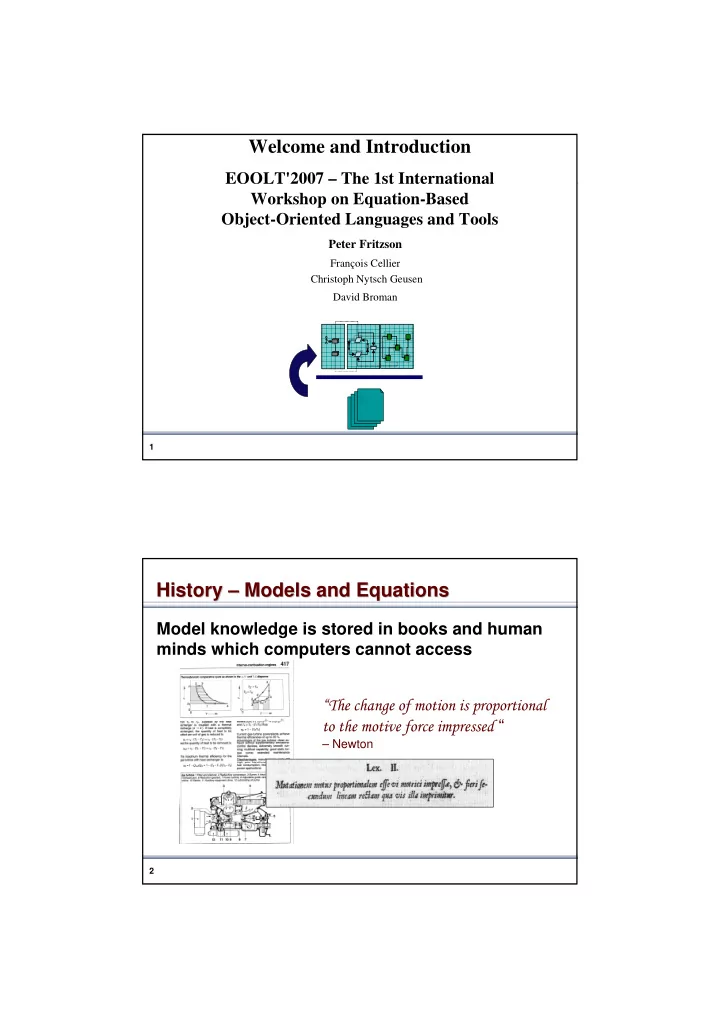
Model knowledge is stored in books and human minds which computers cannot access “The change of motion is proportional to the motive force impressed “

– Newton

slide-2
SLIDE 2

3

History History – – Equation Sign Equation Sign Object Orientation Object Orientation

  • Equations were used in the third millennium B.C.
  • Equality sign was introduced by Robert Recorde in 1557

Newton still wrote text (Principia, vol. 1, 1686)

“The change of motion is proportional to the motive force impressed ”

CSSL (1967) introduced a special form of “equation”: variable = expression v = INTEG(F)/m Simula67 (1967) introduced object orientation – Classes, Objects, Inheritance

4

Equation Equation-

  • Based Object

Based Object-

  • Oriented Languages

Oriented Languages Approximate Characteristics? Approximate Characteristics?

  • Systems of Equations
  • Object Orientation
  • Mostly declarative
  • Hierachical System Decomposition
  • Reuse, Dynamic systems
  • What is the key difference compared to other

programming languages?

  • Tentative answer: Acausality of equations?
slide-3
SLIDE 3

5

Challenges Challenges – – Today and Tomorrow Today and Tomorrow

  • Engineering Complex Systems
  • Model-driven development/engineering
  • What is the special contribution of Equation-

Based Object-Oriented Languages and Tools?

  • What additional benefits can Acausal equations

give?

  • etc.?
  • Topic of this workshop, Discuss, Brainstorm

6

Thanks Thanks

  • To the Authors for the papers
  • To the Program Committe for reviews
  • To Organization Committee for the organization
  • To the overall ECOOP Workshop organization

committee, Michael Cebulla, et al

  • To Stefan Jähnichen for the invitation