
SLIDE 1
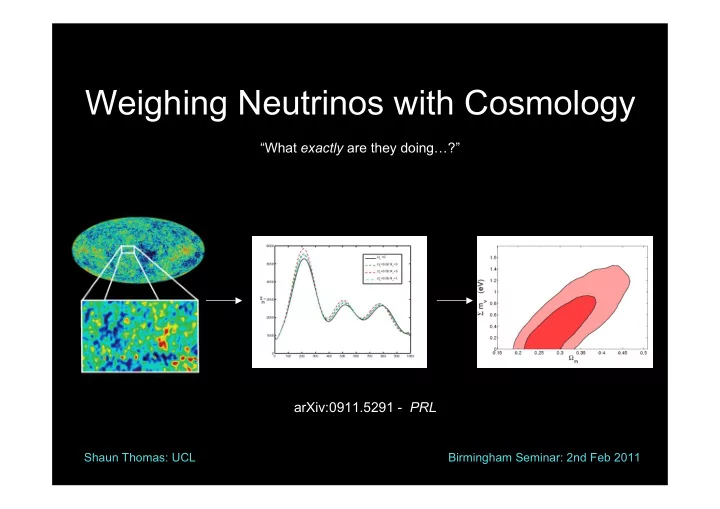
Weighing Neutrinos with Cosmology
“What exactly are they doing…?”
Shaun Thomas: UCL Birmingham Seminar: 2nd Feb 2011
arXiv:0911.5291 - PRL
Weighing Neutrinos with Cosmology What exactly are they doing? - - PowerPoint PPT Presentation
Weighing Neutrinos with Cosmology What exactly are they doing? arXiv:0911.5291 - PRL Shaun Thomas: UCL Birmingham Seminar: 2nd Feb 2011 Outline 1. The Cosmological Model 2. Neutrino signatures in the model 3. Probes of the
“What exactly are they doing…?”
Shaun Thomas: UCL Birmingham Seminar: 2nd Feb 2011
arXiv:0911.5291 - PRL
2. Neutrino signatures in the model 3. Probes of the Model
4. Current/Previous work: Thomas, Abdalla & Lahav: [arXiv:0911.5291] - PRL 5. For the Future…?
Shaun Thomas: UCL Birmingham Seminar: 2nd Feb 2011
Shaun Thomas: UCL
Determining the neutrino mass is important because:
1. Neutrinos’ mass has a significant impact on cosmological measurements _ 2. Incorrect neutrino mass will bias cutting edge science: dark energy _ 3. Particle physics - cosmology comparison: unique check on all cosmology!
Birmingham Seminar: 2nd Feb 2011
OR - “things to put in funding applications….”
1. Neutrinos’ mass has a significant impact on cosmological measurements
Neutrino oscillations indicate they have mass!
But not on the absolute scale of mass…
KATRIN nemo ST, Abdalla, Lahav (2009) For example…
Not just interesting An integral part of the cosmological model…
Age of precision Cosmology
Shaun Thomas: UCL Birmingham Seminar: 2nd Feb 2011
A cosmologist’s understanding..
Neutrino oscillations indicate they have mass!
But not on the absolute scale of mass…
KATRIN nemo ST, Abdalla, Lahav (2009) For example…
Not just interesting An integral part of the cosmological model…
Age of precision Cosmology
Shaun Thomas: UCL
http://www-ik.fzk.de/~katrin/index.html
Birmingham Seminar: 2nd Feb 2011
A cosmologist’s understanding..
Shaun Thomas: UCL
What is Cosmology?
“In science there is only physics; all the rest is stamp collecting“, Rutherford Birmingham Seminar: 2nd Feb 2011 BUT: Interesting contents! Themes intimately related
Famously, supernovae indicated Dark Energy
Probe of distance and expansion: The smooth Universe
Cosmology
Shaun Thomas: UCL Birmingham Seminar: 2nd Feb 2011
Probes of anisotropy: The clumpy Universe! Combination of probes, data and surveys
APM survey: Efstathiou et al. (1990) E.g., Perlmutter et al. (1999)
The Cosmological Model
Does NOT predict the exact location
The statistic is the ‘Power Spectrum’
Does predict the statistical distribution
The power spectrum tells us how much some field varies on different scales Parameters go into the cosmological model - detailing physical quantities (e.g. neutrinos or dark energy) - that change the power spectrum -> compare to data Shaun Thomas: UCL Birmingham Seminar: 2nd Feb 2011
The Power Spectrum
“Variance of the underlying statistic as a function of scale”
Power spectrum of people at a party
Shaun Thomas: UCL Birmingham Seminar: 2nd Feb 2011 power spectrum Scale (metres) 1 2 3 4
separated by ~ metre
metres
Signatures in the Model
Neutrinos have large thermal velocities and Free-stream out of
thus suppressing the clustering of matter and galaxies Shaun Thomas: UCL Birmingham Seminar: 2nd Feb 2011
Signatures in the Model
Which we see in the power spectrum… Shaun Thomas: UCL Birmingham Seminar: 2nd Feb 2011 0 eV Neutrinos 1 eV Neutrinos Dark Matter N-body simulations
Smaller Scales Shaun Thomas: UCL Birmingham Seminar: 2nd Feb 2011
Signatures in the Model
Galaxy tracers = Galaxy Survey
Probes of Cosmology
Cosmic Microwave Background (CMB)
E.g. WMAP and Planck WMAP 5 year (CMB) : < 1.3 eV (95% CL)
Komatsu et al. [arXiv:0803.0547] Thomas et al. [arXiv:0911.5291] Parameter degeneracy - constrain matter component => better neutrino determination Model Data Constraint
Shaun Thomas: UCL Birmingham Seminar: 2nd Feb 2011
Probes of Cosmology
Supernovae (SN)
E.g. Supernova Legacy Survey CMB + SN + BAO : < 0.69 eV (95% CL)
Baryon Acoustic Oscillations (BAOs)
Standard candle allows one to measure the expansion history This is sensitive to matter content of the Universe Standard ruler allows one to measure the expansion history This is sensitive to matter content of the Universe Primordial CMB photon-baryon oscillations are imprinted
Thomas et al. [arXiv:0911.5291]
Shaun Thomas: UCL Birmingham Seminar: 2nd Feb 2011
Probes of Cosmology
+ Galaxy Clustering!
Sloan Digital Sky Survey (SDSS)
Smaller Scales Shaun Thomas: UCL Birmingham Seminar: 2nd Feb 2011
Probes of Cosmology
+ Galaxy Clustering!
Sloan Digital Sky Survey (SDSS) Thomas, Abdalla & Lahav - MNRAS (2010)
MegaZ: Largest galaxy survey
0.45 < z < 0.65
Four redshift bins Shaun Thomas: UCL Birmingham Seminar: 2nd Feb 2011
Probes of Cosmology
+ Galaxy Clustering!
Sloan Digital Sky Survey (SDSS)
Luminous Red Galaxies (LRGS) 723,556 LRGs 7,746 square degrees 0.45 < z < 0.65
CMB + SN + BAO + SDSS LRGs + HST: < 0.28 eV (95% CL)
Thomas et al. [arXiv:0911.5291]
Shaun Thomas: UCL
12 Parameters:
bh2;ch2;;;ns;ln(1010 As); m ;ASZ;b
1;b2;b3;b4
Probes of Cosmology
+ Galaxy Clustering!
Sloan Digital Sky Survey (SDSS)
Luminous Red Galaxies (LRGS) 723,556 LRGs 7,746 square degrees 0.45 < z < 0.65
CMB + SN + BAO + SDSS LRGs + HST: < 0.28 eV (95% CL)
Thomas et al. [arXiv:0911.5291]
Shaun Thomas: UCL
12 Parameters:
bh2;ch2;;;ns;ln(1010 As); m ;ASZ;b
1;b2;b3;b4
Statistics in Cosmology
Bayes
Shaun Thomas: UCL
12 Parameters:
bh2;ch2;;;ns;ln(1010 As); m ;ASZ;b
1;b2;b3;b4
Thomas, Abdalla & Lahav [0911.5291] Cosmology and Neutrinos Komatsu et al. [arXiv:0803.0547] < 0.67 eV (CMB+SN+BAO) Tereno et al. [arXiv:0810.0555] < 0.54 eV (CMB+SN+BAO+WL) Ichiki, Takada & Takahashi [arXiv:0810.4921] < 0.54 eV (CMB+SN+BAO+WL) Seljak et al. [arXiv:0604335] < 0.17 eV (+ Lyman Alpha…)
Systematics - e.g. winds? CMB + SN + BAO + SDSS LRGs +HST Cosmology is starting to predict that experiments such as KATRIN will not detect anything 0.28 eV Shaun Thomas: UCL Birmingham Seminar: 2nd Feb 2011 UNIQUE opportunity for consistency check!!!!!
Systematics
We have seen that ‘precision’ cosmology is sensitive to the neutrino mass and that we are in the process of making very good constraints However Parameter Degeneracies Galaxy Bias Non-linearities Degeneracy with w increases error bar Model underlying matter power spectrum but measure the galaxy power spectrum How are they related? Bias result or lose data Perturbation theory/ N-body simulations
Although we want tighter neutrino constraints We also want trustworthy neutrino constraints.
Shaun Thomas: UCL
L_max = 300 => 0.28 eV L_max = 200 => 0.34 eV
Birmingham Seminar: 2nd Feb 2011
Shaun Thomas: UCL
The Dark Energy Survey (DES)
http://www.darkenergysurvey.org 5000 sq. deg around the southern galactic cap 525 nights: Oct - Feb (2011-2016) Blanco 4m Telescope - Cerro Tololo Inter-American Observatory (CTIO) Birmingham Seminar: 2nd Feb 2011
Shaun Thomas: UCL
The Dark Energy Survey (DES)
http://www.darkenergysurvey.org Measure Dark Energy with 4 main techniques: 1. Clusters 2. Galaxy Clustering 3. Weak Lensing 4. Supernovae Also give exquisite information on: Neutrino masses, gravity etc…. Birmingham Seminar: 2nd Feb 2011
Shaun Thomas: UCL
In the Future… Forecast for Galaxy Clustering + Planck: < 0.12 eV
E.g. Lahav, Kiakotou, Abdalla and Blake - arXiv: 0910.4714
The Dark Energy Survey (DES)
http://www.darkenergysurvey.org
Birmingham Seminar: 2nd Feb 2011
Tighter neutrino constraint. Trustworthy neutrino constraint.
Having produced data for a tighter constraint
Shaun Thomas: UCL Birmingham Seminar: 2nd Feb 2011
Shaun Thomas: UCL
Determining the neutrino mass is important because:
1. Neutrinos’ mass has a significant impact on cosmological measurements _ 2. Incorrect neutrino mass will bias cutting edge science: dark energy _ 3. Particle physics - cosmology comparison: unique check on all cosmology!
Birmingham Seminar: 2nd Feb 2011
OR - “things to put in funding applications….”
1. Neutrinos’ mass has a significant impact on cosmological measurements
Cosmology and Neutrinos ST, Abdalla & Lahav [arXiv:0911.5291] Komatsu et al. [arXiv:0803.0547] Elgaroy and Lahav [arXiv:0606007] Seljak et al. [arXiv:0604335] Agarwal & Feldman [arxiv:0812.3149] Galaxy Clustering ST, Abdalla & Lahav [arxiv:1011.2448] ST, Abdalla & Lahav [arxiv:1012.2272] Neutrino Experiments MINOS NEMO KATRIN
Contact: sat@star.ucl.ac.uk
Shaun Thomas: UCL Birmingham Seminar: 2nd Feb 2011
Shaun Thomas: UCL Padmanabhan et al. 2007
The Photometric Redshift
Observe the flux through broad filters # Neural Network
ANNz - Collister & Lahav (2004)
“photo-z” # Polynomial Fitting Use training set For example: # SDSS # Le Phare Birmingham Seminar: 2nd Feb 2011