We should not ablate atrial fibrillation in young asymptomatic - - PDF document

we should not ablate atrial fibrillation in young
SMART_READER_LITE
LIVE PREVIEW

We should not ablate atrial fibrillation in young asymptomatic - - PDF document

We should not ablate atrial fibrillation in young asymptomatic patients Joshua D. Moss, MD, FACC, FHRS Associate Professor of Clinical Medicine Cardiac Electrophysiology University of California San Francisco @JDMossMD 1 First: important to


slide-1
SLIDE 1

[ADD PRESENTATION TITLE: INSERT TAB > HEADER & FOOTER > NOTES AND HANDOUTS] 12/8/19 1

Joshua D. Moss, MD, FACC, FHRS Associate Professor of Clinical Medicine Cardiac Electrophysiology University of California San Francisco

We should not ablate atrial fibrillation in young asymptomatic patients

@JDMossMD

1

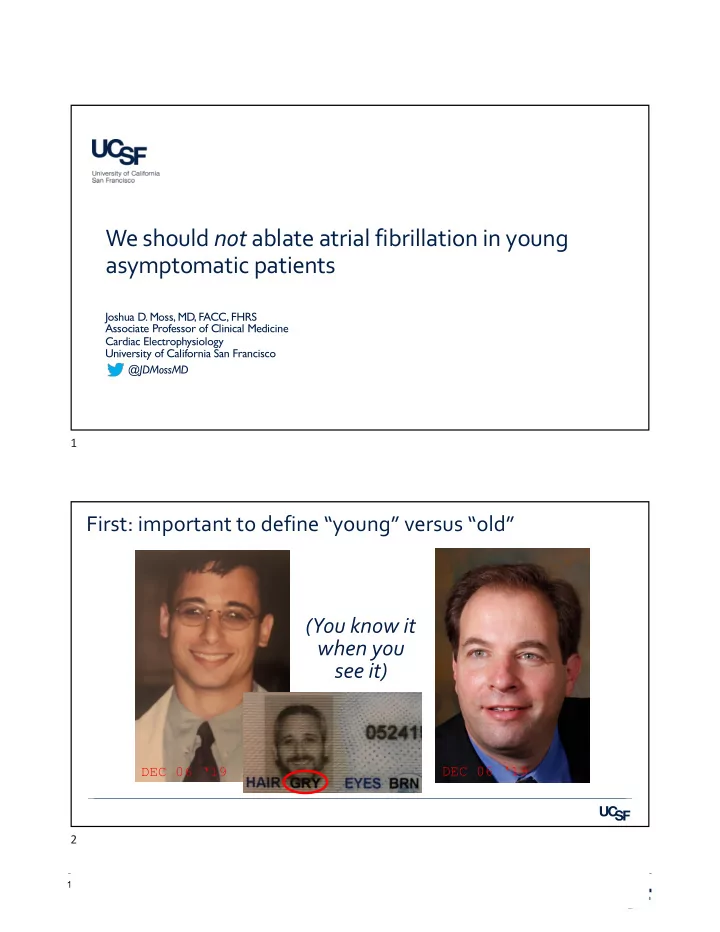
First: important to define “young” versus “old” (You know it when you see it)

DEC 06 ‘19 DEC 06 ‘19

2

slide-2
SLIDE 2

[ADD PRESENTATION TITLE: INSERT TAB > HEADER & FOOTER > NOTES AND HANDOUTS] 12/8/19 2

What is the purpose of rhythm control in AF?

  • A. To save lives
  • B. To prevent strokes
  • C. To make EKG’s less ugly
  • D. To prevent Apple Watch

alerts

  • E. To make patients feel

better

3

What is the purpose of rhythm control?

Packer DL et al. CABANA trial, JAMA 2019; 321: 1261-1274.

  • A. To save lives
  • B. To prevent strokes
  • C. To make EKG’s less ugly
  • D. To prevent Apple Watch

alerts

  • E. To make patients feel

better

4

slide-3
SLIDE 3

[ADD PRESENTATION TITLE: INSERT TAB > HEADER & FOOTER > NOTES AND HANDOUTS] 12/8/19 3

What is the purpose of rhythm control?

Packer DL et al. CABANA trial, JAMA 2019; 321: 1261-1274.

  • A. To save lives
  • B. To prevent strokes
  • C. To make EKG’s less ugly
  • D. To prevent Apple Watch

alerts

  • E. To make patients feel

better

1o endpoint: death, disabling stroke, serious bleeding, cardiac arrest

5

But the ”younger” patients did better!

Packer DL et al. CABANA trial, JAMA 2019; 321: 1261-1274.

6

slide-4
SLIDE 4

[ADD PRESENTATION TITLE: INSERT TAB > HEADER & FOOTER > NOTES AND HANDOUTS] 12/8/19 4

Packer DL et al. CABANA trial, JAMA 2019; 321: 1261-1274.

Duh! Vs. drugs!! And had to have a comorbidity!

7

What is the purpose of “per-protocol” analysis?

Packer D et al. CABANA trial, presented at HRS 2018. https://www.cabanatrial.org 1o endpoint: death, disabling stroke, serious bleeding, cardiac arrest

(actually ablated by 12 mos after randomization)

8

slide-5
SLIDE 5

[ADD PRESENTATION TITLE: INSERT TAB > HEADER & FOOTER > NOTES AND HANDOUTS] 12/8/19 5

Adverse events in CABANA

Good thing in a clinical trial… Solution: no amio!!

Ablation Drugs

9

But there was 1 of these…

10

slide-6
SLIDE 6

[ADD PRESENTATION TITLE: INSERT TAB > HEADER & FOOTER > NOTES AND HANDOUTS] 12/8/19 6

And 1 of these…

11

LIPV Pre-ablation Post-ablation

And 1 of these…

12

slide-7
SLIDE 7

[ADD PRESENTATION TITLE: INSERT TAB > HEADER & FOOTER > NOTES AND HANDOUTS] 12/8/19 7

So are there any trials of ablation in asymptomatic patients?

Wu L et al. J Cardiovasc Electrophysiol 2016; 27: 531-535

§ 66 patients with asymptomatic persistent AF refractory to AAD

  • “None of the usual AF-related symptoms including palpitations, SOB, chest

pressure or pain, dizziness, fatigue, weakness, etc.

  • Mean age 52.0 +/- 9.0

§ 132 matched patients with symptomatic persistent AF

  • Mean age 53.1 +/- 8.6

13

Ablation in asymptomatic patients:

Wu L et al. J Cardiovasc Electrophysiol 2016; 27: 531-535

Asymptomatic patients § 43 of 66 in an arrhythmia at 1 year

  • 25.6% “pure AT”
  • 44.2% paroxysmal AT and AF
  • 30.2% persistent AF

§ 16 were symptomatic!!

  • 37.2% of those with recurrence
  • 24% of all originally

asymptomatic patients

14

slide-8
SLIDE 8

[ADD PRESENTATION TITLE: INSERT TAB > HEADER & FOOTER > NOTES AND HANDOUTS] 12/8/19 8

Cohen A. Watch What Happens Live with Andy Cohen. Bravo 2018.

15

Cohen A. Watch What Happens Live with Andy Cohen. Bravo 2018.

16

slide-9
SLIDE 9

[ADD PRESENTATION TITLE: INSERT TAB > HEADER & FOOTER > NOTES AND HANDOUTS] 12/8/19 9

Quality of life before and after ablation:

Wu L et al. J Cardiovasc Electrophysiol 2016; 27: 531-535

Symptomatic patients Asymptomatic patients

17

Hakalahti A et al. Radiofrequency ablation vs. antiarrhythmic drug therapy as first line treatment of symptomatic atrial fibrillation: systematic review and meta-analysis. Europace 2015; 17: 370-378.

Desperate to try rhythm control? Well which significantly different

  • utcome would you choose?

18

slide-10
SLIDE 10

[ADD PRESENTATION TITLE: INSERT TAB > HEADER & FOOTER > NOTES AND HANDOUTS] 12/8/19 10

So what should we do for these patients?

Packer DL et al. CABANA trial, JAMA 2019; 321: 1261-1274.

19

Middeldorp ME…Sanders P et al. REVERSE-AF . Europace 2018; 20: 1929-35

Perhaps lifestyle modification and weight loss?

§ Of 1415 consecutive AF patients, 825 with BMI ≥ 27 were offered weight and risk factor management § Results were stratified by degree of weight loss

20

slide-11
SLIDE 11

[ADD PRESENTATION TITLE: INSERT TAB > HEADER & FOOTER > NOTES AND HANDOUTS] 12/8/19 11

Middeldorp ME…Sanders P et al. REVERSE-AF . Europace 2018; 20: 1929-35

Perhaps lifestyle modification and weight loss?

§ Of 1415 consecutive AF patients, 825 with BMI ≥ 27 were offered weight and risk factor management § Results were stratified by degree of weight loss

21

Calkins H et al. Heart Rhythm 2017; 14; e275-e444.

Finally, what do the “experts” say?

§ “…the potential benefits of the procedure for the patient without symptoms are uncertain.” § “At the end of the day, the writing group believes that in selected patients, after a careful discussion of the risks, benefits, and alternatives, that AF ablation may be considered in patients with asymptomatic paroxysmal or persistent AF (Class IIb, LOE C-EO)”

22

slide-12
SLIDE 12

[ADD PRESENTATION TITLE: INSERT TAB > HEADER & FOOTER > NOTES AND HANDOUTS] 12/8/19 12

What do the “experts” say?

§ “…the potential benefits of the procedure for the patient without symptoms are uncertain.” § “At the end of the day, the writing group believes that in selected patients, after a careful discussion of the risks, benefits, and alternatives, that AF ablation may be considered in patients with asymptomatic paroxysmal or persistent AF (Class IIb, LOE C-EO)”

23

Conclusion:

I believe in ablation! It has an important role in the treatment of atrial fibrillation. But it is not for asymptomatic young patients:

1. It offers no mortality or stroke benefit 2. It can turn an asymptomatic arrhythmia into a symptomatic one 3. There’s a good chance more than one procedure will be required, each carrying small but real risks for serious complications 4. First line in many patients should probably be risk factor modification and weight loss!

24

slide-13
SLIDE 13

[ADD PRESENTATION TITLE: INSERT TAB > HEADER & FOOTER > NOTES AND HANDOUTS] 12/8/19 13

@JDMossMD

25