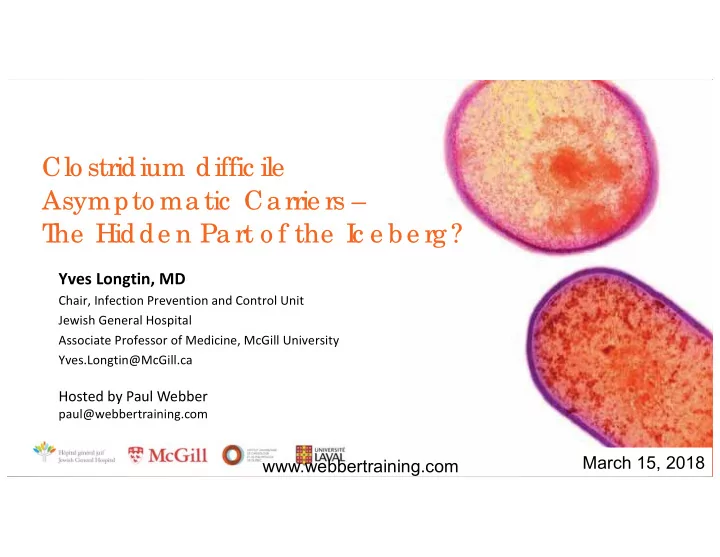
SLIDE 1
Asympto ma tic Ca rrie rs – T he Hidde n Pa rt o f the I c e b e rg ?
SLIDE 2 Disc lo sure s
- Merck Canada, BD Diagnostics, AMD Medical, Canadian
Institute for Health Research
SLIDE 4
BACK GROUND
SLIDE 5
Ba c kg ro und
SLIDE 6
SLIDE 7
SLIDE 8
Ba c kg ro und
1 out of ever y 200 patients a dmitte d in a c ute
c a re institutio ns in Que b e c de ve lo p CDI
SLIDE 9
Pre ve ntio n o f CDI
SLIDE 10
Guide line s
SLIDE 11
Ba c kg ro und
SLIDE 13
SLIDE 14
- Stochastic modeling: food would
be responsible for < 1 newly colonized patient /1,000 adms.
SLIDE 15
Asympto ma tic Ca rrie rs
SLIDE 16
I NCRE ASI NG I NT E RE ST ON C. DI F F I CI L E COL ONI ZAT I ON
SLIDE 17 CD-AC a re not a s c o nta g io us a s CDI pa tie nts… b ut a lmo st!
SLIDE 18
SLIDE 19
Ho w nume ro us a re CD-AC?
SLIDE 20
SLIDE 21
SLIDE 22
SLIDE 23
SLIDE 24
Mo de ling Studie s
SLIDE 25 Rapid detection of colonized patients can significantly affect the prevalence of CDI and its control, especially in the context of asymptomatic carriers and in-ward transmission.
SLIDE 26
SLIDE 27
SLIDE 28
SLIDE 29
SLIDE 31
SLIDE 32
CDI, Non-HA CD carrier Screening test (mainly admission) CD carrier Toxin test* Environ. sample
ML VA to tra c k a c q uisitio n o f CDI
* CDI test + (CCNA) but symptoms do not fulfill criteria for CDI
SLIDE 33
SLIDE 34
- Future infection control measures?
SLIDE 35
I nstitut Unive rsita ire de Ca rdio lo g ie e t Pne umo lo g ie de Qué b e c
SLIDE 36
ra te s, 2004-2013
SLIDE 37
Co ntro l o f CDI
SLIDE 38 Co ntro l o f CDI
CD carriers in CDI
AC
SLIDE 39
CD-AC me a sure s
SLIDE 40 RE AL L Y ?
Can’t we just improve standard precautions?
SLIDE 41
I nfe c tio n c o ntro l me a sure s
SLIDE 42
- Similar to CDI patients with
few exceptions:
SLIDE 43 Why g lo ve s?
Why not only soap and water ?
SLIDE 44 Ha nd wa shing vs.
ve n the best ha nd hyg ie ne te c hniq ue is poor
ly effective
to re mo ve C. diffic ile fro m ha nds!
e.g. ABHRS against E. coli: 3.5 to 5 log reduction
SLIDE 45
E ffic a c y o f g lo ve s
SLIDE 46
Pro phyla xis fo r C. diffic ile c a rrie rs?
secondary prophylaxis
SLIDE 47
De te c tio n o f c a rrie rs
SLIDE 48
De te c tio n o f c arrie rs
SLIDE 49
De te c tio n o f c arrie rs
SLIDE 50
De te c tio n o f c arrie rs
SLIDE 51
De te c tio n o f c a rrie rs
SLIDE 52
De te c tio n o f c a rrie rs
SLIDE 53
De te c tio n o f c a rrie rs
SLIDE 54
De te c tio n o f c a rrie rs
SLIDE 55 De te c tio n o f c a rrie rs
PCR GDH
SLIDE 56
F a lse +?
gene by homebrew PCR
396 tested; 16 ACDC detected
SLIDE 57
ANAL YSI S
SLIDE 58
Outc o me s
SLIDE 59
SLIDE 60
E xte rna l c o ntro l
SLIDE 61 He a lthc a re -Asso c ia te d CDI I nc ide nc e ra te in Que b e c , 2004-2014
SLIDE 62 I nc ide nc e ra te a mo ng unive rsity ho spita ls, 2011-2012
QHLI
SLIDE 63 Ana lyse s
- Intervention period vs. pre-intervention period
- Poisson regression (accounts for seasonality)
SLIDE 64
RE SUL T S
SLIDE 65
SLIDE 66
Ca rria g e ra te o n a dmissio n
SLIDE 67
SLIDE 68
SLIDE 69
SLIDE 70
SLIDE 71
SLIDE 72
SLIDE 73
SLIDE 74
ARI MA mo de ling
SLIDE 75
Se nsitivity a na lyse s
SLIDE 76
SLIDE 77
SLIDE 78
Po te ntia l Co nfo unde rs
SLIDE 79
Po te ntia l Co nfo unde rs
Increased from 37% to 50% during intervention (p<0.001)
SLIDE 80
Antimic ro b ia l a nd PPI use
SLIDE 81
Antimic ro b ia l use
SLIDE 82
Antimic ro b ia l use
SLIDE 83
Antimic ro b ia l use
SLIDE 84
Antimic ro b ia l a nd PPI use
SLIDE 85
Anti-CDI a ntimic ro b ia ls
SLIDE 86
I nte nsity o f CDI te sting
SLIDE 87
% o f ne g a tive CDI te sts
SLIDE 89 L
mpa c t
0.0 5.0 10.0 15.0 20.0 25.0 30.0 35.0
1 5 9 13 17 21 25 29 33 37 41 45 49 53 57 61 65 69 73 77 81 85 89 93 97 101 105 109 113 117 121 125 129 133 137 141 145 149 153 157 161
SLIDE 90 L
mpa c t
0.0 5.0 10.0 15.0 20.0 25.0 30.0 35.0
1 5 9 13 17 21 25 29 33 37 41 45 49 53 57 61 65 69 73 77 81 85 89 93 97 101 105 109 113 117 121 125 129 133 137 141 145 149 153 157 161
SLIDE 91 L
- ng -te rm fo llo w-up
- QHLI
SLIDE 92
I mpa c t o f the I so la tio n Pre c a utio n Burde n
SLIDE 93
- Figure. Prevalence of isolation- days for C. difficile infection (CDI) or colonization April 2008- August 2016. Data presented as the number of isolation- days per 1,000 patient- days per 4- week
- period. Averages represent the average isolation prevalence for C. difficile for the entire periods and for the first and last 12 months of the last period. Healthcare- associated CDI incidence rates
during each study period are presented on the lower panel. Abbreviations: CDI: Clostridium difficile infection; pd: patient- days
SLIDE 94
- Figure. Prevalence of isolation- days for C. difficile infection (CDI) or colonization April 2008- August 2016. Data presented as the number of isolation- days per 1,000 patient- days per 4- week
- period. Averages represent the average isolation prevalence for C. difficile for the entire periods and for the first and last 12 months of the last period. Healthcare- associated CDI incidence rates
during each study period are presented on the lower panel. Abbreviations: CDI: Clostridium difficile infection; pd: patient- days
SLIDE 95
- Figure. Prevalence of isolation- days for C. difficile infection (CDI) or colonization April 2008- August 2016. Data presented as the number of isolation- days per 1,000 patient- days per 4- week
- period. Averages represent the average isolation prevalence for C. difficile for the entire periods and for the first and last 12 months of the last period. Healthcare- associated CDI incidence rates
during each study period are presented on the lower panel. Abbreviations: CDI: Clostridium difficile infection; pd: patient- days
SLIDE 96
- Figure. Prevalence of isolation- days for C. difficile infection (CDI) or colonization April 2008- August 2016. Data presented as the number of isolation- days per 1,000 patient- days per 4- week
- period. Averages represent the average isolation prevalence for C. difficile for the entire periods and for the first and last 12 months of the last period. Healthcare- associated CDI incidence rates
during each study period are presented on the lower panel. Abbreviations: CDI: Clostridium difficile infection; pd: patient- days
SLIDE 97
- Figure. Prevalence of isolation- days for C. difficile infection (CDI) or colonization April 2008- August 2016. Data presented as the number of isolation- days per 1,000 patient- days per 4- week
- period. Averages represent the average isolation prevalence for C. difficile for the entire periods and for the first and last 12 months of the last period. Healthcare- associated CDI incidence rates
during each study period are presented on the lower panel. Abbreviations: CDI: Clostridium difficile infection; pd: patient- days
SLIDE 98
Pro po rtio n o f Ca rrie rs with Re c e nt Ho spita liza tio n a t the QHL I
SLIDE 99
Co st-Be ne fit E stima te
SLIDE 100
Po te ntia l E c o no mic Va lue
SLIDE 101
Co st-b e ne fit a na lysis
SLIDE 102
Co st-b e ne fit a na lysis
SLIDE 103 Unkno wns a nd Re se a rc h Ag e nda
- Very pro-infection control hospital
- carriers who must receive ATB?
- ust receive ATB?
SLIDE 104 GDH + but ToxAB -
Patients with diarrhea who are carriers of toxigenic
- C. difficile but without detectable toxin levels :
are they contagious?
SLIDE 105
SLIDE 106 Source of new CDI cases
SLIDE 107
- C. diffic ile te sting – ma ny te sts, ma ny
po te ntia l use s
SLIDE 108
Po te ntia l use o f CD c a rrie r iso la tio n during o utb re a ks?
Preliminary data from 2 healthcare centers
SLIDE 109
SLIDE 110
- CDI outbreaks are not created equal
SLIDE 111
Ac kno wle dg e me nts
SLIDE 112
SLIDE 113
SLIDE 114