we report on DOE AD R&D funded generic R&D, Kirk McDonald - - PowerPoint PPT Presentation

we report on doe ad r d funded generic r d kirk mcdonald
SMART_READER_LITE
LIVE PREVIEW

we report on DOE AD R&D funded generic R&D, Kirk McDonald - - PowerPoint PPT Presentation

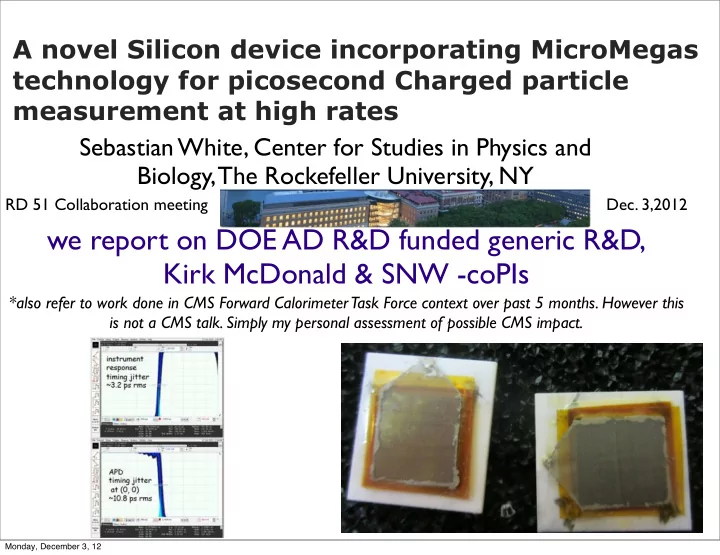
A novel Silicon device incorporating MicroMegas technology for picosecond Charged particle measurement at high rates Sebastian White, Center for Studies in Physics and Biology, The Rockefeller University, NY RD 51 Collaboration meeting


slide-1
SLIDE 1

A novel Silicon device incorporating MicroMegas technology for picosecond Charged particle measurement at high rates Sebastian White, Center for Studies in Physics and Biology, The Rockefeller University, NY

RD 51 Collaboration meeting Dec. 3,2012

we report on DOE AD R&D funded generic R&D, Kirk McDonald & SNW -coPIs

*also refer to work done in CMS Forward Calorimeter Task Force context over past 5 months. However this is not a CMS talk. Simply my personal assessment of possible CMS impact.

Monday, December 3, 12

slide-2
SLIDE 2

Outline

  • Phase II post discovery studies of Higgs

production and related phenomena

  • beyond inclusive measurements-the challenges of

associating tags in high pileup(PU)

  • the role of jet and charged particle/photon timing
  • prior calorimetry timing experience
  • a high rate 11 picosec SPTR photodetector
  • a novel silicon structure incorporating

Micromegas mesh for direct charged particle timing (~12 picosec) at high rates

Monday, December 3, 12

slide-3
SLIDE 3

Phase II unique LHC capabilities

  • CMS will study Higgs couplings through decay

modes and may eventually hand off to ILC for ultimate precision measurements

  • exploration of different production modes is

unique territory of CMS

  • similarly, study in WW scattering up to sqrt(s)~ 2

TeV

  • most interesting production modes involve

detection (and correct association) of a tag

  • challenging to do this in an era of PU~200 !

Monday, December 3, 12

slide-4
SLIDE 4

Tags

  • put aside PYTHIA,

VECBOS, etc. and calculate particle production by composite objects like proton or Pb nucleus

  • seminal 1924 paper by Fermi: “On the Theory of

Collisions between Atoms and Electrically Charged Particles” http://arxiv.org/abs/hep-th/0205086

  • Fermi’s Equivalent Photon Approximation has

been applied to Higgs production in Heavy Ion Collisions-eg:

http://cdsweb.cern.ch/record/325236/files/9705220.pdf

  • and Extended to Equivalent W approximation-ie S.

Dawson, “The Effective W Approximation”, Nucl.Phys. B249 (1985) 42.

Monday, December 3, 12

slide-5
SLIDE 5
  • in 1980’s conceptually similar “equivalent Pomeron

approximation” made popular by Ingleman and Schlein

  • however this concept proved apocryphal by data of

HERA and CDF-”Pomeron flux” is not an attribute

  • f the proton. It depends on probe.
  • much has been learned but qcd is simply more

complex in pp case

  • Nevertheless, if, in future, there is an opportunity for

leading proton acceptance for 126 GeV Higgs (@420m or IP3(Eggert)) CEP could be useful

  • my take is that opportunities not requiring

coherence or exclusive production far more likely Tags (continued)

Monday, December 3, 12

slide-6
SLIDE 6

Tags(continued)-Hard Photoproduction

Higgs Photoproduction calculated (eg in Baltz and Strikman) using equivalent photon approximation (aka Weiszacker-Williams method) “photon flux”--> production cross section--> 2 photon- eg. Higgs @LHC hard photoproduction

  • eg PHENIX J/Psi

Monday, December 3, 12

slide-7
SLIDE 7

tags-Hard Photoproduction

  • the Z4 factor in the cross section makes Heavy Ion

processes more favorable than in pp case

  • also significant advantage in signal-to-noise since

hadronic diffraction backgrounds~A1/3*B1/3

  • naively the tag for these processes would be beam

particles deflected through small angle from the beam

  • however:
  • there is currently no opportunity at the LHC to

access forward protons corresponding to 126 GeV Higgs mass

  • there is never an opportunity to access the beam Pb

ions since rigidity larger and <t> smaller

Monday, December 3, 12

slide-8
SLIDE 8

for these reasons “tags” in photoproduction at the LHC refer to dissociation neutrons @~beam energy soft neutron emmission doesn’t break coherence because Coulomb breakup primarily due to independent

  • pportunistic excitation by other gammas in Weizsacker-

Williams cloud Tags-Hard Photoproduction this was the primary motivation for building ATLAS ZDC

Monday, December 3, 12

slide-9
SLIDE 9

Tags-Hard Photoproduction However: the Higgs photoproduction cross section in Pb-Pb is too small to be practical at LHC multiple event pileup unlikely to become a major issue in PbPb@LHC Nevertheless: useful to discuss ZDC forward neutron tags as an illustrative example but primary topic of this talk is pp->Jet-Higgs-Jet rather than PbPb->neutrons-Higgs-neutrons

Monday, December 3, 12

slide-10
SLIDE 10

Tags-VBF

  • analogous to 2 photon production
  • in W fusion leading baryon->neutron
  • but pay a huge price in form factor

instead we will tag with “forward” jets (central H->gamma-gamma + “tag” jets)

Monday, December 3, 12

slide-11
SLIDE 11

this work is about associating tag to Higgs, in case of previous slide

  • CMS has been successful in retaining key Higgs signatures in

era of PU~25 (with vertexing as primary tool)

  • unlikely to be sustainable in era of HiLum-LHC
  • “We are going to run out of bullets. It’s time to look for

another gun.”-Joel Butler

Monday, December 3, 12

slide-12
SLIDE 12

Model LHC bunch crossing at IP5 as in 2007 paper:"On the Correlation of Subevents in the ATLAS and CMS/Totem Experiments", S.White, http://arxiv.org/abs/0707.1500

computer animations at: http://library.wolfram.com/infocenter/Articles/7716/

as move to larger pseudorapidity, vertexing becomes increasingly

  • difficult. Only timing available for forward neutrons, for example

Monday, December 3, 12

slide-13
SLIDE 13

simulation of bunch crossing with mu=20 how effectively is PU resolved with n(or Jet) ideal time resolution of 10 picosec? Illustrated by error elipse

Monday, December 3, 12

slide-14
SLIDE 14

Fast timing has many potential benefits, aside from pileup rejection

Wigmans et al.

Monday, December 3, 12

slide-15
SLIDE 15

Event timing has a long history in Physics

  • Galilei’s last invention was a more precise clock

to time Astronomical observations

  • CTR Wilson insisted on putting a clock in cloud

chamber photos

  • in spite of events in 2011, it was a good thing to

add timing to OPERA

  • there are many interesting fundamental problems

in physics involving fast timing -eg “Measuring

Propagation Speed of Coulomb Fields”,http://arxiv.org/ pdf/1211.2913.pdf

Monday, December 3, 12

slide-16
SLIDE 16

BNL-Yale built ATLAS ZDC timing(Quartz- Tungsten Shashlik) resolves 400 MHz micro- bunch structure in LHC (only LHC detector to achieve this?) despite reduced bandwidth from low quality cable runs & 40 MSa/s sampling 15,552 tower PHENIX shashlik also used for hadron id via TOF despite low energy deposit of ~0.5 GeV hadrons and TTS in un(longitudinally)-segmented calorimeter

Previous experience with calorimeter timing measurements

Monday, December 3, 12

slide-17
SLIDE 17

What is optimal signal processing?

In a related project (ATLAS ZDC) achieved ~100psec time resolution with 40 MSa/s sampling of a PMT signal:

Very Forward Calorimetry at the LHC - Recent results from ATLAS / White, Sebastian N (Brookhaven)

We present first results from the ATLAS Zero Degree Calorimeters (ZDC) based on 7~TeV pp collision data recorded in 2010. [...] arXiv:1101.2889. - 2011. - 8 p.

Monday, December 3, 12

slide-18
SLIDE 18

!

ATLAS ZDC had severe constraints compared to PHENIX

  • 5 Giga Rad/yr rad dose @ design lum

=200 Watt continuous beam deposition LHC politics vis. LHCf, LUMI... despite constraints

  • > ATLAS is the only imaging

ZDC (x,y,z)

  • n the planet

“ shashlik” /layer sampling hybrid

Monday, December 3, 12

slide-19
SLIDE 19

resulted in Shannon's 1940 PhD thesis at MIT, An Algebra for Theoretical Genetics[6] Victor Shestakov, at Moscow State University, had proposed a theory of electric switches based on Boolean logic a little bit earlier than Shannon, in 1935, but the first publication

  • f Shestakov's result took place in 1941, after the publication of Shannon's thesis.

The theorem is commonly called the Nyquist sampling theorem, and is also known as Nyquist–Shannon–Kotelnikov, Whittaker–Shannon–Kotelnikov, Whittaker– Nyquist–Kotelnikov–Shannon, WKS, etc., sampling theorem, as well as the Cardinal Theorem of Interpolation Theory. It is often referred to as simply the sampling theorem. The theoretical rigor of Shannon's work completely replaced the ad hoc methods that had previously prevailed. Shannon and Turing met every day at teatime in the cafeteria.[8] Turing showed Shannon his seminal 1936 paper that defined what is now known as the "Universal Turing machine"[9][10] which impressed him, as many of its ideas were complementary to his own. He is also considered the co-inventor of the first wearable computer along with Edward O. Thorp.[16] The device was used to improve the odds when playing roulette.

Optimal reconstruction of sparsely sampled ZDC waveforms

Monday, December 3, 12

slide-20
SLIDE 20

ZDC You books about Shannon:

Monday, December 3, 12

slide-21
SLIDE 21

no time to discuss Shannon’s method for getting rich will discuss Shannon’s method for reconstructing digitized waveforms

Monday, December 3, 12

slide-22
SLIDE 22

ZDC ¡waveform: ¡bandwidth ¡limited ¡ by ¡low ¡quality ¡cable ¡

22

=>a ¡sampling ¡frequency ¡of ¡40 ¡or ¡80 ¡Mz ¡is below ¡Shannon-­‑Nyquist ¡frequency ¡(=2*B)

Monday, December 3, 12

slide-23
SLIDE 23

23

Reconstruction of ZDC Pre-Processor Data and its timing Calibration

Soumya Mohapatra, Andrei Poblaguev and Sebastian White Aug.8,2010

ATLAS data set used to develop ZDC reconstruction and do L1calo calibration (in Mathematica 7 .0)

Monday, December 3, 12

slide-24
SLIDE 24

24

Monday, December 3, 12

slide-25
SLIDE 25

25

Monday, December 3, 12

slide-26
SLIDE 26

2-­‑ ¡photon ¡reconstruc@on

26

Monday, December 3, 12

slide-27
SLIDE 27

The ¡Z ¡vertex ¡distribu@on ¡from ¡inner ¡tracker ¡vs. ¡the ¡@me ¡of ¡arrival ¡of ¡showers ¡in ¡ZDC-­‑C ¡rela@ve ¡to ¡the ¡ATLAS ¡ clock ¡calculated ¡from ¡waveform ¡reconstruc@on ¡using ¡Shannon ¡interpola@on ¡of ¡40 ¡MegaSample/sec ¡ATLAS ¡data ¡ (readout ¡via ¡the ¡ATLAS ¡L1calo ¡Pre-­‑processor ¡modules). ¡Typical ¡@me ¡resolu@on ¡is ¡~200 ¡psec ¡per ¡photomul@plier ¡ (see ¡ATL-COM-LUM-2010-022). ¡The ¡two ¡areas ¡outside ¡the ¡main ¡high ¡intensity ¡area ¡are ¡due ¡to ¡satellite ¡bunches. ¡ Note ¡that ¡this ¡plot ¡also ¡provides ¡a ¡more ¡precise ¡calibra@on ¡of ¡the ¡ZDC ¡@ming ¡(here ¡shown ¡using ¡the ¡ZDC ¡@ming ¡ algorithm ¡not ¡corrected ¡for ¡the ¡digi@zer ¡non-­‑linearity ¡discussed ¡in ¡ATL-­‑COM-­‑LUM-­‑2010-­‑027). ¡With ¡the ¡non-­‑ linearity ¡correc@on ¡the ¡upper ¡and ¡lower ¡satellite ¡separa@ons ¡are ¡equalized. ¡

HD0C_Time 12 14 16 18 20 22 24 VertexPositionZ

  • 1000
  • 500

500 1000 1 10

2

10

3

10

4

10 Preliminary ATLAS = 7 TeV data s

Monday, December 3, 12

slide-28
SLIDE 28

Support ¡material ¡for ¡blessing:

"anyone who abandons what is for what should be pursues his downfall rather than his preservation" Niccolo Machiavelli

28

Monday, December 3, 12

slide-29
SLIDE 29

Synchronization of detectors 1km apart to <5 psec is not expensive.

T.Tsang and SNW: design for FP420 (cost ~$60k) State of the art is ~10 femtoseconds using interferometrically stabilized optical fiber

  • see ILC design or

National Ignition Facility

Monday, December 3, 12

slide-30
SLIDE 30

Sensor technology

Monday, December 3, 12

slide-31
SLIDE 31

Deep ¡diffused ¡avalanche ¡photodiode 650 ¡picosecond ¡rise@me ¡(β’s) “A ¡10 ¡picosecond ¡@me ¡of ¡flight ¡detector ¡using ¡APD’s”, ¡SNW ¡et ¡al. Cerenkov ¡Radia@on ¡cone Pre-­‑produc@on ¡Hybrid ¡photodetector

Cerenkov

  • r

APD

  • p@on

Monday, December 3, 12

slide-32
SLIDE 32

32

Applications in eg fluorescence spectroscopy T.Tsang, S.White

risetime=300 psec

Monday, December 3, 12

slide-33
SLIDE 33

11 psec single photon response is not common! Below studies comparing LE, CFD , PicoHarp

similar exercises in literature comparing methods (see eg. Breton, Delanges, Va’vra, et al.) now developing formalism for calculating expected resolution

  • potentially useful for electronics development

Clearly a great substitute for MCP-PMT with 102-103 times the lifetime!

11 ps

Monday, December 3, 12

slide-34
SLIDE 34

a unique feature of ATF beam is 3 picosec bunch length(streak camera) could this be exploited to evaluate fast timing detectors? common technique for secondary beam design is successive dispersion and collimation this requires real estate

Testbeams used to characterize APD based timing detector

1.Single electron project at ATF 2.PSI (~200 MeV muons and electrons) 3.Frascati BTF <500 MeV electrons, tertiary beam from DAFNE Linac rates calculated based on Hofstadter’s data

Monday, December 3, 12

slide-35
SLIDE 35

Vitaly Kirk, Thomas, Misha

Monday, December 3, 12

slide-36
SLIDE 36

the beamline

36

Monday, December 3, 12

slide-37
SLIDE 37

Target IN 20 cm Target IN 40 cm Target IN 20 cm, 6 mm Pb Target OUT 20 cm

Monday, December 3, 12

slide-38
SLIDE 38

38

Gain Curve for APDs used in Frascati/PSI

Monday, December 3, 12

slide-39
SLIDE 39

In fall 2011 (in Crispin’s lab) at CERN focused on getting fastest possible signal from apd. Low noise, fast amplifiers, LRS 6 GHz, 40 GSa/s scope, etc.

help from Crispin Williams, Fritz Caspers,Christian Joram, Iouri Musienko, Philippe Farthouat, Xavier Boissier...

Monday, December 3, 12

slide-40
SLIDE 40

with higher BW amplifiers (ie 3GHz $70 ones from min-circuits) reduced risetime to 0.5nsec).Noise is DAQ limited (scope noise floor).

Monday, December 3, 12

slide-41
SLIDE 41

PSI testbeam team:

Monday, December 3, 12

slide-42
SLIDE 42
  • testbeam results (all with 8x8mm APDs) and beta

source tests (mostly using 2x2mm APDs) gave inconsistent results which we attributed to lack of tracking information and potential for position dependence of timing performance. This has held up publication of results- particularly under the DOE ADR&D project.

  • In late August 2012 started tests with a femtosec
  • laser. At ~1000nm and with proper intensity this is

excellent model for MIP signal formation. Advantage

  • f good localization (to <20 microm) and laser

timing signal (to beter than 2 picosec).

Monday, December 3, 12

slide-43
SLIDE 43

RMD APD monochromator for IR wavelength selection IR spectrometer Femtosecond Ti:sapphire laser oscillator white light supercontinuum generation from photonic crystal fiber

  • ptical

power meter

Experimental set-up for femtosecond laser tests

send IR beam directly from φ=0.6 mm optical fiber directly onto the APD both separated by <5 mm.

Monday, December 3, 12

slide-44
SLIDE 44

August 24, 2012 APD timimg jitter on Agilent DSO91304A 13 GHz oscilloscope

Laser wavelength: 1000 nm, ~ 2 µW Trigger: ET2010 photodiode, tr=120 ps Signal: RMD APD + Ortec 9306 preamp HV bias on APD -1.85 kV pulse amplitude timing jitter

timing jitter trms=8.28 ps

( this is a relatively high bias- near Top of range. At lower bias (1.75 kV) Jitter is 9.8 psec.) Nb: these are raw distributions from LE timing, no signal processing, baseline Restoration or post-analysis.

Monday, December 3, 12

slide-45
SLIDE 45

Spatial response map of RMD APD RMD data

  • T. Tsang data, Inst. Div.
  • Sept. 12, 2012

Laser pulse width 3 µs to ~fs

Monday, December 3, 12

slide-46
SLIDE 46

9.6 mm guard ring box

  • H.V.

Sept 26, 2012 RMD APD 8x8 mm2

Spatial response map

APD bias at -1750 volt, 850 nm laser laser focus spot size <100 µm

~3 µs pulse, 1 kHz, 8.5x10⁷ photons/pulse

5

  • 5
  • 5

5 x-positon (mm) y-position (mm) 50 100 signal (mV)

x-position y-position APD active area is larger than 8x8 mm2 ? APD signal amplitude has good spatial uniformity with long duration light pulses

marking

  • n the back

Monday, December 3, 12

slide-47
SLIDE 47

guard ring box

  • H.V.

Sept 26, 2012 RMD APD 8x8 mm2

Spatial response map

APD bias at -1750 volt, 850 nm laser laser focus spot size <100 µm

~3 ns pulse, 1 kHz, 2.5x10⁵ photons/pulse

(1-σ noise ~7.7x10³ photons)

5

  • 5
  • 5

5 x-positon (mm) y-position (mm) 25 50 signal (mV)

x-position y-position

9.6 mm

APD signal amplitude does not has good spatial uniformity with ns short light pulses

Here too there is clearly an issue with metalization!

Monday, December 3, 12

slide-48
SLIDE 48
  • Oct. 2nd message from Dick Farrell, Director
  • f APD Research at RMD, Dynasil:

“Hello All, I promised Sebastian that I would let him know if we saw anything interesting. We don't yet have the APD coated with 50 Angstrom Al , but yesterday I applied a band of Indium around the top edge of an '8X8mm'

  • device. This device had previously had Indium applied to its 7X7mm n+ back contact, but when tested it

showed the same nonuniform response to short laser pulses as had shown up in Thomas' data. When re- tested after the Indium band was applied around the top surface, however, there was a marked improvement in the uniformity of response across the exposed area using 2ns pulses from a 980nm laser. Looking at the scope, we could discern no variation in pulse amplitude across the APD area. My best guess, based on this result, is that.......”

=>Very realistic expectation that we will have in hand 8x8 mm APDs which do not show position variation and will be fully characterized with femtosecond laser tests. =>This greatly simplifies upcoming beam tests at T10, since tracking will be unnecessary.

Monday, December 3, 12

slide-49
SLIDE 49

Plans for coming months concerning APD (charged particle)timing R&D

  • we are in productive close contact with RMD APD

development activities and are jointly submitting a related SBIR

  • for completeness, also in close contact with Hamamatsu

concerning limits of their (thin) APD technology

  • have applied for testbeam scheduling in Oct-Nov at PS
  • longstanding discussion with TOTEM technical

coordination about an LHC exposure in Jan-Feb 2013

*partial list of collaborators can be found in Kirk’s web area- ie: http://puhep1.princeton.edu/~mcdonald/LHC/White/ATF_proposal_final_k.pdf

Monday, December 3, 12

slide-50
SLIDE 50

Monday, December 3, 12

slide-51
SLIDE 51

an earlier device w. mesh femtosecond laser and Vecsel used to characterize uniformity

Monday, December 3, 12

slide-52
SLIDE 52

Picture ¡show

52

Monday, December 3, 12

slide-53
SLIDE 53

53

Monday, December 3, 12

slide-54
SLIDE 54

54

PSI ¡beam ¡test 10 ¡PM, ¡(2011)Dec. ¡1-­‑>7 ¡AM, ¡Dec. ¡2 170 ¡MeV ¡nega@ve ¡beam hadrons ¡suppressed ¡with ¡absorber

me, ¡Konrad ¡and ¡Michele setup ¡in ¡the ¡beam

Monday, December 3, 12

slide-55
SLIDE 55

2012 ¡TB ¡in ¡RD52 ¡(ended ¡this ¡ morning) ¡and ¡PS ¡for ¡next ¡2 ¡weeks

55

Monday, December 3, 12

slide-56
SLIDE 56
  • we ¡are ¡currently ¡in ¡CERN ¡testbeams ¡through ¡end ¡
  • f ¡season
  • work ¡con@nuing ¡in ¡context ¡of ¡CMS ¡Forward ¡

Calorimeter ¡Task ¡Force

  • CMS ¡generic ¡R&D ¡commiiee ¡considering ¡

proposal ¡on ¡sensor ¡development

  • discussions ¡ongoing ¡about ¡merging ¡with ¡exis@ng ¡

R&D ¡collab ¡at ¡CERN ¡-­‑possibly ¡RD52

56

Plans

Monday, December 3, 12

slide-57
SLIDE 57

Principal ¡Authors

57

To: Richard Farrell <RFarrell@rmdinc.com> Cc: Sebastian White <swhite@rockefeller.edu>, "Tsang, Thomas Y" <tsang@bnl.gov>, Kirk T McDonald <kirkmcd@Princeton.EDU>, Sebastian White <swhite@rockefeller.edu>, Changguo Lu <changguo@Princeton.EDU>, Mickel McClish <MMcclish@rmdinc.com>, Rick Myers <RMyers@rmdinc.com>

thanks ¡to:

Crispin ¡Williams,Raman ¡Zuyeuski, ¡Iouri ¡Musienko, ¡Markus ¡Joos, ¡Fritz ¡Caspers, ¡Konrad ¡ Dieters,Philippe ¡Farthouat, ¡Henry ¡Frisch, ¡Chris@an ¡Joram, ¡Walter ¡Snoeys, ¡Michele ¡ Gallinaro, ¡Stefano ¡Miscel

Monday, December 3, 12