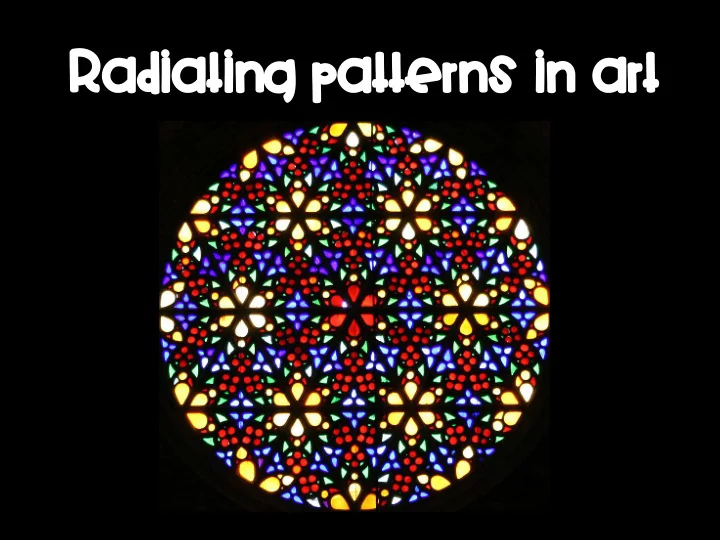
SLIDE 1
SLIDE 2 Balance in art refers to the arrangement of elements or objects in an artwork so that they seem equal in weight or importance. We get 3 different types of balance in art: Symmetrical:
- ne side is a mirror image of the
- ther
Asymmetrical:
Two sides are not identical but are arranged so their weight is equal
Radial:
Elements are evenly spaced around a central point
SLIDE 3
Radial design or a radiating pattern is one of the basic ways to organize visual material, by arranging it around a central point. For centuries radial design has been used in architecture and art by peoples from many different cultures around the world.
Charger of Charles II in the Boscobel Oak England, circa 1685 Common visigothic decoration. Archaeological crypt in Valencia Cathedral, 6–7th century
SLIDE 4
France, Notre-Dame de Paris (1250–1260). Merovingian illumination in Missale Gothicum, towards 700.
SLIDE 5
Flamboyant – Meaux Cathedral, France
SLIDE 6
Sweden, Oscar Frediks Church.
SLIDE 7
Mandalas are also examples of radial balance.
The Aztec Sun Stone as an amate print Vishnu Mandala (Traditionally found in Nepal)
SLIDE 8
Mandalas are also examples of radial balance.
Mandalas have become popular today for colouring as relaxation. Peace Mandala Sky Top View
SLIDE 9
More modern artists also make use of radiating patterns and radial symmetry in their art. Do you notice how these images have a number of different interwoven radial patterns?
MC Escher often incorporated radiating patterns and radial design in his tessellating patterns.
SLIDE 10
Look at how natural objects from the environment can be used to create radiating patterns. This type of art is called land art and was created by artist Andy Goldsworthy.
SLIDE 11
This painting by Robert Delauney is an example of radial balance, yet it does not show a radiating pattern or design. The balance is created by use of different colours and shapes which are composed around a central point with a few radiating lines to create the balance.
SLIDE 12 Now it is your turn. Look at the pdf ‘Radiating patterns’ and select at least one of the
- activities. These activities have been varied to account for the fact that many of you may
not have a vast array of art media at home. There is ‘something for everyone’ included…using media from leaves from your garden to recyclables, paper and pencil to fancy art media. If you are really stuck and cannot find anything that suits you do not hesitate to email me. I am more than happy to help you find a way of completing one of the activities. mwalker@collegiate.co.za You will need to send me a photo of your completed artwork (and please save the actual piece if you are able to to bring to school when we return). Happy creating!!