We are in challenging fiscal times and it appears that the 18 - - PDF document

we are in challenging fiscal times and it appears that the
SMART_READER_LITE
LIVE PREVIEW

We are in challenging fiscal times and it appears that the 18 - - PDF document

9/18/2015 We are in challenging fiscal times and it appears that the 18 August 2015 situation will become T. Bart Quimby Academic Planning Facilitator increasingly challenging in Professor Emeritus, Civil Engineering 2015 ACADEMIC PLANNING


slide-1
SLIDE 1

9/18/2015 1

2015 ACADEMIC PLANNING DOCUMENT

18 August 2015

  • T. Bart Quimby

Academic Planning Facilitator Professor Emeritus, Civil Engineering

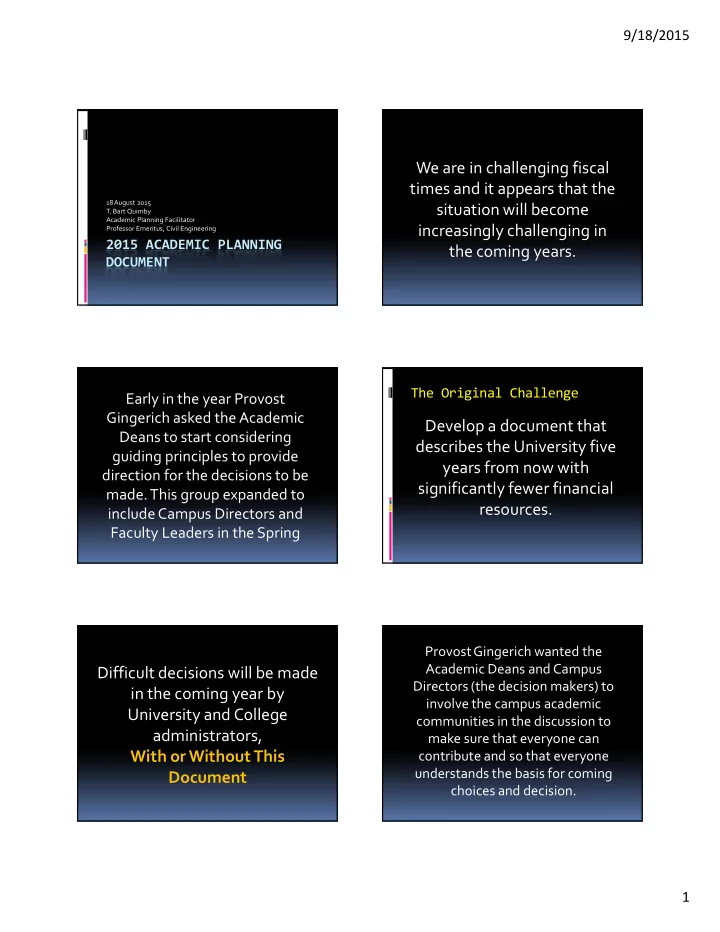
We are in challenging fiscal times and it appears that the situation will become increasingly challenging in the coming years.

Early in the year Provost Gingerich asked the Academic Deans to start considering guiding principles to provide direction for the decisions to be

  • made. This group expanded to

include Campus Directors and Faculty Leaders in the Spring

The Original Challenge

Develop a document that describes the University five years from now with significantly fewer financial resources. Difficult decisions will be made in the coming year by University and College administrators, With or Without This Document

Provost Gingerich wanted the Academic Deans and Campus Directors (the decision makers) to involve the campus academic communities in the discussion to make sure that everyone can contribute and so that everyone understands the basis for coming choices and decision.

slide-2
SLIDE 2

9/18/2015 2

Time Line

Early 2015: Initial Discussions by Academic Deans Spring and Summer 2015: Campus Directors and Faculty Governance Leaders brought in to the discussion Early Fall 2015: Discussion taken to the Colleges and Community Campuses October 2015: Discussion in the Faculty Senate Mid October 2015: “Finalize” the document

The current version of the resulting document is titled:

Guidance for Academic Decisions in Climate of Declining Budgets, AY2016-17

Preamble “The purpose of this document is to provide UAA with a coherent rationale for making the difficult resource decisions required during a time of decreased funding. These decisions must be driven by UAA’s academic mission and by the need to continually invest in strategic

  • initiatives. These academic decisions will

determine shifts in support and service areas.”

Document Basis

UAA Mission UAA 2017 Strategic Plan Shaping Alaska’s Future UAA Core Accreditation Themes Anchorage Campus Prioritization College and Campus Missions National trends in higher education Local and Regional workforce demands Cultural and Economic landscape of SouthcentralAlaska

Implementation of UAA Mission

To implement its mission, the University of Alaska Anchorage: 1. Prepares students to be:

  • Proficient in 21st century skills (literacy, numeracy, collaboration,

problem solving/critical thinking, cultural competence),

  • Employees with the technical and employability skills needed by

Alaskan industries,

  • Professionals ready for employment, licensure, advancement and

leadership in Alaskan business, industry, non-profit, and governmental agencies in Alaska, and

  • Educated, active, and engaged citizens.

2. Strengthens the institution to be a:

  • Center for research, scholarship, and creative activity,
  • Cultural hub of Southcentral Alaska and the state,
  • Leader in Alaska’s developing role in the Arctic, and
  • Leader to support the work of the state.

Institutional Core Themes

  • 1. Teaching and Learning
  • 2. Research, Scholarship, and

Creative Activity

  • 3. Student Success
  • 4. UAA Community
  • 5. Public Square
slide-3
SLIDE 3

9/18/2015 3

Emphasis Areas Arctic Issues Indigenous Cultures Sustainable Communities,

Environments, & Economies

Local, Regional, &

International Location

Program Areas Health Sciences Professional Programs Career & Technical Education Liberal Arts & Sciences Additional Considerations Mission Alignment Student Demand State Priorities Unit Specific Considerations

  • 1. Provide access to higher education,
  • 2. Support certificate or degree programs,
  • 3. Produce research, scholarship, and/or

creative work,

  • 4. Attract internal and external partners that

enhance program offerings and student learning, and

  • 5. Create active, engaged, and well-rounded

citizens prepared for the 21st century.

What Can You Do To Help?

Review the document and tell us Does this document outline processes that are built from the Institutional Core Themes and the other planning documents listed? How so? How do you think that this document will be effective in guiding decisions? Are the Focus Areas identified in the best interest of the University and the people we serve? Do they need alteration? If so, how?

What Can You Do To Help?

Does this document adequately focus

the direction of the institution? Why?

Will this document will be effective in

guiding decisions? If not, what can be done to sharpen the focus?

Do you have other comments?