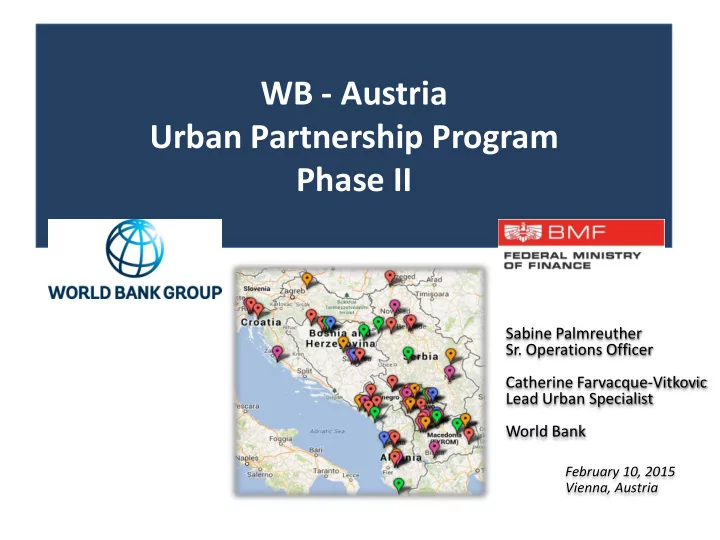
SLIDE 1 WB - Austria Urban Partnership Program Phase II
February 10, 2015 Vienna, Austria
Sabine Palmreuther
Catherine Farvacque-Vitkovic Lead Urban Specialist World Bank
SLIDE 2 Strengthening Local Government Capacity in South-East Europe Professionalization of LG officials Practical tools for city leaders
Addressing the Demand Priority issues identified and vetted with clients and partners
- Municipal finance
- Urban planning and land management
- Municipal service delivery (i.e. SWM)
- Urban governance/Anti-corruption
- Social Accountability
SLIDE 3
Strengthening Local Government Capacity in SEE: WB - Austria UPP Where We Work in South-East Europe
SLIDE 4 OVERARCHING GOAL More livable and sustainable cities in South East Europe that provide a high quality of life for the citizens OBJECTIVES
Support cities and local governments in South East Europe in a process
- f modernization and reform, in order to promote local development
for inclusive and sustainable growth, and enhanced urban governance Foster effective, responsive and participatory city owned strategies to address problems of corruption, urban land development, and revenue management Supporting commitment of municipal champions to find innovative solutions to transform their cities Support urban development towards greater accountability and transparency of local governments in meeting citizen demands for services
Strengthening Local Government Capacity in South-East Europe
SLIDE 5 Content
E-learning
- Global curriculum: World Bank e-Institute
- Regional/local Partners: NALAS, LGAs
E-Institute Wholesale partners
DIALOGUES
City to City Dialogues
- Municipal finances
- Urban planning & land management
In depth engagement
- LGs engage in self-assessments (by
using different tools), and use the information for benchmarking/ monitoring, and public dialogue with citizens
- Anti-corruption capacity building
- Social Accountability Initiative
- Coalition building
Strengthening Capacities of Local Governments in SEE How it all comes together
SLIDE 6 WB urban curriculum: With an Edge…
URBAN PLANNING AND LAND MANAGEMENT PUBLIC SAFETY AND RESILIENCY EFFICIENT & INCLUSIVE SERVICE DELIVERY MUNICIPAL FINANCE AND GOVERNANCE
*Sustainable Urban Land Use Planning *City Mapping for Municipal Management *Municipal Finances: A Learning Program for Local Govts *City Leadership for Mayors *Municipal Self- Assessments *Upgrading Informal Settlements *Water Utility Reform *Integrated Urban Transport Planning *Urban Crime and Violence Prevention *Introduction to Disaster Risk Management *Safe and Resilient Cities
E-learning curriculum delivered under the World Bank’s E-Institute
- ffered to a number of local government officials and urban
practitioners in SEE (i.e. Sustainable Urban Land Use Planning, City Mapping for Municipal Management, Municipal Finances) Partner organizations instrumental in disseminating information about the learning programs and mobilizing a critical mass of participants, a key ingredient for sustainability NALAS and LGAs translating and customizing e-learning curriculum to local languages, to serve as wholesalers in SEE
SLIDE 7
Accountability - to promote financial self-assessment as part of the change management process of local administration Transparency - to help LG share information with other LGs, and to inform central government, LG Association and citizens about their situation (open data) Prioritization - to encourage municipal financial and technical departments (asset management, urban planning, strategic planning, mayor’s office) to work together on strategic and capital investment planning anchored in financial realism Efficiency - to monitor and act on a set of key actions aiming at improving mobilization of local resources, rationalization public expenditures and improving financial management practices Access to external funding - to share common methodologies and international indicators and facilitate negotiations with banking institutions and external donors
MFSA Objectives
SLIDE 8 MFSA 2011-2013
Date Title Activities
December 2011 Budapest, Hungary Improving Municipal revenues Presentation of the MFSA’s objectives and methodology May 2012 Mavrovo, Macedonia Modernizing Local Public Expenditure Management Sharing of the MFSA preliminary findings June 2012 Tirana, Albania Modernizing Legal and Regulatory Framework for Urban Planning in SEE November 2012 Budva, Montenegro Guided Urban Development: Reconciling Public and Private Interests Group discussion on the link between municipal finance and urban development January 2013 Vienna, Austria Towards Greater Transparency and Accountability: A Mayor’s Dialogue Group discussion on the link between municipal finance and urban development June 2013 Dubrovnik, Croatia From Local Government Self- Assessment to Implementation Group discussions on investment budgeting. December 2013 Skopje, Macedonia From MFSA to Municipal Investment Programming Discussion about the link between Urban Audit and MFSA
SLIDE 9
25 Cities/Municipalities of the Region actively contributed to the experience (ranging from small municipalities to capital cities) 15 Cities/Municipalities successfully prepared Financial Improvement Plan based on MFSA 13 Cities/Municipalities presented their data profiles in MFSA brochure More municipalities are ready to engage
MFSA Outcomes
SLIDE 10
SLIDE 11
Summarize through key data the institutional/administrative situation of the city, its demo-eco position and the main urban development issues
Step 1: Provide your City profile
SLIDE 12 Step 3: Financial position
Assess:
growth savings and
- perating surplus
- To promote Capital
Investment effort
worthiness
SLIDE 13 Step 5: Performance measurement through Ratio analysis
Stock ratios
- Credit worthiness
- Indebtedness
- Fiscal autonomy
- Capital investment effort
- Level of services
- etc.
Flow ratio: Margin ratio Comparison ratios: based on revenues and expenditures items Benchmarks: To base on country specificities (national database ?)
SLIDE 14 Step 6: Financial projections
- The 5Y financial projections are performed with the
- bjective to measure impact of decisions on finance
capacity and credit worthiness
- The main condition is to start with reliable and relevant
historical data and formalize through assumptions the impact of policy decisions (expenses, borrowing, tax pressure, etc. )
- Usually, several assumptions and scenarios are tested :
past trends projections and projections on the basis of significant changes.
SLIDE 15 Step 8: Municipal Finance Improvement Plan
The objective is to translate lessons learnt from the different steps
actions to be implemented by the municipality to improve its financial situation and its financial management. Actions that are not under full control of LGs can be mentioned if they are part
- f State reforms currently
under discussion or if they are included in the current agenda of National Associations of Local Governments.
SLIDE 16
MFSA Brochure
SLIDE 17
Integration of MFSA and UA
SLIDE 18
Urban Audit
SLIDE 19
Urban Audit Framework
SLIDE 20
Urban Audit – Regional context
SLIDE 21
Urban Audit – Urban setting and Organization of the City
SLIDE 22
Urban Audit – Urban setting and Organization of the City
SLIDE 23
Urban Audit – Urban setting and Organization of the City
SLIDE 24
Urban Audit – Urban setting and Organization of the City
SLIDE 25
Urban Audit – Population trends and projections
SLIDE 26
Urban Audit – Urban Economy
SLIDE 27
Urban Audit – Urban Services (Infrastructure)
SLIDE 28 Urban Audit
Table 7 - Municipal Assets
SLIDE 29
Urban Audit – Urban Servises (ISPI tables)
SLIDE 30
Urban Audit – Urban Services (ISPI as database)
SLIDE 31
Urban Audit – Deficiencies and Needs
SLIDE 32
Urban Audit – Proposed projects presentation
SLIDE 33
Urban Audit – Criteria selection and validation
SLIDE 34
SLIDE 35
- Integrate Municipal Finances Self-Assessment (MFSA); Land
Use and Urban Planning Self-Assessment (UPSA); Urban Audit (UA); Social Audit (SA): Municipal Programs Investments+ capacity building
- Response to Flooding crisis: (1) exposure to fundamentals of
DRM (e-course); (2) CoP on urban floods; (3) Local resilience Diagnostics.
- Foster central-local government dialogue for improved policy
making: strengthen the dialogue between local governments, national associations of local authorities, and ministries.
UPP II: Strengthening Local Government Capacity in South-East Europe
Areas of Focus
SLIDE 36
Thank you! For more information: www.seecities.eu tnikolic@worldbank.org