Water Survey Summary Urban water, resources and risks Burkina India - - PowerPoint PPT Presentation

water survey summary
SMART_READER_LITE
LIVE PREVIEW

Water Survey Summary Urban water, resources and risks Burkina India - - PowerPoint PPT Presentation

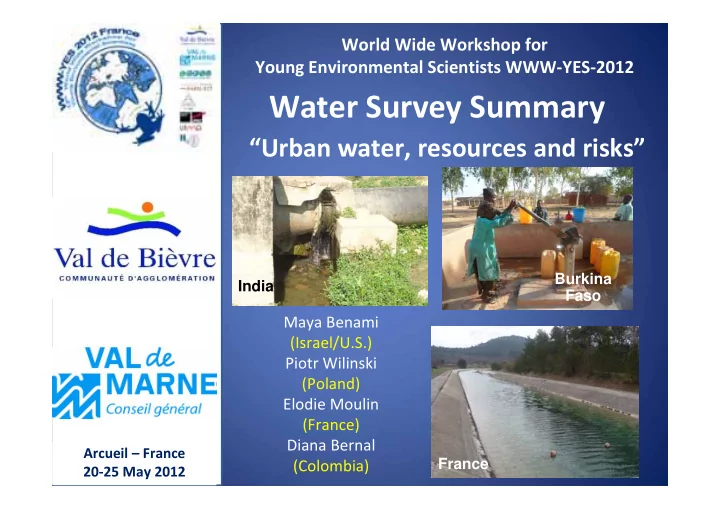
World Wide Workshop for Young Environmental Scientists WWW YES 2012 Water Survey Summary Urban water, resources and risks Burkina India Faso Maya Benami France (Israel/U.S.) Piotr Wilinski (Poland) Elodie Moulin (France) Diana


slide-1
SLIDE 1

World Wide Workshop for Young Environmental Scientists WWW‐YES‐2012

Water Survey Summary

Maya Benami (Israel/U.S.) Piotr Wilinski (Poland) Elodie Moulin (France) Diana Bernal (Colombia)

Arcueil – France 20‐25 May 2012

“Urban water, resources and risks”

India Burkina Faso France France

slide-2
SLIDE 2

WWW-YES 2009-2012 – Participants and surveyed cities

Teheran - Iran

WWW-YES 2009 – 2012 in numbers

  • 84 cities surveys (>50 countries,

5 continents)

  • Inhabitants from 435 Ikare – to

17 500 000 Cairo

slide-3
SLIDE 3

Water resources

Fada N’Gourma – Burkina Faso Lullea – Sweden

Survey 2009-2012 - Curiosities 40% rain water – Singapore Ibadan (Nigeria) – only 22% demand of water fullfilled

Zahle - Lebanon

slide-4
SLIDE 4

Water resources – 2012

”Uses 100% desalinated seawater from the sea and groundwater” – Maya Benami Israel, Eilat City Surface water from Malaysia, rain water from Singapore, sea water, treated wastewater

  • Singapore

Lucknow - India Sidney - They use : Dams + Recycling + Desalination + Water efficiency = Water 4 life.”

Plant in Eilat

slide-5
SLIDE 5

Water distribution

Years 2009 - 2012

  • Lucknow, India – water supplied

2h/d

  • Buga, Colombia -38% water loss in

distribution system (decresed during last 10 years from 43%)

  • Europe– people started collect

rainwater for watering

  • Cairo, Egypt – some people stay in

queue to get the access to public wells

  • Lebanon – 79% people connected

to the network (41% Hermel, 93% Beirut)

  • Ziguinchor, Senegal – water

becomes saltier because of drought

slide-6
SLIDE 6

Company or institution delivering the water Italy-Cagliari-Drinking-water-plant-of-Corongiu-Foddis

> 100 years 100 years<y<50 years 50 years<y<10 years < 10 years 24% 23% 42% 11% Start of water delivery (all years)

slide-7
SLIDE 7

Water price (€/m3)

Europe 0.65 – 3.9 Median : 2.3 North America 0 – 0.4 Median : 0.25 Africa 0.07 – 46 Median : 0.45 Asia 0 – 5 Median : 0.13 Central and South America 0.12 – 2.6 Median : 0.51

slide-8
SLIDE 8

Percentage of household income spent for water

0.8% - 5% 0.5% – 25% 4% 0.3% - 2% 0.6%

Minimun Maximun Africa El Hencha (Tunisia) Bizerte (Tunisia) Asia Nagpur (India) 22,5 (Tajikistan) Europe Marseille (France) Lyon (France)

slide-9
SLIDE 9

Key problems of drinking water ‐ 2012

Discontinuity of delivery Distance between source and household Water quality and sanity Water price Bizerte (Tunisia) Lucknow (India) Nagpur (India) Ikare, Ondo State (Nigeria) Dushanbe (Tajikistan) Lucknow (India) Tehran (Iran) Ikare, Ondo State (Nigeria) Dushanbe (Tajikistan) Lucknow (India) Shoushtar (Iran) Lucknow (India) Marseille (France)

Others problems:

  • Buga (Colombia) – Losses in distribution system
  • Eilat (Isarael), Nagpur (India) - Leaks in the piping
  • Tehran (Iran) – Nitrate problems
slide-10
SLIDE 10

COKE BOTTLE (€/L) / AVERAGE WATER PRICE (€/L)

300 - 1000 500 - 3000

300

2000 1000 – 300000 (Tajikistan)

slide-11
SLIDE 11

Water Price and Other Key Water Problems

  • Over the years the

average participant stated on a scale of 0‐3 a 1.1, indicating that the water price is not a major problem (yet).

  • Except in places such as

France and Israel (stated from 2012 participants)

  • However, 2012 participants

report problems with:

  • Nitrate contamination (Iran)
  • Contaminated groundwater

(India)

  • Water losses during

distribution (Columbia and Israel)

slide-12
SLIDE 12

Opinion of Participants on water privatization: “should water be public?”

  • Reasons for public
  • wnership:
  • Water is a common good
  • Social equity
  • Control of water price
  • Control of corruption
  • Guarantee of safe drinking water
  • Control of corruption

transparency of management Year Private Public 2009‐2012 22% 78%

For those who say “privatize!”: Case Studies on water privatization: Cochabamba, Bolivia; the Thatcher regime in the UK, and South Africa. For those who say “keep it public”: ask yourselves why to privatize in the first place, i.e., governments need money, companies can provide better services?
slide-13
SLIDE 13

Question: Should citizens be involved in w ater m anagem ent?

Year Yes No 2009‐2012 42% 58% Year Yes No 2009‐2012 93.4% 6.6%

Question: Should drinking w ater be free? Quote from Ahmed Al-Rubaei from Iraq, who thinks that drinking water should not be free because: “Water is too valuable, so it should not be free to reduce the loss of water and also to conserve it.”

slide-14
SLIDE 14

Women involved in housework (water acquisition in particular)

Women’s % importance in water acquisition 2012 Participant country home 100 % Nigeria Burkin a Faso India (2) 4 Tunisia Iran Poland 3 France 2 Tunisia Iran Iran 1 Tajikistan Colum bia Israel

Less than 50% More than 50% From Temitope Oyedotun, Nigeria: “Women are the ones going to fetch the water - it is generally viewed as a woman’s role in the city“

slide-15
SLIDE 15

Type 2 0 0 9 -2 0 1 2 Men W om en W ater Delivery Director 9 6 % 4 % Local Service Director 9 6 % 4 %

Mary Drikas - the water industry in Australia. From Mukta Chandel, India: “There is a need to consider why the gender issues exist: women and men both have different priorities for water.”

slide-16
SLIDE 16

CONCLUSIONS

84 cities surveys (>50 countries, 6 continents) Water Resources: Dams/lakes, groundwater, sea, river, rainwater Water Delivery: mostly publicly owned Water price: 0 (Montreal) - 2 (Paris) - 46 Euros/m3 Percentage of household income spent for water : 0.3% in Europe

and 25% in Tajikistan

Key water problems – Discontinuity of delivery, water quality and

sanity and water price

Should water be public? Gender issues Population + Price + Scarcity + Sewage/Sanitation Merci !!