
SLIDE 1
Water Security in a Changing World
Kevin Rumsey, M.A., M.Sc
Sustaineo Blue Water Consulting
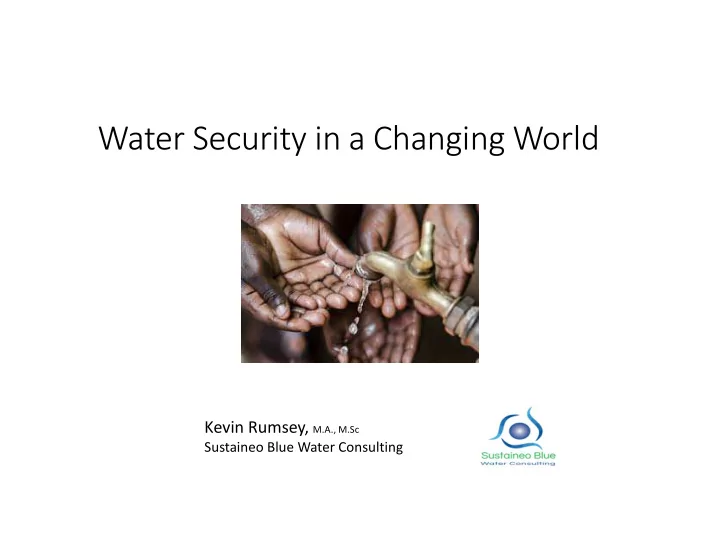
Water Security in a Changing World Kevin Rumsey, M.A., M.Sc - - PowerPoint PPT Presentation
Water Security in a Changing World Kevin Rumsey, M.A., M.Sc Sustaineo Blue Water Consulting Outline https://www.raconteur.net/sustainability/worldwide-water-crisis-is-looming Water Security defined as: The capacity of a population to
Kevin Rumsey, M.A., M.Sc
Sustaineo Blue Water Consulting
https://www.raconteur.net/sustainability/worldwide-water-crisis-is-looming
“The capacity of a population to safeguard sustainable access to adequate quantities of and acceptable quality water for sustaining livelihoods, human well-being water for sustaining livelihoods, human well-being and socio-economic development. In addition, protection against water-borne pollution, water- related disasters and for preserving ecosystems in a climate of peace and political stability.” - UN (2013)
http://www.unwater.org/publications/water-security-global-water-agenda/
https://www.weforum.org/agenda/2016/02/4-billion-people-face-severe-water-scarcity-at-least-for-one-month-every-year/
https://www.co2.earth/
https://www.esrl.noaa.gov/gmd/ccgg/trends_ch4/
https://water.usgs.gov/edu/earthhowmuch.html
https://slideplayer.com/slide/1519972/
https://boingboing.net/2008/03/11/all-the-water-and-ai.html
safely managed drinking water
untreated/un-reused.
sanitation facilities
from waterborne diseases.
scarcity
(263) have no cooperative agreements.
agriculture
low level flooding (16%)
http://wedocs.unep.org/bitstream/handle/20.500.11822/19524/UNEP_WWQA_report_03052016.pdf?isAllowed=y& sequence=1
will, corruption, low institutional capacity
sea harvesting
Ed McBean, Ph.D, P.Eng Canada Research Chair in Water Supply Security
“…we’re moving towards increasing water scarcity – despite Canada’s theoretical abundance – this is probably the biggest looming problem for Canada
David Schindler, Professor Emeritus University of Alberta
problem for Canada”
https://www.theglobeandmail.com/news/national/canada-fresh-water-review-1/article35262579/
http://www.waterpolitics.com/2012/08/30/global-water-demand-by-2050/
https://www.weforum.org/agenda/2016/02/4-billion-people-face-severe-water-scarcity-at-least-for-one-month-every-year/
https://www.weforum.org/agenda/2016/02/4-billion-people-face-severe-water-scarcity-at-least-for-one-month-every-year/
http://watergovernance.sites.olt.ubc.ca/files/2010/04/FS_Myth_of_Water_Abundance.pdf
http://assets.wwf.ca/downloads/WWF_Watershed_Reports_Summit_FINAL_web.pdf?_ga=2.247247181.891394252.1497266572- 984777005.1497266572
http://www.cbc.ca/news/technology/vancouver-water-shortage-climate-snowpack-conservation-1.4562900
warming in all seasons, with increased precipitation in winter, spring and fall, in most watersheds, spring and fall, in most watersheds, expect for the interior;
in Spring, yet with lower flows in the late summer/fall.
supply for hydro-electric power in the Province.
https://www.bchydro.com/content/dam/hydro/medialib/internet/documents/ab
Temp increases up by 2.7 C.
hampered by droughts
infectious diseases, species die Increase in Average Annual Rainfall by up to 12% in some regions, with hot dry summers.
infectious diseases, species die
functioning
storms causing damage to buildings and infrastructure.
soil erosion
https://www2.gov.bc.ca/gov/content/environment/climate-change/adaptation/impacts
By 2100, up to 70% of BC glaciers disappeared
temperature affecting fish habitat
Sea level rise along coast
experience more frequent and severe flooding temperature affecting fish habitat and hydroelectric power generation
and quantity
competition between various water users. flooding
systems, and seawater intruding into groundwater aquifers
too saline for cultivation
https://www2.gov.bc.ca/gov/content/environment/climate-change/adaptation/impacts
https://www.freshwateralliance.ca/bc_drought_message_guide
define British Columbia’s future.
conditions in the fall 2017 and 1/5 of all provincial observation wells conditions in the fall 2017 and 1/5 of all provincial observation wells showed moderate to large rates of decline.
undervalues the services and benefits of freshwater. Nestle pays $2.25 for a 1 Million L’s of water -- almost as much as they charge for 1L of bottled water.
https://www.freshwateralliance.ca/bc_drought_message_guide
Requires integration of social, economic and ecological components
methodologies/thinking
chemical
growth
consideration, community engagement to influence decisions. …business as usual
integrity.
multidisciplinary
infrastructure
consultation and political review. Uses an Integration approach- multidisciplinary
resilience
watershed level
consultation and political review.
specific
ttps://poliswaterproject.org/polis-research-publication/new- path-water-sustainability-town-oliver-bc-soft-path-case-study
https://poliswaterproject.org/
http://www.cwn-rce.ca/focus-areas/blue-cities/canadian-municipal-water-priorities-report/
http://www.cwn-rce.ca/focus-areas/blue-cities/canadian-municipal-water-priorities-report/
https://www.rdn.bc.ca/drinking-water-and-watershed-protection
improve understanding.
management plans.
improve understanding.
and incentive programs.
nongovernment organizations.
groundwater sources and to protect the "recharge areas"
) “A land development approach that is more holistic, integrated and works with nature to manage the impacts of stormwater in accordance with simple principles”. a) keep water close to source, b) preserve landscape features, b) preserve landscape features, c) minimize imperviousness, d) create functional and appealing drainage, e) reduce area of the build up, f) promote natural movement of water, and g) protect ecological and hydrologic functionality.”
https://www.epa.gov/sites/production/files/2015-09/documents/bbfs2terms.pdf
https://www.vancouverconventioncentre.com/news/media-release-annual- mowing-of-living-roof
http://www.sechelt.ca/Portals/0/public%20document%20library/Public%20Notices/2014-10-16%20WRC%20Fast%20Facts.pdf http://www.sechelt.ca/Live/Water-Sewer-Drainage/Water-Resource-Centre
https://www.canadianconsultingengineer.com/features/reclaiming-wastewater-in-dawson-creek/
http://cirs.ubc.ca/building/
http://waterbucket.ca
https://www.canada.ca/en/services/environment/weather/climatechange/pan-canadian- framework/adaptation-climate-resilience.html
https://www.toolkit.bc.ca/
http://www.canarm.org/
http://www.bcbuildinginfo.com/display_topic.php?division_id=2&topic_title_id=53&topicid=234
respond and adapt to changes and manage a level of uncertainty.
governance institutions, policies and laws and regulations.
development; with monitoring and enforcement. development; with monitoring and enforcement.
integral to resource stewardship. “learning by doing” approach
http://watergovernance.sites.olt.ubc.ca/files/2011/12/PART-1-SECTION-1.pdf
http://akblg.ca/src/documents/2018%20AGM%20&%20Convention%2 0Presentations/drinking_water_workshop_20180322%20Workbook%2 0Draft.pdf
A plan to ensure the safety of drinking water through the use of a comprehensive and integrated risk assessment and risk management approach that encompasses all steps in water supply source catchment to consumer’s taps. The multi-barriers approach.
http://www.who.int/water_sanitation_health/dwq/wsp170805.pdf
skills, knowledge to develop, implement and maintain effective sector
primarily the main way through which the impacts of climate change will be felt. These changes will ultimately come down to 3 changes: 1) the timing of water flow/access/use, 2) water quantity and 3)water 1) the timing of water flow/access/use, 2) water quantity and 3)water
challenge the global and its water security.
cooperation, flexibility, leadership, engagement….and a new frontier in relationships.
approach that accounts for multiple stressors and cumulative effects.
including water quality, quantity (including climate change and allocation), aquatic ecosystem health, human health, risk and adaptive governance. aquatic ecosystem health, human health, risk and adaptive governance.
interest groups and private industry also to be on board.
regional decision–making needed.
strengthen our water ethics
Thank you for your attention