Warmup : On paper, write a C++ function that takes a single int - - PowerPoint PPT Presentation

warmup on paper write a c function that takes a single
SMART_READER_LITE
LIVE PREVIEW

Warmup : On paper, write a C++ function that takes a single int - - PowerPoint PPT Presentation

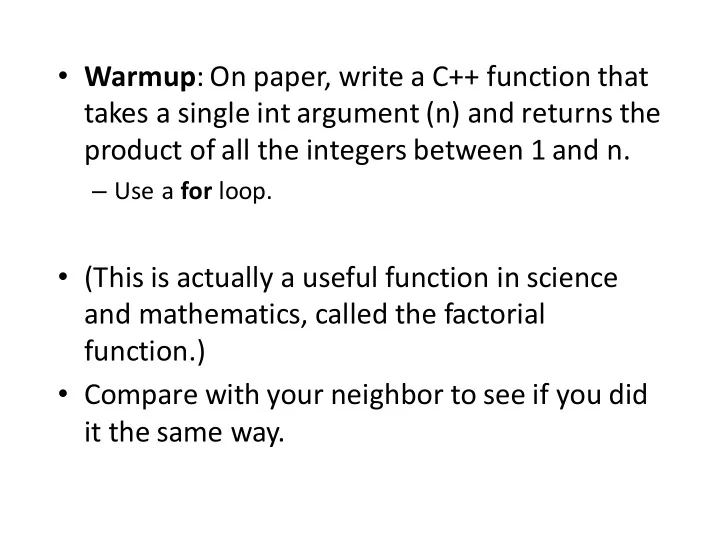
Warmup : On paper, write a C++ function that takes a single int argument (n) and returns the product of all the integers between 1 and n. Use a for loop. (This is actually a useful function in science and mathematics, called the


slide-1
SLIDE 1
  • Warmup: On paper, write a C++ function that

takes a single int argument (n) and returns the product of all the integers between 1 and n.

– Use a for loop.

  • (This is actually a useful function in science

and mathematics, called the factorial function.)

  • Compare with your neighbor to see if you did

it the same way.

slide-2
SLIDE 2

Recursion

slide-3
SLIDE 3
  • On paper, write a C++ function that takes a

single int argument (n) and returns the product of all the integers between 1 and n.

– Use a for loop.

  • (This is actually a useful function in science

and mathematics, called the factorial function.)

slide-4
SLIDE 4

long long fact(int n) { long long answer = 1; for (int x = 1; x <= n; x++) { answer *= x; } return answer; }

slide-5
SLIDE 5
  • Let's look at this problem a different way:
  • fact(1) = 1
  • fact(2) = 1 * 2
  • fact(3) = 1 * 2 * 3
  • fact(4) = 1 * 2 * 3 * 4
  • fact(5) = 1 * 2 * 3 * 4 * 5
  • Notice that each product involves computing

the entire product on the row above.

slide-6
SLIDE 6
  • Let's look at this problem a different way:
  • fact(1) = 1
  • fact(2) = 1 * 2
  • fact(3) = 1 * 2 * 3
  • fact(4) = 1 * 2 * 3 * 4
  • fact(5) = 1 * 2 * 3 * 4 * 5
slide-7
SLIDE 7
  • Let's look at this problem a different way:
  • fact(1) = 1
  • fact(2) = 1 * 2
  • fact(3) = 1 * 2 * 3
  • fact(4) = 1 * 2 * 3 * 4
  • fact(5) = 1 * 2 * 3 * 4 * 5
slide-8
SLIDE 8
  • Let's look at this problem a different way:
  • fact(1) = 1
  • fact(2) = 1 * 2
  • fact(3) = 1 * 2 * 3
  • fact(4) = 1 * 2 * 3 * 4
  • fact(5) = 1 * 2 * 3 * 4 * 5
slide-9
SLIDE 9
  • Let's look at this problem a different way:
  • fact(1) = 1
  • fact(2) = 1 * 2
  • fact(3) = 1 * 2 * 3
  • fact(4) = 1 * 2 * 3 * 4
  • fact(5) = 1 * 2 * 3 * 4 * 5
  • Let's reformulate the definition of a factorial

to take advantage of this.

slide-10
SLIDE 10
  • Let's look at this problem a different way:
  • fact(1) = 1
  • fact(2) = 1 * 2
  • fact(3) = 1 * 2 * 3
  • fact(4) = 1 * 2 * 3 * 4
  • fact(5) =

fact(4) * 5

slide-11
SLIDE 11
  • Let's look at this problem a different way:
  • fact(1) = 1
  • fact(2) = 1 * 2
  • fact(3) = 1 * 2 * 3
  • fact(4) = 1 * 2 * 3 * 4
  • fact(5) =

fact(4) * 5

slide-12
SLIDE 12
  • Let's look at this problem a different way:
  • fact(1) = 1
  • fact(2) = 1 * 2
  • fact(3) = 1 * 2 * 3
  • fact(4) = fact(3) * 4
  • fact(5) =

fact(4) * 5

slide-13
SLIDE 13
  • Let's look at this problem a different way:
  • fact(1) = 1
  • fact(2) = 1 * 2
  • fact(3) = 1 * 2 * 3
  • fact(4) = fact(3) * 4
  • fact(5) =

fact(4) * 5

slide-14
SLIDE 14
  • Let's look at this problem a different way:
  • fact(1) = 1
  • fact(2) = 1 * 2
  • fact(3) = fact(2) * 3
  • fact(4) = fact(3) * 4
  • fact(5) =

fact(4) * 5

slide-15
SLIDE 15
  • Let's look at this problem a different way:
  • fact(1) = 1
  • fact(2) = 1 * 2
  • fact(3) = fact(2) * 3
  • fact(4) = fact(3) * 4
  • fact(5) =

fact(4) * 5

slide-16
SLIDE 16
  • Let's look at this problem a different way:
  • fact(1) = 1
  • fact(2) = fact(1) * 2
  • fact(3) = fact(2) * 3
  • fact(4) = fact(3) * 4
  • fact(5) =

fact(4) * 5

slide-17
SLIDE 17
  • Let's look at this problem a different way:
  • fact(1) = 1
  • fact(2) = fact(1) * 2
  • fact(3) = fact(2) * 3
  • fact(4) = fact(3) * 4
  • fact(5) = fact(4) * 5
slide-18
SLIDE 18
  • Let's look at this problem a different way:
  • fact(1) = 1
  • fact(2) = fact(1) * 2
  • fact(3) = fact(2) * 3
  • fact(4) = fact(3) * 4
  • fact(5) = fact(4) * 5
  • Notice how for n >= 2, each factorial is defined

in terms of a smaller factorial.

  • So if n >= 2, what is fact(n)?

– fact(n) = fact(n-1) * n

slide-19
SLIDE 19

Recursion

  • A recursive function is a function that calls

itself.

  • Recursive functions are used to solve

problems where the solution to the problem may involve solving a smaller version of the same problem.

slide-20
SLIDE 20
  • A recursive function has two parts:
  • Base case: How to solve the smallest

version(s) of the problem that we care about.

  • Recursive case: How to reduce a bigger

version of the problem to a smaller version.

– In order to work, the recursive case (when applied

  • ver and over) must eventually reduce every size
  • f the problem down to the base case.
  • What are these for factorial?
  • Let’s write this in C++.
slide-21
SLIDE 21

How does this work in C++?

  • Recursion works (in all modern programming

languages) because:

– All variables are local. – We get new memory for local variables every time a function is called.

  • Lets look at a memory diagram when we call

factrec(3).

slide-22
SLIDE 22

Why is this useful?

  • Any loop (for/while) can be replaced with a

recursive function that does the same thing.

– Some languages don't include loops!

  • Because we started with Python and C++, we

naturally see things in terms of loops.

  • Some problems have a "naturally" recursive

solution that is hard to solve with a loop.

  • Other problems have solutions that work

equally well recursively or with loops (iteratively).

slide-23
SLIDE 23

Demo

slide-24
SLIDE 24

How to "get" recursion

  • Forget all loops.
  • To find the base case:

– "What is the smallest version of this problem I would ever care about solving?"

  • To find the recursive case:

– "If I have a instance of the problem, how can I phrase how to solve the problem in terms of solving a smaller instance?"

An "instance" of a problem is a single example or

  • ccurrence of that

problem.

slide-25
SLIDE 25

Trust the recursion

  • Base case is usually easy ("When do I stop?")
  • In recursive case:

– Break the problem into two parts (not necessarily the same size):

  • A part I can solve "now."
  • The answer from a smaller instance of the problem.

– Assume the recursive call does the right thing. – Figure out how to combine the two parts.

slide-26
SLIDE 26

Try this

  • I want to write a function that returns an

uppercase version of an entire string

– uc("hello") would return"HELLO"

  • All C++ gives me is a function that returns the

uppercase of a single character (toupper).

  • To solve this recursively, find the recursive

case and the base case.