Warm-up Question Do you understand the following sentence? The set - - PowerPoint PPT Presentation

warm up
SMART_READER_LITE
LIVE PREVIEW

Warm-up Question Do you understand the following sentence? The set - - PowerPoint PPT Presentation

Warm-up Question Do you understand the following sentence? The set of 2 2 symmetric matrices is a subspace of the vector space of 2 2 matrices. Dr Scott Morrison (ANU) MATH1014 Notes Second Semester 2015 1 / 31 Overview Last time we


slide-1
SLIDE 1

Warm-up

Question

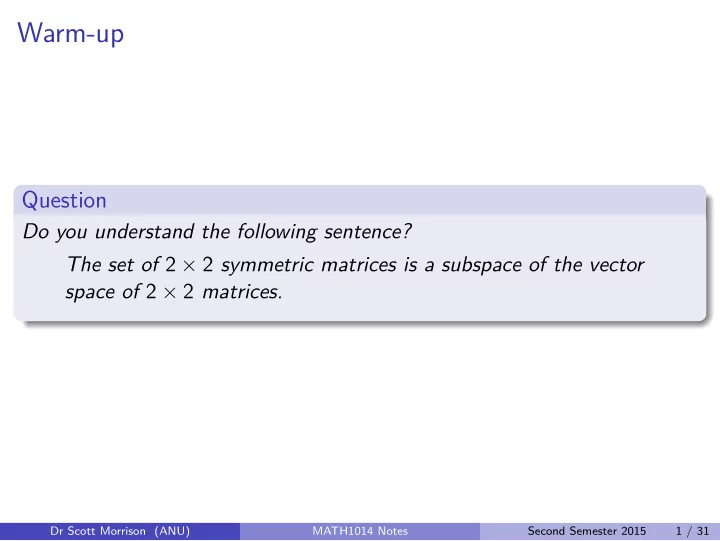
Do you understand the following sentence? The set of 2 × 2 symmetric matrices is a subspace of the vector space of 2 × 2 matrices.

Dr Scott Morrison (ANU) MATH1014 Notes Second Semester 2015 1 / 31
slide-2
SLIDE 2

Overview

Last time we defined an abstract vector space as a set of objects that satisfy 10 axioms. We saw that although Rn is a vector space, so is the set

  • f polynomials of a bounded degree and the set of all n × n matrices. We

also defined a subspace to be a subset of a vector space which is a vector space in its own right. To check if a subset of a vector space is a subspace, you need to check that it contains the zero vector and is closed under addition and scalar multiplication. Recall from 1013 that a matrix has two special subspaces associated to it: the null space and the column space.

Question

How do the null space and column space generalise to abstract vector spaces? (Lay, §4.2)

Dr Scott Morrison (ANU) MATH1014 Notes Second Semester 2015 2 / 31

slide-3
SLIDE 3

Matrices and systems of equations

Recall the relationship between a matrix and a system of linear equations: Let A =

  • a1

a2 a3 a4 a5 a6

  • and let b =
  • b1

b2

  • .

The equation Ax = b corresponds to the system of equations a1x + a2y + a3z = b1 a4x + a5y + a6z = b2. We can find the solutions by row-reducing the augmented matrix

  • a1

a2 a3 b1 a4 a5 a6 b2

  • to reduced echelon form.

Dr Scott Morrison (ANU) MATH1014 Notes Second Semester 2015 3 / 31

slide-4
SLIDE 4

The null space of a matrix

Let A be an m × n matrix.

Definition

The null space of A is the set of all solutions to the homogeneous equation Ax = 0: Nul A = {x : x ∈ Rn and Ax = 0}.

Dr Scott Morrison (ANU) MATH1014 Notes Second Semester 2015 4 / 31

slide-5
SLIDE 5

Example 1

Let A =

  • 1

4 1 −3

  • .

Then the null space of A is the set of all scalar multiples of v =

  

−4 3 1

  .

We can check easily that Av = 0. Furthermore, A(tv) = tAv = t0 = 0, so tv ∈ NulA. To see that these are the only vectors in Nul A, solve the associated homogeneous system of equations.

Dr Scott Morrison (ANU) MATH1014 Notes Second Semester 2015 5 / 31

slide-6
SLIDE 6

The null space theorem

Theorem (Null Space is a Subspace)

The null space of an m × n matrix A is a subspace of Rn. This implies that the set of all solutions to a system of m homogeneous linear equations in n unknowns is a subspace of Rn.

Dr Scott Morrison (ANU) MATH1014 Notes Second Semester 2015 6 / 31

slide-7
SLIDE 7

The null space theorem

Proof Since A has n columns, Nul A is a subset of Rn. To show a subset is a subspace, recall that we must verify 3 axioms:

Dr Scott Morrison (ANU) MATH1014 Notes Second Semester 2015 7 / 31

slide-8
SLIDE 8

The null space theorem

Proof Since A has n columns, Nul A is a subset of Rn. To show a subset is a subspace, recall that we must verify 3 axioms: 0 ∈ Nul A because A0 = 0. Let u and v be any two vectors in Nul A. Then Au = 0 and Av = 0. Therefore A(u + v) = Au + Av = 0 + 0 = 0. This shows that u + v ∈ Nul A. If c is any scalar, then A(cu) = c(Au) = c0 = 0. This shows that cu ∈ Nul A. This proves that Nul A is a subspace of Rn.

Dr Scott Morrison (ANU) MATH1014 Notes Second Semester 2015 7 / 31

slide-9
SLIDE 9

Example 2

Let W =

             

r s t u

     : 3s − 4u = 5r + t

3r + 2s − 5t = 4u

        

Show that W is a subspace.

Dr Scott Morrison (ANU) MATH1014 Notes Second Semester 2015 8 / 31

slide-10
SLIDE 10

Example 2

Let W =

             

r s t u

     : 3s − 4u = 5r + t

3r + 2s − 5t = 4u

        

Show that W is a subspace. Hint: Find a matrix A such that Nul A=W .

Dr Scott Morrison (ANU) MATH1014 Notes Second Semester 2015 8 / 31

slide-11
SLIDE 11

Example 2

Let W =

             

r s t u

     : 3s − 4u = 5r + t

3r + 2s − 5t = 4u

        

Show that W is a subspace. Hint: Find a matrix A such that Nul A=W . If we rearrange the equations given in the description of W we get −5r + 3s − t − 4u = 3r + 2s − 5t − 4u = 0. So if A is the matrix A =

  • −5

3 −1 −4 3 2 −5 −4

  • , then W is the null space of

A, and by the Null Space is a Subspace Theorem, W is a subspace of R4.

Dr Scott Morrison (ANU) MATH1014 Notes Second Semester 2015 8 / 31

slide-12
SLIDE 12

An explicit description of Nul A

The span of any set of vectors is a subspace. We can always find a spanning set for Nul A by solving the associated system of equations. (See Lay §1.5).

Dr Scott Morrison (ANU) MATH1014 Notes Second Semester 2015 9 / 31

slide-13
SLIDE 13

The column space of a matrix

Let A be an m × n matrix.

Definition

The column space of A is the set of all linear combinations of the columns of A. If A =

  • a1

a2 · · · an

  • , then

Col A = Span {a1, a2, . . . , an}.

Dr Scott Morrison (ANU) MATH1014 Notes Second Semester 2015 10 / 31

slide-14
SLIDE 14

The column space of a matrix

Let A be an m × n matrix.

Definition

The column space of A is the set of all linear combinations of the columns of A. If A =

  • a1

a2 · · · an

  • , then

Col A = Span {a1, a2, . . . , an}.

Theorem

The column space of an m × n matrix A is a subspace of Rm. Why?

Dr Scott Morrison (ANU) MATH1014 Notes Second Semester 2015 10 / 31

slide-15
SLIDE 15

Example 3

Suppose W =

       

3a + 2b 7a − 6b −8b

   : a, b ∈ R     

. Find a matrix A such that W = Col A.

Dr Scott Morrison (ANU) MATH1014 Notes Second Semester 2015 11 / 31

slide-16
SLIDE 16

Example 3

Suppose W =

       

3a + 2b 7a − 6b −8b

   : a, b ∈ R     

. Find a matrix A such that W = Col A. W =

    

a

  

3 7

   + b   

2 −6 −8

   : a, b ∈ R     

= Span

       

3 7

   ,   

2 −6 −8

       

Put A =

  

3 2 7 −6 −8

  . Then W = Col A.

Dr Scott Morrison (ANU) MATH1014 Notes Second Semester 2015 11 / 31

slide-17
SLIDE 17

Another equivalent way to describe the column space is Col A = {Ax : x ∈ Rn} .

Example 4

Let u =

    

6 7 1 −4

     ,

A =

    

5 −5 −9 8 8 −6 −5 −9 3 3 −2 −7

    

Does u lie in the column space of A? We just need to answer: does Ax = u have a solution?

Dr Scott Morrison (ANU) MATH1014 Notes Second Semester 2015 12 / 31

slide-18
SLIDE 18

Consider the following row reduction:

    

5 −5 −9 8 8 −6 −5 −9 3 3 −2 −7

  • 6

7 1 −4

    

rref

− − →

    

1 1 1

  • 11/2

−2 7/2

     .

We see that the system Ax = u is consistent. This means that the vector u can be written as a linear combination of the columns of A.

Dr Scott Morrison (ANU) MATH1014 Notes Second Semester 2015 13 / 31

slide-19
SLIDE 19

Consider the following row reduction:

    

5 −5 −9 8 8 −6 −5 −9 3 3 −2 −7

  • 6

7 1 −4

    

rref

− − →

    

1 1 1

  • 11/2

−2 7/2

     .

We see that the system Ax = u is consistent. This means that the vector u can be written as a linear combination of the columns of A. Thus u is contained in the Span of the columns of A, which is the column space of A. So the answer is YES!

Dr Scott Morrison (ANU) MATH1014 Notes Second Semester 2015 13 / 31

slide-20
SLIDE 20

Comparing Nul A and Col A

Example 5

Let A =

  • 4

5 −2 6 1 1 1

  • .

The column space of A is a subspace of Rk where k = ___. The null space of A is a subspace of Rk where k = ___. Find a nonzero vector in Col A. (There are infinitely many.) Find a nonzero vector in Nul A.

Dr Scott Morrison (ANU) MATH1014 Notes Second Semester 2015 14 / 31

slide-21
SLIDE 21

Comparing Nul A and Col A

Example 5

Let A =

  • 4

5 −2 6 1 1 1

  • .

The column space of A is a subspace of Rk where k = ___. The null space of A is a subspace of Rk where k = ___. Find a nonzero vector in Col A. (There are infinitely many.) Find a nonzero vector in Nul A. For the final point, you may use the following row reduction:

  • 4

5 −2 6 1 1 1

  • 1

1 1 4 5 −2 6

  • 1

1 1 1 −2 2

  • Dr Scott Morrison (ANU)

MATH1014 Notes Second Semester 2015 14 / 31

slide-22
SLIDE 22

Table: For any m × n matrix A

Nul A Col A

  • 1. Nul A is a subspace of Rn.

1.Col A is a subspace of Rm.

  • 2. Any v in Nul A has

the property that Av = 0. 2. Any v in Col A has the property that the equation Ax = v is consistent.

  • 3. Nul A = {0} if and only if

the equation Ax = 0 has only the trivial solution.

  • 3. Col A = Rm if and only if

the equation Ax = b has a solution for every b ∈ Rm.

Dr Scott Morrison (ANU) MATH1014 Notes Second Semester 2015 15 / 31

slide-23
SLIDE 23

Question

How does all this generalise to an abstract vector space? An m × n matrix defines a function from Rn to Rm, and the null space and column space are subspaces of the domain and range, respectively. We’d like to define the analogous notions for functions between arbitrary vector spaces.

Dr Scott Morrison (ANU) MATH1014 Notes Second Semester 2015 16 / 31

slide-24
SLIDE 24

Linear transformations

Definition

A linear transformation from a vector space V to a vector space W is a function T : V → W such that

  • L1. T(u + v) = T(u) + T(v) for u, v ∈ V ;
  • L2. T(cu) = cT(u) for u ∈ V , c ∈ R.

Dr Scott Morrison (ANU) MATH1014 Notes Second Semester 2015 17 / 31

slide-25
SLIDE 25

Matrix multiplication always defines a linear transfomation.

Example 6

Let A =

  • 1

2 1 −1 4

  • . Then the mapping defined by

TA(x) = Ax is a linear transformation from R3 to R2. For example TA

     

1 −2 3

      =

  • 1

2 1 −1 4

  

1 −2 3

   =

  • 7

15

  • Dr Scott Morrison (ANU)

MATH1014 Notes Second Semester 2015 18 / 31

slide-26
SLIDE 26

Example 7

Let T : P2 → P0 be the map defined by T(a0 + a1t + a2t2) = 2a0. Then T is a linear transformation. T

(a0 + a1t + a2t2) + (b0 + b1t + b2t2)

  • = T

(a0 + b0) + (a1 + b1)t + (a2 + b2)t2

= 2(a0 + b0) = 2a0 + 2b0 = T(a0 + a1t + a2t2) + T(b0 + b1t + b2t2). T

c(a0 + a1t + a2t2) = T(ca0 + ca1t + ca2t2)

= 2ca0 = cT(a0 + a1t + a2t2)

Dr Scott Morrison (ANU) MATH1014 Notes Second Semester 2015 19 / 31

slide-27
SLIDE 27

Kernel of a linear transformation

Definition

The kernel of a linear transformation T : V → W is the set of all vectors u in V such that T(u) = 0. We write ker T = {u ∈ V : T(u) = 0}. The kernel of a linear transformation T is analogous to the null space of a matrix, and ker T is a subspace of V . If ker T = {0}, then T is one to one.

Dr Scott Morrison (ANU) MATH1014 Notes Second Semester 2015 20 / 31

slide-28
SLIDE 28

The range of a linear transformation

Definition

The range of a linear transformation T : V → W is the set of all vectors in W of the form T(u) where u is in V . We write Range T = {w : w = T(u) for some u ∈ V }. The range of a linear transformation is analogous to the columns space of a matrix, and Range T is a subspace of W . The linear transformation T is onto if its range is all of W .

Dr Scott Morrison (ANU) MATH1014 Notes Second Semester 2015 21 / 31

slide-29
SLIDE 29

Example 8

Consider the linear transformation T : P2 → P0 by T(a0 + a1t + a2t2) = 2a0. Find the kernel and range of T.

Dr Scott Morrison (ANU) MATH1014 Notes Second Semester 2015 22 / 31

slide-30
SLIDE 30

Example 8

Consider the linear transformation T : P2 → P0 by T(a0 + a1t + a2t2) = 2a0. Find the kernel and range of T. The kernel consists of all the polynomials in P2 satisfying 2a0 = 0. This is the set {a1t + a2t2}. The range of T is P0.

Dr Scott Morrison (ANU) MATH1014 Notes Second Semester 2015 22 / 31

slide-31
SLIDE 31

Example 9

The differential operator D : P2 → P1 defined by D(p(x)) = p′(x) is a linear transformation. Find its kernel and range.

Dr Scott Morrison (ANU) MATH1014 Notes Second Semester 2015 23 / 31

slide-32
SLIDE 32

Example 9

The differential operator D : P2 → P1 defined by D(p(x)) = p′(x) is a linear transformation. Find its kernel and range. First we see that D(a + bx + cx2) = b + 2cx. So ker D = {a + bx + cx2 : D(a + bx + cx2) = 0} = {a + bx + cx2 : b + 2cx = 0} But b + 2cx = 0 if and only if

Dr Scott Morrison (ANU) MATH1014 Notes Second Semester 2015 23 / 31

slide-33
SLIDE 33

Example 9

The differential operator D : P2 → P1 defined by D(p(x)) = p′(x) is a linear transformation. Find its kernel and range. First we see that D(a + bx + cx2) = b + 2cx. So ker D = {a + bx + cx2 : D(a + bx + cx2) = 0} = {a + bx + cx2 : b + 2cx = 0} But b + 2cx = 0 if and only if b = 2c = 0, which implies b = c = 0. Therefore ker D = {a + bx + cx2 : b = c = 0} = {a : a ∈ R}

Dr Scott Morrison (ANU) MATH1014 Notes Second Semester 2015 23 / 31

slide-34
SLIDE 34

The range of D is all of P1 since every polynomial in P1 is the image under D (i.e the derivative) of some polynomial in P2. To be more specific, if a + bx is in P1, then a + bx = D

  • ax + b

2x2

  • Dr Scott Morrison (ANU)

MATH1014 Notes Second Semester 2015 24 / 31

slide-35
SLIDE 35

Example 10

Define S : P2 → R2 by S(p) =

  • p(0)

p(1)

  • .

That is, if p(x) = a + bx + cx2, we have S(p) =

  • a

a + b + c

  • .

Show that S is a linear transformation and find its kernel and range.

Dr Scott Morrison (ANU) MATH1014 Notes Second Semester 2015 25 / 31

slide-36
SLIDE 36

Leaving the first part as an exercise to try on your own, we’ll find the kernel and range of S. From what we have above, p is in the kernel of S if and only if S(p) =

  • a

a + b + c

  • =
  • For this to occur we must have a = 0 and c = −b.

So p is in the kernel of S if p(x) = bx − bx2 = b(x − x2). This gives ker S = Span

x − x2.

Dr Scott Morrison (ANU) MATH1014 Notes Second Semester 2015 26 / 31

slide-37
SLIDE 37

The range of S. Since S(p) =

  • a

a + b + c

  • and a, b and c are any real numbers, the

range of S is all of R2.

Dr Scott Morrison (ANU) MATH1014 Notes Second Semester 2015 27 / 31

slide-38
SLIDE 38

Example 11

let F : M2×2 → M2×2 be the linear transformation defined by taking the transpose of the matrix: F(A) = AT. We find the kernel and range of F.

Dr Scott Morrison (ANU) MATH1014 Notes Second Semester 2015 28 / 31

slide-39
SLIDE 39

Example 11

let F : M2×2 → M2×2 be the linear transformation defined by taking the transpose of the matrix: F(A) = AT. We find the kernel and range of F. We see that ker F = {A in M2×2 : F(A) = 0} = {A in M2×2 : AT = 0} But if AT = 0, then A = (AT)T = 0T = 0. It follows that ker F = 0. For any matrix A in M2×2, we have A = (AT)T = F(AT). Since AT is in M2×2 we deduce that Range F = M2×2.

Dr Scott Morrison (ANU) MATH1014 Notes Second Semester 2015 28 / 31

slide-40
SLIDE 40

Example 12

Let S : P1 → R be the linear transformation defined by S(p(x)) =

1

p(x)dx. We find the kernel and range of S. In detail, we have S(a + bx) =

1

(a + bx)dx =

  • ax + b

2x2

1

= a + b 2.

Dr Scott Morrison (ANU) MATH1014 Notes Second Semester 2015 29 / 31

slide-41
SLIDE 41

Therefore, ker S = {a + bx : S(a + bx) = 0} =

  • a + bx : a + b

2 = 0

  • =
  • a + bx : a = −b

2

  • =
  • −b

2 + bx

  • Geometrically, ker S consists of all those linear polynomials whose graphs

have the property that the area between the line and the x-axis is equally distributed above and below the axis on the interval [0, 1].

Dr Scott Morrison (ANU) MATH1014 Notes Second Semester 2015 30 / 31

slide-42
SLIDE 42

The range of S is R, since every number can be obtained as the image under S of some polynomial in P1. For example, if a is an arbitrary real number, then

1

a dx = [ax]1

0 = a − 0 = a.

Dr Scott Morrison (ANU) MATH1014 Notes Second Semester 2015 31 / 31