WakeNet2-Europe - Presentation Langley March 14, 2005
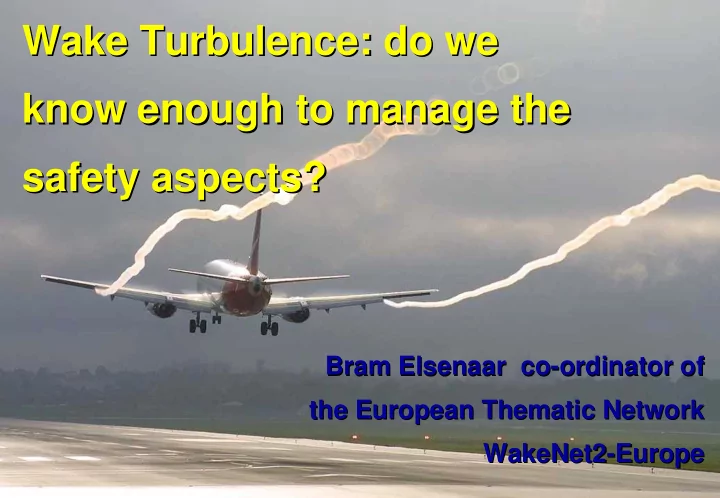
Wake Turbulence: do we Wake Turbulence: do we know enough to manage the know enough to manage the safety aspects? safety aspects?
Bram Elsenaar Bram Elsenaar co- co-ordinator
- rdinator of
- f
Wake Turbulence: do we Wake Turbulence: do we know enough to manage - - PowerPoint PPT Presentation
Wake Turbulence: do we Wake Turbulence: do we know enough to manage the know enough to manage the safety aspects? safety aspects? Bram Elsenaar co- co-ordinator ordinator of of Bram Elsenaar the European Thematic Network the European
WakeNet2-Europe - Presentation Langley March 14, 2005
Introduction and background Present ruling, possible changes and benefits How to assess wake vortex safety ?
WakeNet2-Europe - Presentation Langley March 14, 2005
EUROWAKE near field vortex WAVENC encounter modeling M-FLAME
C-WAKE wake characterization S-WAKE safety assessment AWIATOR minimizing by design I-WAKE
WakeNet
FAR-WAKE Fundamental aspects ATC-WAKE ATM implementation
STILL ACTIVE
WakeNet2-Europe - Presentation Langley March 14, 2005
Flying aircraft generate a wake of two counter rotating vortices (like
horizontal ‘tornado’s’) – their initial strength depends roughly on the lift and wing span – they are transported by the wind – they normally descent but may stall or rebound for specific atmospheric conditions and near the ground – they decay due to atmospheric turbulence but persist for long time in quiet weather
When a following aircraft enters a wake, it may result in a severe
upset (bank-angle, sink rate)
Hence ICAO has made rules that prescribe the minimum separation
distances
These rules put a limit to airport capacity
WakeNet2-Europe - Presentation Langley March 14, 2005
For VFR conditions separation is determined by the
For IFR conditions separation distances (in excess of
Closely spaced parallel runways (CSPR) are treated as a
WakeNet2-Europe - Presentation Langley March 14, 2005
B747
Leading aircraft heavy > 136 t medium 7 - 136 t (small)/ light < 7 t heavy medium small Separation, miles
3 4 5 6
DHC-8 DHC-8 DHC-8 A320 A320 A320 B747
followed by No vortex-related separation for heavy aircraft
aircraft to scale A320 DHC-8
ICAO WV Separation Criteria
WakeNet2-Europe - Presentation Langley March 14, 2005
(ATM related accident rate’s from NLR Aviation Safety Data Base)
. . . but not ZERO!
WakeNet2-Europe - Presentation Langley March 14, 2005
There are regular incident reports of wake vortex
There are very few wake vortex induced accidents and
Occasionally incident reports are filed for encounters
WakeNet2-Europe - Presentation Langley March 14, 2005
Would it be possible to reduce separation distances (by
Possible benefits are two-fold:
WakeNet2-Europe - Presentation Langley March 14, 2005
Examples of ‘simple’ (rule) changes
Examples of more complex changes:
WakeNet2-Europe - Presentation Langley March 14, 2005
17:10 14:30 11:50
ATC WAKE
08:20
ATC WAKE
Arrivals : 2.5 NM Departures : 90 s Arrivals : 2.8 NM Departures : 100 s
07:29 Mode transition at 07:40 17:10 14:30 11:50
ATC WAKE
08:20
ATC WAKE
Arrivals : 2.5 NM Departures : 90 s Arrivals : 2.8 NM Departures : 100 s
07:29 Mode transition at 07:40
WakeNet2-Europe - Presentation Langley March 14, 2005
EU estimates: Air Traffic delays cost 62 € per minute ;
total costs in 2002 : 700 M€ - 1000 M€ ( from EUROCONTROL Performance Review Report 6 )
NASA study on Dallas/FortWorth airport (independent runways)
indicates 8% capacity increase for weather dependent Wake Vortex Warning System
US Business Case Study indicates very favourable cost / benefit
ratio’s for Wake Vortex Advisory Systems (WVAS) in CSPR situations (sometimes as high as order of 100)
WakeNet2-Europe - Presentation Langley March 14, 2005
ATM is already very complex! How to assess the safety?
WakeNet2-Europe - Presentation Langley March 14, 2005
In Europe ESARR4 sets requirements for safety
wake encounters are very rare events, strongly weather
in European research programs building blocks for
for validation of risk assessment methodologies
WakeNet2-Europe - Presentation Langley March 14, 2005
A probabilistic risk assessment model for wake
Rigor mathematical techniques are required to handle the
WakeNet2-Europe - Presentation Langley March 14, 2005
this presentation
WakeNet2-Europe - Presentation Langley March 14, 2005
Vortex core and peak velocity make the difference in decay
WakeNet2-Europe - Presentation Langley March 14, 2005
but modelling vortex cores is not trivial Simple models will do here
WakeNet2-Europe - Presentation Langley March 14, 2005
large variations in decay, vortex life times don’t fit easily in weather classes!
WakeNet2-Europe - Presentation Langley March 14, 2005
. . . there are more parameters than Eddy Dissipation rate ε like: Windshear S Thermal stratification N
WakeNet2-Europe - Presentation Langley March 14, 2005
color code in m/s
Good enough ? A difference of a few m/sec in cross wind might matter !
WakeNet2-Europe - Presentation Langley March 14, 2005
. . . in this case never safe
WakeNet2-Europe - Presentation Langley March 14, 2005
. . . for Frankfurt the benefit is small: too conservative . . . ?
WakeNet2-Europe - Presentation Langley March 14, 2005
VFS NEW VFS VORTEX P2P
. . . better modelling
effect might help but needs more validation !
WakeNet2-Europe - Presentation Langley March 14, 2005
Combination of Doppler-Radar for clear air measurements and Radio Acoustic Sound System (RASS) for measurements in bad weather
Manufacturer: Scintec AG, Tübingen, Germany
WakeNet2-Europe - Presentation Langley March 14, 2005
separation 5 Nm Winckelmans / Sarpkaya model
Vortex core detail might matter here !
WakeNet2-Europe - Presentation Langley March 14, 2005
slow intercept from above (vertical intercept is 2 deg.) quick intercept from aside (horizontal intercept angle is 20 deg.)
. . . and here
WakeNet2-Europe - Presentation Langley March 14, 2005
. . . . pragmatic, can be made to cover a ‘class of followers’ ; possibly somewhat conservative
WakeNet2-Europe - Presentation Langley March 14, 2005
Target Levels
Safe separation distance
WakeNet2-Europe - Presentation Langley March 14, 2005
ATM ATM design design
Safety Safety assessment assessment
e.g. NLR VORTEX, LHR reporting
Not part of this presentation
WakeNet2-Europe - Presentation Langley March 14, 2005
Possible WVE
at 3000 ft
WakeNet2-Europe - Presentation Langley March 14, 2005
Peak in crosswind
component
Peak in vertical
wind component
WakeNet2-Europe - Presentation Langley March 14, 2005
One single peak
both in roll and aileron
Bank angle
disturbance about +30 deg!
WakeNet2-Europe - Presentation Langley March 14, 2005
. . . encounters do
WakeNet2-Europe - Presentation Langley March 14, 2005
Bram Elsenaar, to be discussed
Jens Konopka, DFS, Langen 2004
WakeNet2-Europe - Presentation Langley March 14, 2005
NLR (co-ordinator) IFALPA (Vereinigung Cockpit) DLR THALES-AVIONICS DFS UCL NATS En-Route Ltd (NERL) EUROCONTROL AIRBUS (dep co-ordinator) UK MetOffice QinetiQ ONERA
. . . . . and to WakeNet-USA (FAA / NASA) ! WakeNet2-Europe is sponsored by the European Commision
WakeNet2-Europe - Presentation Langley March 14, 2005