W HAT ABOUT OTHER SYSTEMS ? We know that the system F T is sound. - - PowerPoint PPT Presentation

w hat about other systems
SMART_READER_LITE
LIVE PREVIEW

W HAT ABOUT OTHER SYSTEMS ? We know that the system F T is sound. - - PowerPoint PPT Presentation

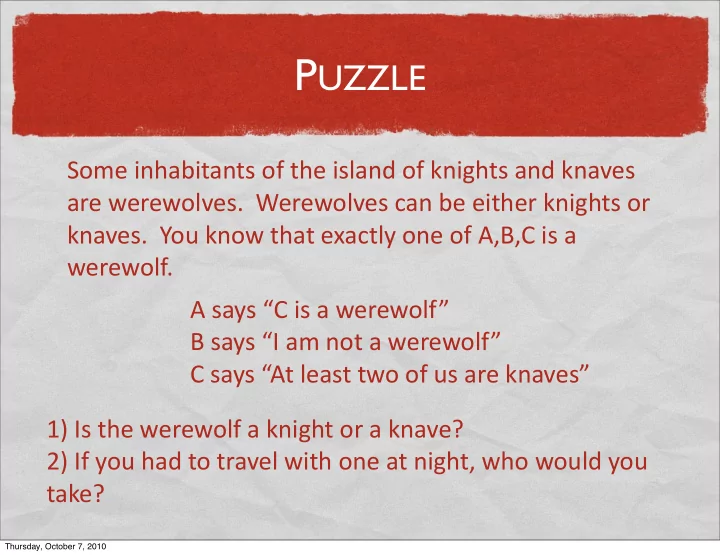
P UZZLE Some inhabitants of the island of knights and knaves are werewolves. Werewolves can be either knights or knaves. You know that exactly one


slide-1
SLIDE 1

PUZZLE

Some ¡inhabitants ¡of ¡the ¡island ¡of ¡knights ¡and ¡knaves ¡ are ¡werewolves. ¡ ¡Werewolves ¡can ¡be ¡either ¡knights ¡or ¡

  • knaves. ¡ ¡You ¡know ¡that ¡exactly ¡one ¡of ¡A,B,C ¡is ¡a ¡

werewolf. 1) ¡Is ¡the ¡werewolf ¡a ¡knight ¡or ¡a ¡knave? 2) ¡If ¡you ¡had ¡to ¡travel ¡with ¡one ¡at ¡night, ¡who ¡would ¡you ¡ take? A ¡says ¡“C ¡is ¡a ¡werewolf” B ¡says ¡“I ¡am ¡not ¡a ¡werewolf” C ¡says ¡“At ¡least ¡two ¡of ¡us ¡are ¡knaves”

Thursday, October 7, 2010

slide-2
SLIDE 2

PROPOSITIONAL LOGIC

Wednesday, 6 October

Thursday, October 7, 2010

slide-3
SLIDE 3

SOUNDNESS THEOREM

SOUNDNESS THEOREM (for FT): If {P1, P2, .... Pn} ⊢(in FT) C then {P1, P2, .... Pn} tf-entails C Negative Criterion If {P1, P2, .... Pn} DOES NOT tf-entail C then {P1, P2, .... Pn} ⊢(in FT) C

Thursday, October 7, 2010

slide-4
SLIDE 4

COROLLARIES

If {P1, P2, .... Pn} ⊢(in FT) C then {P1, P2, .... Pn} tf-entails C If {} ⊢(in FT) C [=def C is a theorem of FT] then {} tf-entails C [= C is a tautology] If {P1, P2, .... Pn} DOES NOT tf-entail C then {P1, P2, .... Pn} ⊢(in FT) C All satisfiable sets are consistent or contrapositively All inconsistent sets are unsatisfiable

Thursday, October 7, 2010

slide-5
SLIDE 5

SOUNDNESS OF A WHOLE SYSTEM

You can show that none of ∧E ∧I ∨E ∨I →E →I ↔E ↔I ⊥E ⊥I ¬E ¬I reit or making an assumption can introduce the first invalid step so there can’t be any invalid steps anywhere in any proof (that uses just these steps). So the last line of the proof is a valid step so the conclusion really does follow from the premises on the assumption that there is a legal proof. So we say that the system, FT is sound.

Thursday, October 7, 2010

slide-6
SLIDE 6

WHAT ABOUT OTHER SYSTEMS?

We know that the system FT is sound. What if we weren’t allowed to us the ¬Intro rule? Obviously the resulting system would still be sound. You could still prove only valid arguments. You can just prove less of them. But what if we allowed ourselves other rules - like DeMorgan’s Laws. Would the system still be sound?

Thursday, October 7, 2010

slide-7
SLIDE 7

FT+DEM

Call FT+DeM the system that results from allowing any rules in FT and also allows the following rule:

  • 1. ¬(P∨Q)
  • 2. ¬P∧¬Q DeM 1

IsFT+DeM sound? Answer: YES Anything proved in FT+DeM really is a valid argument

Thursday, October 7, 2010

slide-8
SLIDE 8

FT+DEM

One way to show soundness is to show that you can’t prove anything new - anything provable in FT+DeM is also provable in FT (but perhaps the proof is longer). But we could also directly proof the soundness of the rule: Assuming that A1, A2, ... Ak really does entail ¬(P∨Q), then A1, A2, ... Ak (plus possibly more) really does entail ¬P∧¬Q. So DeM can’t introduce the FIRST invalid step.

Thursday, October 7, 2010

slide-9
SLIDE 9

FT+XOR

  • 1. P∨Q
  • 2. P
  • 3. ¬Q xor 1,2

IsFT+xor sound? Answer: NO xor CAN introduce the first invalid step

For example, take the proof above. Make P:T Q:T - now steps 1, 2 are valid (since they depend on themselves - the given assumptions) and step 3 is invalid.

Thursday, October 7, 2010

slide-10
SLIDE 10

BAD RULES ARE REALLY BAD

If we had xor as a rule (plus the others) our system would be so terrible that it could prove anything at all. Example - feel like proving P?

  • 1. ¬P
  • 2. ¬P∨¬P ∨Intro 1
  • 3. ¬¬P xor 1,2
  • 4. ⊥ ⊥ intro 1,3
  • 5. P ¬Intro 1-4

Thursday, October 7, 2010

slide-11
SLIDE 11

WHICH RULES WOULD BE OKAY?

If a rule represents a valid argument (one you could prove anyway by the other rules) then it is okay. If a rule represents an invalid argument, or improperly messes with subproofs (reaching into a closed subproof, ending two subproofs at the same time, etc.) it is a bad rule. DeM, NegCon, DisjSyll, Modus Tollens, etc. all would be okay rules. Affirming the consequent? Terrible.

Thursday, October 7, 2010

slide-12
SLIDE 12

COMPLETENESS THEOREM

As a matter of fact, the converse of soundness is true

  • if an argument is tf-valid, then you can do a proof in

FT. This is much harder to prove [take 3310 or read chapter 17]. But you can just assume it is true. Since FT is sound and complete, you can prove all and only the tf-valid arguments. Many other systems

  • f natural deduction have this same quality.

Thursday, October 7, 2010

slide-13
SLIDE 13

TRUTH-FUNCTIONAL COMPLETENESS

Is it possible to have a truth-functional sentence that we can’t express with our connectives? A set of connectives is truth-functionally complete if they allow us to express any truth function. We can express exactly one of A+B, neither A nor B, not both A+B, etc. What about ‘either 2 or 5 of these 7 variables are true’?

  • YES. We can express ANY truth function of arbitrary

size or complexity .

Thursday, October 7, 2010

slide-14
SLIDE 14

TRUTH-FUNCTIONAL COMPLETENESS

Want a sentence true in exactly these cases? How about: (P∧Q∧R)∨(¬P∧Q∧R)∨(¬P∧Q∧¬R) If a sentence’s truth is completely determined by the truth of its subsentences, then it is equivalent to a sentence like the above using just ¬, ∧, and ∨

Thursday, October 7, 2010

slide-15
SLIDE 15

TRUTH-FUNCTIONAL COMPLETENESS

A set of connectives is truth-functionally complete if they allow us to express any truth function. Theorem (in book): The set of Boolean Connectives {¬, ∧, and ∨} is truth-functionally complete. {¬ and ∨}, {¬ and ∧}, {¬ and →}, {⊥ and →}, are also truth-functionally complete. Some combos, like {¬ and ↔} are not complete (you can’t express ‘A and B’ with only ¬ and ↔). Awesome fact: “NAND” [↑] and “NOR” [↓] each by themselves are complete.

Thursday, October 7, 2010

slide-16
SLIDE 16

NORMAL FORMS

For various reasons (like automated proof - or proofs

  • f metatheorems like completeness) it is often useful

to turn sentences into specific forms. The book mentions three kinds - Negated Normal Form (1st step...) Conjunctive Normal Form, Disjunctive Normal Form

Thursday, October 7, 2010

slide-17
SLIDE 17

NEGATION NORMAL FORM

A sentence is in negation normal form (NNF) when any ¬ applies to an atomic sentence and all literals are joined by ∧ or ∨ (and parentheses). Any sentence can be put into NNF by getting rid of →s and ↔s and then using double negation and DeMorgan’s Laws if necessary.

Thursday, October 7, 2010

slide-18
SLIDE 18

CONJUNCTIVE NORMAL FORM

A sentence is in conjunctive normal form (CNF) iff it is a conjunction of one or more disjunctions of literals.

Any sentence in NNF can be put into CNF using the distribution rules. Distribution of ∨ over ∧: A ∨ (B ∧ C) ⇔ (A ∨ B) ∧ (A ∨ C) (P∧Q)∨(R∧S) ⇔ [(P∧Q)∨R]∧[(P∧Q)∨S] ⇔ [(P∨R)∧(Q∨R)] ∧ [(P∨S)∧(Q∨S)]

Thursday, October 7, 2010

slide-19
SLIDE 19

DISJUNCTIVE NORMAL FORM

A sentence is in disjunctive normal form (DNF) iff it is a disjunction of one or more conjunctions of literals.

Any sentence in NNF can be put into DNF using the distribution of ∧ over ∨. Distribution of ∧ over ∨: A ∧ (B ∨ C) ⇔ (A ∧ B) ∨ (A ∧ C) (P∨Q)∧(R∨S) ⇔ [(P∨Q)∧R]∨[(P∨Q)∧S] ⇔ [(P∧R)∨(Q∧R)] ∨ [(P∧S)∨(Q∧S)]

Thursday, October 7, 2010

slide-20
SLIDE 20

LIMITS OF TRUTH-FUNCTIONS

a is a cube a ≠ b b is not a cube

This is provable if you add the identity rules

a is a cube There are at least two things b is not a cube

This is still not

Thursday, October 7, 2010

slide-21
SLIDE 21

LIMITS OF TRUTH-FUNCTIONS

All men are mortal Socrates is mortal Socrates is a man No apples are rotten Some fruits aren’t apples Some fruits are rotten All men are tall Some tall people aren’t bald Not every man is bald For any number, there is a larger prime number There is no largest prime number

None are truth-functionally valid

  • We need a stronger logical system

Thursday, October 7, 2010

slide-22
SLIDE 22

QUANTIFIERS

Two quantifier symbols: ∀ means “everything” or “for all”. ∃ means “something” or “there exists at least one”. Just these two quantifiers can be used to capture many of the quantifications we want to talk about. For example, all, every, any, none, not all of, some, some are not, at least one, at least two, exactly two, etc.

Thursday, October 7, 2010

slide-23
SLIDE 23

EXAMPLE SENTENCES

∀x Cube(x) - Everything is a cube ∃x Cube(x) - Something is a cube ∀x(Cube(x)∧Small(x)) - Everything is a small cube ∃x(Cube(x)∧Small(x)) - Something is a small cube ∀x(Cube(x)→Small(x)) - Every cube is small ∀x(Tet(x)→Cube(x)) - Every tet is a cube ¬∃x(Cube(x)∧Large(x)) - There aren’t any large cubes

Thursday, October 7, 2010