Vragen Defining Problem and Scope Noem 3 software proces modellen - - PowerPoint PPT Presentation

vragen defining problem and scope
SMART_READER_LITE
LIVE PREVIEW

Vragen Defining Problem and Scope Noem 3 software proces modellen - - PowerPoint PPT Presentation

Vragen Defining Problem and Scope Noem 3 software proces modellen A problem can be expressed as: Wat de overeenkomst tussen de moderne proces A difficulty the users or customers are facing, modellen? Or as an opportunity


slide-1
SLIDE 1

Vragen

  • Noem 3 software proces modellen
  • Wat de overeenkomst tussen de moderne proces

modellen? W t i h t t d i l ?

  • Wat is het nut van domein analyse?

/ Faculteit Wiskunde en Informatica

PAGE 0 15-2-2010

Defining Problem and Scope

  • A problem can be expressed as:
  • A difficulty the users or customers are facing,
  • Or as an opportunity that will result in some benefit

such as improved productivity or sales such as improved productivity or sales.

  • The solution to the problem normally will entail

e so ut o to t e p ob e

  • a y

e ta developing software

  • A good problem statement is short and succinct

/ Faculteit Wiskunde en Informatica

PAGE 1 15-2-2010

Defining the Scope

  • Narrow the scope by defining a more precise

y g problem

  • List all the things you might imagine the system doing

Exclude some of these things if too broad − Exclude some of these things if too broad − Determine high-level goals if too narrow

  • Example: A university registration system

p y g y

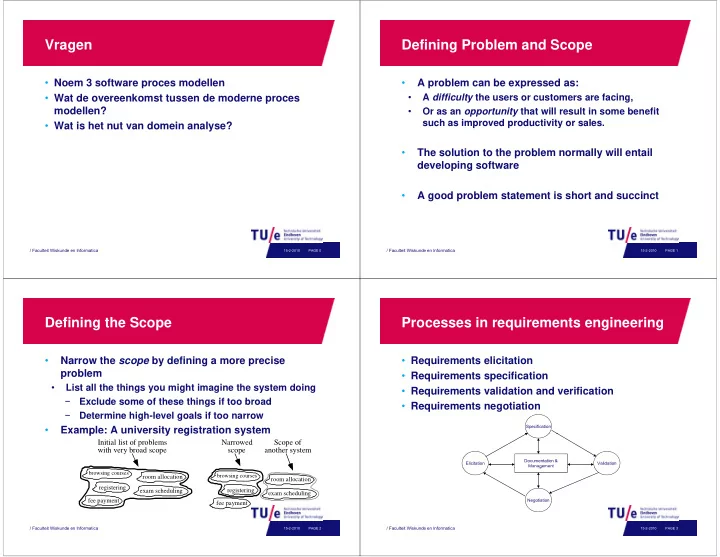
Initial list of problems with very broad scope Narrowed scope Scope of another system

exam scheduling room allocation fee payment

browsing courses

registering exam scheduling room allocation f t

browsing courses

registering

/ Faculteit Wiskunde en Informatica

PAGE 2 15-2-2010

fee payment fee payment

Processes in requirements engineering

  • Requirements elicitation
  • Requirements specification
  • Requirements validation and verification
  • Requirements negotiation

Specification Documentation & Management Elicitation Validation g Negotiation / Faculteit Wiskunde en Informatica

PAGE 3 15-2-2010

Negotiation

slide-2
SLIDE 2

What is a Requirement ?

  • It is a statement describing either

g

  • 1) an aspect of what the proposed system must do,
  • r 2) a constraint on the system’s development.

I ith it t t ib t i t d

  • In either case it must contribute in some way towards

adequately solving the customer’s problem;

  • the set of requirements as a whole represents a

negotiated agreement among the stakeholders.

  • A collection of requirements is a requirements
  • A collection of requirements is a requirements

document.

/ Faculteit Wiskunde en Informatica

PAGE 4 15-2-2010

Types of Requirements

  • Functional requirements
  • Describe what the system should do
  • Quality requirements
  • Constraints on the design to meet specified levels of
  • Constraints on the design to meet specified levels of

quality

  • Platform requirements

C t i t th i t d t h l f th

  • Constraints on the environment and technology of the

system

  • Process requirements
  • Constraints on the project plan and development

methods

/ Faculteit Wiskunde en Informatica

PAGE 5 15-2-2010

Functional Requirements

  • What inputs the system should accept
  • What outputs the system should produce
  • What data the system should store that other

systems might use

  • What computations the system should perform
  • The timing and synchronization of the above

/ Faculteit Wiskunde en Informatica

PAGE 6 15-2-2010

Quality Requirements

  • All must be verifiable
  • Examples: Constraints on
  • Response time
  • Throughput
  • Throughput
  • Resource usage
  • Reliability
  • Availability
  • Recovery from failure

All f i t i bilit d h t

  • Allowances for maintainability and enhancement
  • Allowances for reusability

/ Faculteit Wiskunde en Informatica

PAGE 7 15-2-2010

slide-3
SLIDE 3

Elicitation techniques

  • Asking:
  • Others:

g

  • interview
  • Delphi technique
  • brainstorming session
  • analysis of natural

language descriptions

  • domain analysis
  • brainstorming session
  • Observing
  • task analysis

domain analysis

  • Business Process

Redesign (BPR)

  • prototyping
  • scenario analysis
  • ethnography
  • form analysis
  • prototyping

form analysis

  • synthesis from existing

system

/ Faculteit Wiskunde en Informatica

PAGE 8 15-2-2010

Interviewing

  • Conduct a series of interviews
  • Ask about specific details
  • Ask about the stakeholder’s vision for the future
  • Ask if they have alternative ideas
  • Ask if they have alternative ideas
  • Ask for other sources of information
  • Ask them to draw diagrams

/ Faculteit Wiskunde en Informatica

PAGE 9 15-2-2010

Brainstorming

  • Appoint an experienced moderator
  • Arrange the attendees around a table
  • Decide on a ‘trigger question’
  • Ask each participant to write an answer and pass
  • Ask each participant to write an answer and pass

the paper to its neighbour

! ! ! ! ! !

  • Joint Application Development (JAD) is a technique based on

intensive brainstorming sessions

/ Faculteit Wiskunde en Informatica

PAGE 10 15-2-2010

Observation

  • Read documents and discuss requirements with

users

  • Shadowing important potential users as they do

their work their work

  • ask the user to explain everything he or she is doing
  • Session video taping

p g

/ Faculteit Wiskunde en Informatica

PAGE 11 15-2-2010

slide-4
SLIDE 4

Task Analysis

  • Task analysis is the process of analyzing the way

y y g y people perform their jobs: the things they do, the things they act on and the things they need to know.

  • The relation between tasks and goals: a task is
  • The relation between tasks and goals: a task is

performed in order to achieve a goal.

  • Task analysis has a broad scope.

y p

/ Faculteit Wiskunde en Informatica

PAGE 12 15-2-2010

Task Analysis

  • Task analysis concentrates on the current situation.

y However, it can be used as a starting point for a new system:

  • users will refer to new elements of a system and its
  • users will refer to new elements of a system and its

functionality

  • scenario-based analysis can be used to exploit new

ibiliti possibilities

/ Faculteit Wiskunde en Informatica

PAGE 13 15-2-2010