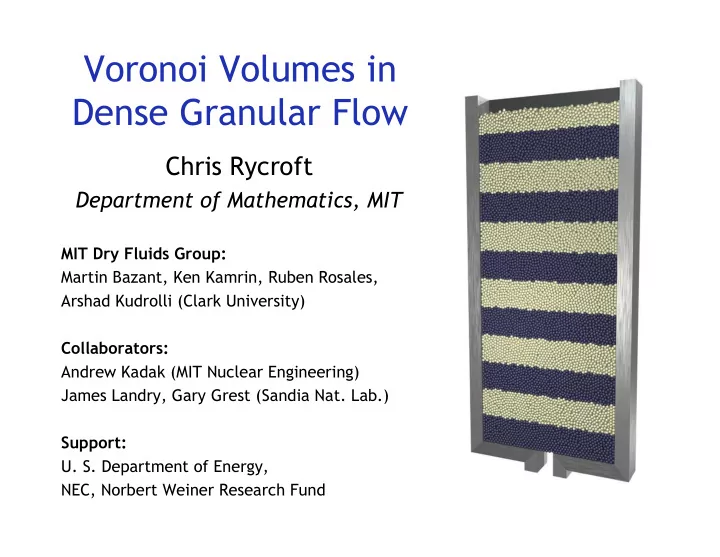
Voronoi Volumes in Dense Granular Flow Chris Rycroft Department of - - PowerPoint PPT Presentation

voronoi volumes in dense granular flow
SMART_READER_LITE
LIVE PREVIEW

Voronoi Volumes in Dense Granular Flow Chris Rycroft Department of - - PowerPoint PPT Presentation

Voronoi Volumes in Dense Granular Flow Chris Rycroft Department of Mathematics, MIT MIT Dry Fluids Group: Martin Bazant, Ken Kamrin, Ruben Rosales, Arshad Kudrolli (Clark University) Collaborators: Andrew Kadak (MIT Nuclear Engineering)


slide-1
SLIDE 1

Voronoi Volumes in Dense Granular Flow

MIT Dry Fluids Group: Martin Bazant, Ken Kamrin, Ruben Rosales, Arshad Kudrolli (Clark University) Collaborators: Andrew Kadak (MIT Nuclear Engineering) James Landry, Gary Grest (Sandia Nat. Lab.) Support:

  • U. S. Department of Energy,

NEC, Norbert Weiner Research Fund

Chris Rycroft

Department of Mathematics, MIT

slide-2
SLIDE 2

Free volume in dense amorphous materials

Spot model for random packing dynamics (Bazant, Mechanics of Materials, 2005) Void model for granular drainage (Litwiniszyn, 1963, Mullins 1972) Vacancy mechanism for flow in viscous liquid (Eyring, 1936)

slide-3
SLIDE 3

Measuring packing fraction using Voronoi volumes

  • Investigate changes in

packing fraction at the scale of a spot

  • Voronoi cell: the region
  • f free space closer to a

particle than any other

  • Packing fraction defined

as the ratio of a particle volume to its Voronoi cell

  • Averaged over particles

in a small region

slide-4
SLIDE 4

Measuring packing fraction using Voronoi volumes

  • Investigate changes in

packing fraction at the scale of spot

  • Voronoi cell: the region
  • f free space closer to a

particle than any other

  • Packing fraction defined

as the ratio of a particle volume to its Voronoi cell

  • Averaged over particles

in a small region

(Three dimensional Voronoi cell network)

slide-5
SLIDE 5

Two simulation methods

  • Simulation 1: Discrete

Element Method (DEM)

– Parallel code (Sandia) – Realistic friction model

  • Simulation 2: Spot Model

– Based on spot model mechanism – Use initial packing from DEM – Calibrate free parameters from DEM – See cond-mat/0602394

(55000 particles in a container of dimensions 50d x 8d x 110d)

slide-6
SLIDE 6

Comparison of density changes

70% 60% 50%

(Spot Simulation) (DEM simulation) (Spot Simulation) (DEM simulation)

Voronoi density plots Simulation snapshots

slide-7
SLIDE 7

3D Cylindrical container

  • Simulations of a

pebble-bed nuclear reactor

  • 400,000 particles
  • Continuously

cycled

  • Two pebble types

30° exit funnel 60° exit funnel

(See cond-mat/0602395)

slide-8
SLIDE 8

Packing fraction in the reactor simulation

  • Packing defects

propagate far down into the packing

  • Sharp crossover to

a lower density region near orifice

30° exit funnel 60° exit funnel

slide-9
SLIDE 9

Conclusion

  • Consistent with

predictions of shocks from plasticity theory

  • But simulations show

continuous velocity profiles

  • Sharp elastic/plastic

transition

(Time averaged plots)

See http://math.mit.edu/dryfluids for papers, movies, and more information

slide-10
SLIDE 10

Examples of algorithm results

Cross section through a thin container Corner boundary condition

slide-11
SLIDE 11

Complicated boundaries

Looking up from below at a funnel