VoroCrust: Simultaneous Surface Reconstruction and Volume Meshing - - PowerPoint PPT Presentation

vorocrust simultaneous surface reconstruction and volume
SMART_READER_LITE
LIVE PREVIEW

VoroCrust: Simultaneous Surface Reconstruction and Volume Meshing - - PowerPoint PPT Presentation

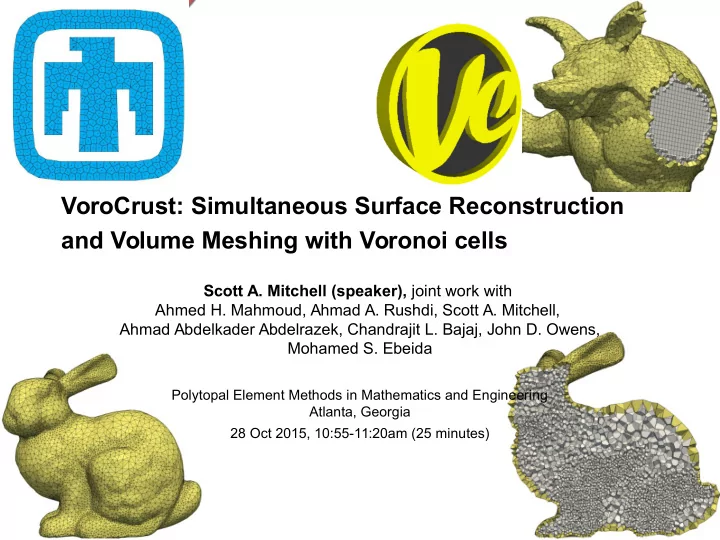
VoroCrust: Simultaneous Surface Reconstruction and Volume Meshing with Voronoi cells Scott A. Mitchell (speaker), joint work with Ahmed H. Mahmoud, Ahmad A. Rushdi, Scott A. Mitchell, Ahmad Abdelkader Abdelrazek, Chandrajit L. Bajaj, John D.


slide-1
SLIDE 1

Scott A. Mitchell (speaker), joint work with Ahmed H. Mahmoud, Ahmad A. Rushdi, Scott A. Mitchell, Ahmad Abdelkader Abdelrazek, Chandrajit L. Bajaj, John D. Owens, Mohamed S. Ebeida

Polytopal Element Methods in Mathematics and Engineering Atlanta, Georgia 28 Oct 2015, 10:55-11:20am (25 minutes)

VoroCrust: Simultaneous Surface Reconstruction and Volume Meshing with Voronoi cells

slide-2
SLIDE 2

Summary

  • VoroCrust is meshing for polytopal cells

– talk has no finite element content, just geometry

  • Output

– Produces 3D Voronoi cells

  • convex
  • planar facets
  • no sharp dihedral angles
  • good aspect ratio

– Surface (boundary) mesh is reconstructed (naturally, without clipping, snapping or cleanup) by the boundary between inside and outside 3D cells

  • planar convex 2D surface facets
  • convex 3D cells adjacent to boundary
  • not cells clipped by the boundary

– Open quality goals

  • no small edges, no sharp edge angles,

no small area faces ...

  • did other workshop talks describe what was needed in a mesh?
slide-3
SLIDE 3

ALGORITHM OVERVIEW

VoroCrust

Sandia National Laboratories

slide-4
SLIDE 4

VoroCrust Primal-Dual-Primal Dance

Input: domain with boundary (3D algorithm, illustrated in 2D) Theory for smooth manifolds Practical rules for sharp features

slide-5
SLIDE 5

Primal-Dual-Primal Dance

  • Create well-spaced sample points
  • Required properties

– Weighted Voronoi balls cover bdy – Spheres have uncovered interior and exterior point: “north” and “south” poles

  • Sufficient for uncovered poles

– local feature size lfs spacing and – no ball center inside another ball

slide-6
SLIDE 6

Primal-Dual-Primal Dance

Spheres Intersect at two points = unweighted seeds pairs

red = exterior blue = interior

Ideal: both intersection points lie outside all other balls Want seeds sufficient to reconstruct surface surface mesh nodes are Voronoi vertices surface mesh edges are Voronoi edges surface mesh triangles are Voronoi facets

slide-7
SLIDE 7

Primal-Dual-Primal Dance

Properties surface mesh nodes are Voronoi vertices surface mesh edges are Voronoi edges surface mesh triangles are Voronoi facets Build unweighted Voronoi diagram of seeds. Boundary between interior and exterior cells = surface mesh, it reconstructs surface

slide-8
SLIDE 8

Mesh Quality Enhancement

Freedom: Additional seeds outside balls. Achieve aspect ratio bound. Additional goals: lattice points for a hex-dominant mesh

slide-9
SLIDE 9

Enhancement

Freedom: Additional seeds outside balls. Achieve aspect ratio bound. Additional goals: lattice points for a hex-dominant mesh

slide-10
SLIDE 10

Examples

slide-11
SLIDE 11

Examples

Wall of Hampton Inn Atlanta, GA 

slide-12
SLIDE 12

Armadillo

slide-13
SLIDE 13

Armadillo

hex-dominant mesh is trivial extention interior seeds = lattice points (centers of hexes)

slide-14
SLIDE 14

Dragon

slide-15
SLIDE 15

Bunny – size graded mesh

slide-16
SLIDE 16

Built-in Robustness

Not water tight? Easy, sample spheres fill the gaps No parameterization, complicated topology? Easy, overlap and coverage tests are purely local, sphere radius

slide-17
SLIDE 17

Fertility

slide-18
SLIDE 18

Theory

  • Why does this work?
slide-19
SLIDE 19

Intersections and Duality

  • Intersection point pairs

– 2D: 2 circles ∧ two points – 3D: 3 spheres ∧ two points

  • Intersection points on Voronoi edge

dual to triangle

  • Three overlapping spheres =

wDel triangle, negative circumradius

G↑ G↓ p1 p3 p2 s1 s3 s2 c12 c13 c23 e13 e23 e12 G p1 p3 p2

slide-20
SLIDE 20

Intersections and Duality

  • Multiple seeds on a sphere surface,

none inside a sphere

  • Sphere center is equidistant to all these seeds

and none are closer = definition of a Voronoi vertex

G↑ G↓

Surface mesh is set of Voronoi facets that happen to be triangles

slide-21
SLIDE 21

Naïve Mirroring/Ghosting

  • Placing seeds exactly on

spheres is important

– Bad normals result from mirrored pairs without cospherical seeds around surface points.

slide-22
SLIDE 22
  • Problem

– One intersection point is covered,

  • ther is uncovered

– It happens for sliver tetrahedra (3D)

  • four points nearly cocircular and coplanar
  • Solution

– It’s not that bad

  • Consequences

– Extra surface vertex – New triangles, interpolating a sliver tetrahedra – Surface mesh still provably close to input manifold – normals?

Challenge half-covered guide pairs

slide-23
SLIDE 23
  • vs. Filtering
  • Some reconstruction

techniques select 2 triangles of sliver f123

p1 p3 p2 p4

f 2 3 4 f123

p1 p3 p2 p4

f 1 3 4

light = triangle seen from below dark = triangle seen from above

p1 p3 p2 p4

f 1 3 4 f123 upper pair lower pair

slide-24
SLIDE 24

Sliver Tetrahedra

G 2 ↑ g 1 ↑ G 1 ↓ g 2 ↓

s1 s3 s2 s4 c34

G 234 ↑ G 124 ↑ G 123 ↓ G 134 ↓

f 1 4

G2 134 ↓ G4 234 ↑

f34 f 1 2

G3 124 ↑ G1 123 ↓

f24 f13 f 2 3

p1 p3 p2 p4

n f14

G2 134 ↓ G4 234 ↑

f34 f12

G3 124 ↑ G1 123 ↓

f 2 4 f 1 3 f23

p1 p3 p2 p4

n

slide-25
SLIDE 25

Sliver Tetrahedra

f23 f14

G2 134 ↓ G4 234 ↑

f34 f12

G3 124 ↑ G1 123 ↓

f 2 4 f 1 3 f23

p1 p3 p2 p4

n

surface mesh = four green triangles

f 1 3 f 2 4 f14

p4 p3 p2 p1

n

G4 234 ↑ G3 124 ↑ G2 134 ↓ G1 123 ↓

slide-26
SLIDE 26

Power crust

  • VoroCrust vs. famous “power crust” algorithm [1998]
  • 1000 Google Scholar citations (6 papers)

Densely sample boundary. (Same lfs density.

  • vs. need sample weights =

balls covering boundary.) Use as weighted seeds. (vs. unweighted seeds) Select weighted Delaunay triangles for mesh and surface reconstruction. (vs. Voronoi cells) Far unweighted Voronoi vertices lie near medial axis. (vs. close points from weighted Voronoi edges near surface.)

images courtesy Nina Amenta, power crust author https://www.cs.utah.edu/~jeffp/8F-CG/namenta.ppt

Both have sliver issues, but they’re different issues. VoroCrust allows additional seeds and a well-shaped mesh.

slide-27
SLIDE 27

Challenge

  • Problem:

– Theory was for smooth manifolds – What about sharp CAD models?

  • Solution:

– Careful placement at sharp features, akin to Delaunay based methods

slide-28
SLIDE 28

Sharp Features

ignoring sharp features results in bad sphere overlaps small spheres can avoid overlaps ideal is to share overlaps

slide-29
SLIDE 29

Conclusion

  • VoroCrust

– Robust polyhedral meshing with true Voronoi cells has arrived – “ideal” polytopal mesh with

  • convex cells, planar facets
  • no clipping
  • good aspect ratio

– provable surface convergence

  • Status

– paper nearly complete – reimplementing production software

  • Open

– mesh quality

  • short edges, sharp edge angles, small area faces

– mesh quality needed for polytopal elements?

  • seeds interior to the volume, want surface ones too?

– (bad surface normals in pathological cases?)

slide-30
SLIDE 30
  • backup slides
slide-31
SLIDE 31

Primal-Dual-Primal dance

tweaked: red: 58, 218, 75, 329, 53, 432, 74, 509.5, 204, 718, 268, 699, 444, 668, 487, 689, 608, 681, 640, 52 blue: 122, 218, 105, 329, 129, 430, 112, 509, 203, 564, 269, 588, 444, 62 black: 163, 246, 254, 271, 175, 322, 263, 346, 344, 317, 436, 2 red: 58, 218, 75, 329, 53, 432, 74, 509.5, 204, 718, 268, 699, 444, 668, 487, 689, 608, 681, 640, 52 blue 122, 218, 105, 329, 129, 430, 112, 509, 203, 564, 269, 588, 444, 62