Voltage Divider Rule Series and parallel resistors Current divider - - PowerPoint PPT Presentation

voltage divider rule
SMART_READER_LITE
LIVE PREVIEW

Voltage Divider Rule Series and parallel resistors Current divider - - PowerPoint PPT Presentation

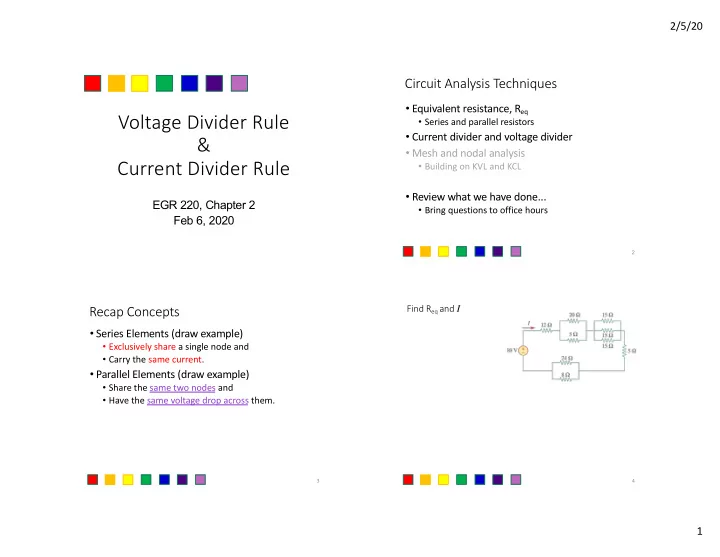
2/5/20 Circuit Analysis Techniques Equivalent resistance, R eq Voltage Divider Rule Series and parallel resistors Current divider and voltage divider & Mesh and nodal analysis Current Divider Rule Building on KVL and KCL


slide-1
SLIDE 1

2/5/20 1

Voltage Divider Rule & Current Divider Rule

EGR 220, Chapter 2 Feb 6, 2020

Circuit Analysis Techniques

  • Equivalent resistance, Req
  • Series and parallel resistors
  • Current divider and voltage divider
  • Mesh and nodal analysis
  • Building on KVL and KCL
  • Review what we have done...
  • Bring questions to office hours

2

Recap Concepts

  • Series Elements (draw example)
  • Exclusively share a single node and
  • Carry the same current.
  • Parallel Elements (draw example)
  • Share the same two nodes and
  • Have the same voltage drop across them.

3 4

Find Req and I

slide-2
SLIDE 2

2/5/20 2 Different Req for Different Terminals

5

We will discuss the role of Vs and Is later (with Thevenin equivalent)

6 7

Voltage Divider Rule

8

  • Re

Resistors and elements in Se Series…

  • Current or voltage is the same for R1 & R2?
  • Current or voltage is partitioned across R1 & R2?
  • Prove, or demonstrate, using KCL and KVL.
slide-3
SLIDE 3

2/5/20 3

Voltage Divider: Series R

  • Find v1, v2 in terms of vsrc, R1 & R2 →

derive the expression

9

Voltage Divider: Series R

  • Solve for v1 and v2
  • Which resistor will have the

larger V drop?

10

V-Divider Discussion

11

Current Divider Rule

12

  • Re

Resistors, elements and branches in Pa Parallel…

  • Current Divider:
  • I is partitioned, flowing through these resistors
  • What is the relationship of V for each element?
  • Prove, or demonstrate, using KCL and KVL.
slide-4
SLIDE 4

2/5/20 4

Current Divider: Parallel R

13

i

R1 R2

  • Find i1, i2 in terms of isrc, R1 & R2
  • Derive the expression…

Current Divider: Parallel R

  • Solve for i1 and i2
  • Which R will carry the larger current?

14

I-Divider Discussion

15

Lab Experiments – Find RMultimeter

16

(1) R = 10MΩ (2) R = 10kΩ

slide-5
SLIDE 5

2/5/20 5

Lab Experiments – Find RMultimeter

17

R = 10MΩ

Lab Experiments – Find RMultimeter

18

R = 10kΩ

Ammeter – Introduced Error

19

  • Find the current I in circuit (a).
  • An ammeter with an internal resistance of 1W is inserted in the

network to measure I' as shown circuit (b). Does current, I’, increase or decrease relative to part (a)?

Ammeter – Introduced Error

20

slide-6
SLIDE 6

2/5/20 6

Voltmeter – Introduced Error

21

  • Calculate the voltage Vo in circuit (a).
  • Is the voltage V’o, measured when a voltmeter with 6-kW

internal resistance is connected as in figure (b), greater or less than Vo in circuit (a)?

Voltmeter – Introduced Error

22

Fundamental Analysis Tools for the Semester

  • Basic analysis laws
  • Ohm’s law
  • KVL: Kirchhoff’s voltage law
  • KCL: Kirchhoff’s current law
  • Analysis tools using the basic laws
  • Equivalent resistance
  • Current divider
  • Voltage divider
  • Mesh analysis
  • Nodal analysis
  • Equivalent Circuits

24

Questions?