Visual Encodings of Temporal Times are often imprecise The - - PowerPoint PPT Presentation

visual encodings of temporal
SMART_READER_LITE
LIVE PREVIEW

Visual Encodings of Temporal Times are often imprecise The - - PowerPoint PPT Presentation

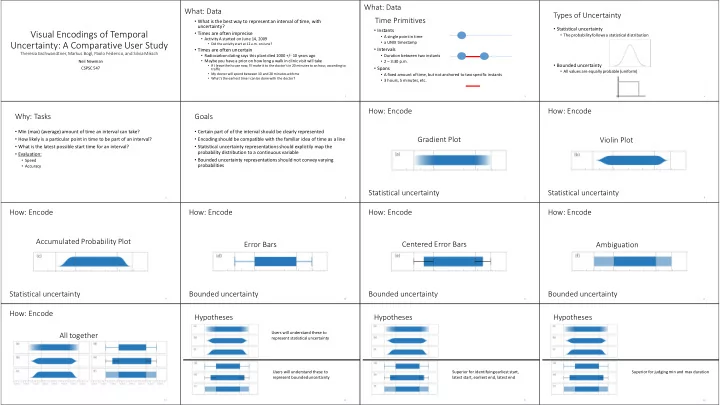
What: Data What: Data Types of Uncertainty Time Primitives What is the best way to represent an interval of time, with uncertainty? Statistical uncertainty


slide-1
SLIDE 1

Visual ¡Encodings ¡of ¡Temporal ¡ Uncertainty: ¡A ¡Comparative ¡User ¡Study

TheresiaGschwandtner, ¡Markus ¡Bogl, ¡Paolo ¡Federico, ¡and ¡Silvia ¡Miksch Neil ¡Newman CSPSC ¡547

What: ¡Data

  • What ¡is ¡the ¡best ¡way ¡to ¡represent ¡an ¡interval ¡of ¡time, ¡with ¡

uncertainty?

  • Times ¡are ¡often ¡imprecise
  • Activity ¡A ¡started ¡on ¡June ¡14, ¡2009
  • Did ¡the ¡activity ¡start ¡at ¡12 ¡a.m. ¡on ¡June?
  • Times ¡are ¡often ¡uncertain
  • Radiocarbon ¡dating ¡says ¡this ¡plant ¡died ¡1000 ¡+/-­‑ 10 ¡years ¡ago
  • Maybe ¡you ¡have ¡a ¡prior ¡on ¡how ¡long ¡a ¡walk ¡in ¡clinic ¡visit ¡will ¡take
  • If ¡I ¡leave ¡the ¡house ¡now, ¡I’ll ¡make ¡it ¡to ¡the ¡doctor’s ¡in ¡20 ¡minutes ¡to ¡an ¡hour, ¡according ¡to ¡

traffic

  • My ¡doctor ¡will ¡spend ¡between ¡10 ¡and ¡20 ¡minutes ¡with ¡me
  • What’s ¡the ¡earliest ¡time ¡I ¡can ¡be ¡done ¡with ¡the ¡doctor? ¡

2

Time ¡Primitives

  • Instants
  • A ¡single ¡point ¡in ¡time
  • a ¡UNIX ¡timestamp
  • Intervals
  • Duration ¡between ¡two ¡instants
  • 2 ¡– 3:30 ¡p.m. ¡
  • Spans
  • A ¡fixed ¡amount ¡of ¡time, ¡but ¡not ¡anchored ¡to ¡two ¡specific ¡instants
  • 3 ¡hours, ¡5 ¡minutes, ¡etc.

3

What: ¡Data Types ¡of ¡Uncertainty

  • Statistical ¡uncertainty
  • The ¡probability ¡follows ¡a ¡statistical ¡distribution
  • Bounded ¡uncertainty
  • All ¡values ¡are ¡equally ¡probable ¡(uniform)

4

Why: ¡Tasks

  • Min ¡(max) ¡(average) ¡amount ¡of ¡time ¡an ¡interval ¡can ¡take?
  • How ¡likely ¡is ¡a ¡particular ¡point ¡in ¡time ¡to ¡be ¡part ¡of ¡an ¡interval?
  • What ¡is ¡the ¡latest ¡possible ¡start ¡time ¡for ¡an ¡interval?
  • Evaluation:
  • Speed
  • Accuracy

5

Goals

  • Certain ¡part ¡of ¡of ¡the ¡interval ¡should ¡be ¡clearly ¡represented
  • Encoding ¡should ¡be ¡compatible ¡with ¡the ¡familiar ¡idea ¡of ¡time ¡as ¡a ¡line
  • Statistical ¡uncertainty ¡representations ¡should ¡explictily map ¡the ¡

probability ¡distribution ¡to ¡a ¡continuous ¡variable

  • Bounded ¡uncertainty ¡representations ¡should ¡not ¡convey ¡varying ¡

probabilities

6

Gradient ¡Plot

7

How: ¡Encode Statistical ¡uncertainty Violin ¡Plot

8

How: ¡Encode Statistical ¡uncertainty Accumulated ¡Probability ¡Plot

9

How: ¡Encode Statistical ¡uncertainty Error ¡Bars

10

How: ¡Encode Bounded ¡uncertainty Centered ¡Error ¡Bars

11

How: ¡Encode Bounded ¡uncertainty Ambiguation

12

How: ¡Encode Bounded ¡uncertainty All ¡together

13

How: ¡Encode Hypotheses

14

Users ¡will ¡understand ¡these ¡to ¡ represent ¡statistical ¡uncertainty Users ¡will ¡understand ¡these ¡to ¡ represent ¡bounded ¡uncertainty

Hypotheses

15

Superior ¡for ¡identifying ¡earliest ¡start, ¡ latest ¡start, ¡earliest ¡end, ¡latest ¡end

Hypotheses

16

Superior ¡for ¡judging ¡min ¡and ¡max ¡duration

slide-2
SLIDE 2

Hypotheses

17

Superior ¡for ¡judging ¡average ¡duration ¡of ¡ interval

Hypotheses

18

Equal ¡for ¡judging ¡probability ¡that ¡a ¡point ¡ falls ¡in ¡interval

Data

  • Generated ¡a ¡uniform ¡day, ¡month ¡in ¡2014
  • Randomly ¡add ¡/ ¡subtract ¡hours ¡to ¡get ¡start ¡times, ¡end ¡times
  • Fixed ¡time ¡scale ¡for ¡all ¡visualizations
  • Normal ¡CDF ¡for ¡statistical ¡uncertainty

19

Participants

  • 73 ¡Computer ¡Science ¡students, ¡taking ¡a ¡viz course
  • 14 ¡female

20

Tasks

21

Does ¡this ¡represent ¡statistical ¡or ¡bounded ¡uncertainty? ¡ (Repeated ¡for ¡each ¡of ¡the ¡6)

Tasks

22

Earliest ¡(Latest) ¡possible ¡start ¡(end)? ¡Min ¡(max) ¡(average) ¡duration? ¡ (Repeated ¡for ¡each ¡of ¡the ¡6)

Tasks

23

P(already_started) ¡= ¡? P(already_ended) ¡= ¡? ¡ (Repeated ¡for ¡each ¡of ¡the ¡3 ¡statistical ¡visualizations)

Tasks

24

Preferences ¡(5 ¡point ¡scale) ¡for ¡each ¡viz

Experimental ¡Design ¡Flaws

  • Earliest ¡start, ¡latest ¡start, ¡earliest ¡end, ¡latest ¡end ¡are ¡confusing ¡terms ¡

that ¡are ¡easy ¡to ¡mix ¡up

  • “The ¡probability ¡the ¡interval ¡has ¡already ¡ended” ¡is ¡1 ¡– “The ¡

probability ¡the ¡interval ¡is ¡ongoing”

25

Hypotheses

26

Users ¡will ¡understand ¡these ¡to ¡ represent ¡statistical ¡uncertainty Users ¡will ¡understand ¡these ¡to ¡ represent ¡bounded ¡uncertainty

27

Hypotheses

28

Superior ¡for ¡identifying ¡earliest ¡start, ¡ latest ¡start, ¡earliest ¡end, ¡latest ¡end

29

Hypotheses

30

Superior ¡for ¡judging ¡min ¡and ¡max ¡duration

31

Hypotheses

32

Superior ¡(faster, ¡more ¡accurate) ¡for ¡ judging ¡average ¡duration ¡of ¡interval

slide-3
SLIDE 3

33

Hypotheses

34

Equal ¡(speed, ¡accuracy) ¡for ¡judging ¡ probability ¡that ¡a ¡point ¡falls ¡in ¡interval

35 36

Preferences Criticisms

  • Does ¡it ¡make ¡sense ¡to ¡compare ¡statistical ¡and ¡bounded ¡distributions ¡

in ¡the ¡same ¡visualizations? ¡

  • Limited ¡scope ¡of ¡what ¡was ¡tested: ¡normal ¡distribution, ¡no ¡cases ¡

where ¡the ¡certain ¡part ¡of ¡the ¡interval ¡is ¡shorter ¡than ¡it’s ¡starting ¡ uncertainty

  • Dependencies ¡between ¡intervals ¡were ¡not ¡explored

37

Conclusions

  • Compared ¡six ¡ways ¡of ¡encoding ¡temporal ¡uncertainty
  • If ¡you ¡don’t ¡need ¡statistical ¡uncertainty, ¡any ¡of ¡the ¡three ¡bounded ¡

encodings ¡are ¡good

  • Gradient ¡plots ¡are ¡best ¡for ¡statistical ¡uncertainty

38