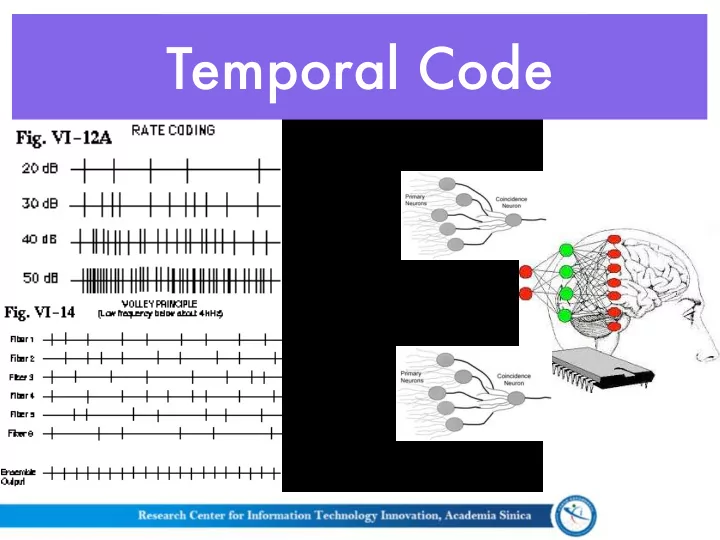
SLIDE 1
Temporal Code Temporal Code Temporal Code (Acoustic Front-end) - - PowerPoint PPT Presentation
Temporal Code Temporal Code Temporal Code (Acoustic Front-end) Human Recognition Machine Recognition RECOGNIZED UTTERANCE LANGUAGE MODELING (Back-end) HYPOTHESIZED UTTERANCES STATISTICAL SEQUENCE RECOGNITION ACOUSTIC REPRESENTATION
SLIDE 2
SLIDE 3
Temporal Code
(Acoustic Front-end)
SLIDE 4
Human Recognition
SLIDE 5
Machine Recognition
(Back-end)
SPEECH WAVEFORM RECOGNIZED UTTERANCE ACOUSTIC REPRESENTATION HYPOTHESIZED UTTERANCES
ACOUSTIC FRONT END STATISTICAL SEQUENCE RECOGNITION LANGUAGE MODELING
SLIDE 6
Human vs. Machine
SLIDE 7
“Top-down” Processing
SLIDE 8
Machine Training
- Aurora-4 Speech Database
- Wall Street Journal (WSJO) Corpus
- Large Vocabulary Continuous Speech Recognition
- 7,138 clean speech utterances, 16kHz
SLIDE 9
Human Training
- Wernicke’s Area: Speech Understanding
- Broca’s Area: Speech Production
SLIDE 10
Acoustic Model
Emission Probability Density Transition Probability
Hidden Markov Model (HMM)
- Each triphone characterized
by HMM consisting of 3 states, 8 Gaussian mixtures per state
SLIDE 11
Acoustic Model
- Maximum likelihood (ML)
training applied to estimate a set of context-dependent triphone acoustic models
SLIDE 12
Language Model
- Standard 5k lexicon
(CMU pronouncing Dictionary)
- Tri-gram language model
SLIDE 13
Decoder
- Single-pass Viterbi beam
search-based decoder
SLIDE 14
- Noise-Vocoder
- Tone-Vocoder
Human Recognition
SLIDE 15
CI Recognition
SLIDE 16
Normal Hearing vs. CI
- Cochlear Implant range (hatched area) compared
with average normal hearing scores (filled squares)
SLIDE 17
CI vs. Machine Recognition
- ASR provided most accurate simulation ever!
SLIDE 18
Machine Recognition
- ASR derived by world’s best auditory scientists
SLIDE 19
Effects of Training
SLIDE 20
Effects of Training
SLIDE 21
Effects of Training
SLIDE 22
Clinical Implications
- Alter Frequency Allocation
- Deactivate Interfering Electrodes
- Alter Compression Curve
- Modify Electric Pulse Width
SLIDE 23
Summary
SLIDE 24
Information Technology
- 2014, HMM can now improve Hearing Science
SLIDE 25
Future Work
- Design improved signal
processing to mimic:
- 1) Place code of neurons
- 2) Neural Firing Rates
SLIDE 26
FAME Strategy
- Frequency Amplitude Modulation Encoder
SLIDE 27
SLIDE 28
SLIDE 29
SOUND
Spectral Or Undertone Normalization Decomposition