Visual Analytics Approach to User-Controlled Evacuation Scheduling - - PDF document

visual analytics approach to user controlled evacuation
SMART_READER_LITE
LIVE PREVIEW

Visual Analytics Approach to User-Controlled Evacuation Scheduling - - PDF document

Visual Analytics Approach to User-Controlled Evacuation Scheduling Natalia & Gennady Andrienko, Ulrich Bartling Fraunhofer Institute IAIS Sankt Augustin Germany http://www.ais.fraunhofer.de/and Outline Introduction Problem


slide-1
SLIDE 1

1

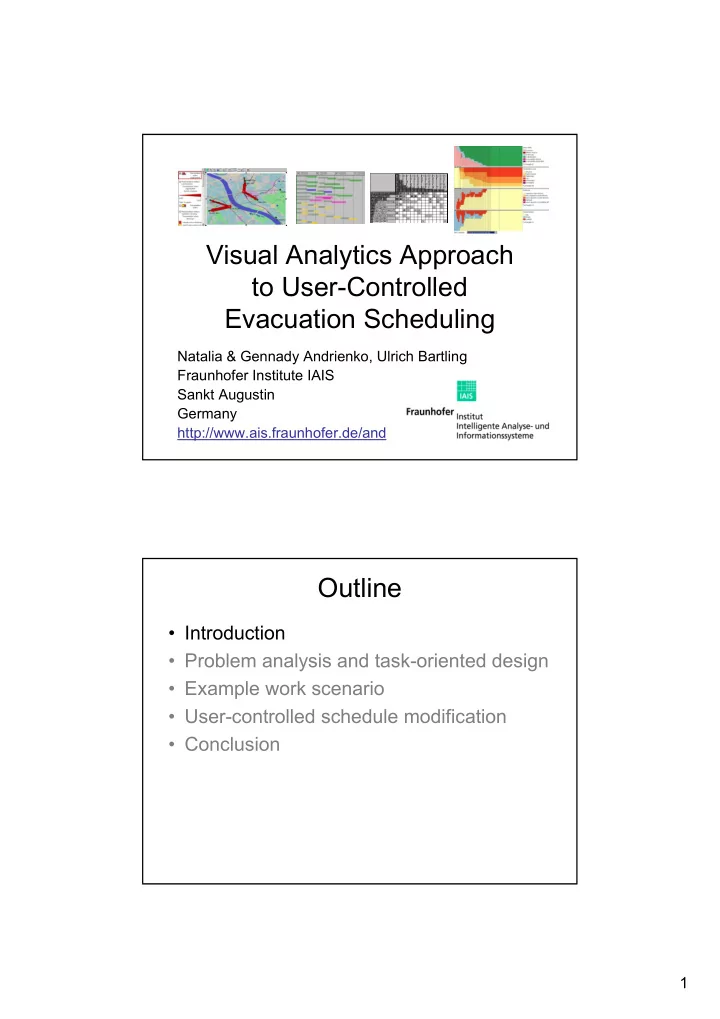
Visual Analytics Approach to User-Controlled Evacuation Scheduling

Natalia & Gennady Andrienko, Ulrich Bartling Fraunhofer Institute IAIS Sankt Augustin Germany http://www.ais.fraunhofer.de/and

Outline

  • Introduction
  • Problem analysis and task-oriented design
  • Example work scenario
  • User-controlled schedule modification
  • Conclusion
slide-2
SLIDE 2

2

“GeoVisual Analytics for Spatial Decision Support: Setting the Research Agenda”, IJGIS, 2007, v.21(8)

In particular: specifics and complexities of decision problems involving geographical space and time

Problems involving geographical space and time Time-critical decision problems

Emergency evacuation problem Require high efficiency Involve much data Complex Ill-defined Depend on tacit knowledge and criteria

Computational methods Human expert

×

Synergy required!

No adequate computer representation for geographic space

Background knowledge Understanding of geographical space Experience Intuition

slide-3
SLIDE 3

3

Vehicle class Operation Vehicle ID Vehicle home base Source ID Source name Destination ID Destination name Start End Item class ID Item class name Number
  • f items
20 Pick Up 41 Children clinics 75 Children clinics 60 Braun and Co 00:00:00 00:00:04 0 EMPTY 1 20 Deliver 41 Children clinics 75 Children clinics 60 Braun and Co 00:00:00 00:00:04 0 EMPTY 1 20 Pick Up 41 Children clinics 60 Braun and Co 68 St. John Hospital 00:00:04 00:00:30 21 invalids who cannot seat 2 20 Deliver 41 Children clinics 60 Braun and Co 68 St. John Hospital 00:00:04 00:00:30 21 invalids who cannot seat 2 20 Pick Up 41 Children clinics 68 St. John Hospital 22 St. Peter Hospital 00:00:51 00:00:54 0 EMPTY 1 20 Deliver 41 Children clinics 68 St. John Hospital 22 St. Peter Hospital 00:00:51 00:00:54 0 EMPTY 1 20 Pick Up 41 Children clinics 22 St. Peter Hospital 40 Spa healing house 00:00:54 00:01:22 21 invalids who cannot seat 2 20 Deliver 41 Children clinics 22 St. Peter Hospital 40 Spa healing house 00:00:54 00:01:22 21 invalids who cannot seat 2 10 Pick Up 102 City coach park 109 City coach park 60 Braun and Co 00:00:00 00:00:05 0 EMPTY 1 10 Deliver 102 City coach park 109 City coach park 60 Braun and Co 00:00:00 00:00:05 0 EMPTY 1 10 Pick Up 102 City coach park 60 Braun and Co 50 Exhibition hall 00:00:05 00:00:18 10 general people or children 50 10 Deliver 102 City coach park 60 Braun and Co 50 Exhibition hall 00:00:05 00:00:18 10 general people or children 50 10 Pick Up 102 City coach park 50 Exhibition hall 32 Kindergarten 00:00:28 00:00:34 0 EMPTY 1 10 Deliver 102 City coach park 50 Exhibition hall 32 Kindergarten 00:00:28 00:00:34 0 EMPTY 1 10 Pick Up 102 City coach park 32 Kindergarten 41 Descartes School 00:00:34 00:00:51 10 general people or children 50 10 Deliver 102 City coach park 32 Kindergarten 41 Descartes School 00:00:34 00:00:51 10 general people or children 50 10 Pick Up 48 City coach park 109 City coach park 60 Braun and Co 00:00:00 00:00:05 0 EMPTY 1 10 Deliver 48 City coach park 109 City coach park 60 Braun and Co 00:00:00 00:00:05 0 EMPTY 1 10 Pick Up 48 City coach park 60 Braun and Co 49 Leonardo School 00:00:05 00:00:18 10 general people or children 50 10 Deliver 48 City coach park 60 Braun and Co 49 Leonardo School 00:00:05 00:00:18 10 general people or children 50 10 Pick Up 48 City coach park 49 Leonardo School 5 Frings Gymnasium 00:00:28 00:00:33 0 EMPTY 1 10 Deliver 48 City coach park 49 Leonardo School 5 Frings Gymnasium 00:00:28 00:00:33 0 EMPTY 1 10 Pick Up 48 City coach park 5 Frings Gymnasium 41 Descartes School 00:00:33 00:00:48 10 general people or children 50 10 Deliver 48 City coach park 5 Frings Gymnasium 41 Descartes School 00:00:33 00:00:48 10 general people or children 50 10 Pick Up 78 City coach park 109 City coach park 21 Kindergarten 00:00:00 00:00:05 0 EMPTY 1 10 Deliver 78 City coach park 109 City coach park 21 Kindergarten 00:00:00 00:00:05 0 EMPTY 1 10 Pick Up 78 City coach park 21 Kindergarten 50 Exhibition hall 00:00:05 00:00:19 10 general people or children 20 10 Deliver 78 City coach park 21 Kindergarten 50 Exhibition hall 00:00:05 00:00:19 10 general people or children 20 10 Pick Up 78 City coach park 50 Exhibition hall 18 Albert College 00:00:29 00:00:35 0 EMPTY 1 10 Deliver 78 City coach park 50 Exhibition hall 18 Albert College 00:00:29 00:00:35 0 EMPTY 1 10 Pick Up 78 City coach park 18 Albert College 42 Riverside hall 00:00:35 00:00:52 10 general people or children 50 10 Deliver 78 City coach park 18 Albert College 42 Riverside hall 00:00:35 00:00:52 10 general people or children 50 12 Pick Up 117 Bus travel company 110 Bus travel company 60 Braun and Co 00:00:00 00:00:06 0 EMPTY 1 12 Deliver 117 Bus travel company 110 Bus travel company 60 Braun and Co 00:00:00 00:00:06 0 EMPTY 1 12 Pick Up 117 Bus travel company 60 Braun and Co 42 Riverside hall 00:00:06 00:00:23 10 general people or children 100 12 Deliver 117 Bus travel company 60 Braun and Co 42 Riverside hall 00:00:06 00:00:23 10 general people or children 100

Approach

Input: data, goals, criteria, … Draft solution

produces assesses

Improved solution Accepted solution

guides produces assesses

Requires visualisation!

?

Background knowledge Understanding of geographical space Experience Intuition

Outline

  • Introduction
  • Problem analysis and task-oriented design
  • Example work scenario
  • User-controlled schedule modification
  • Conclusion
slide-4
SLIDE 4

4

Emergency evacuation problem

  • Several categories of people

– General public; critically sick or injured people; disabled people who can/cannot sit, prisoners, …

  • Multiple source locations

– Number of people of different categories – Time constraints (e.g. latest allowed departure time)

  • Multiple destinations

– Suitability and capacity for different categories

  • Different types of vehicles

– E.g. buses, ambulance cars, police vans, … – Suitability and capacity for different people categories

  • Task:

– divide people into groups fitting in available types of vehicles – assign the groups to suitable destinations – find appropriate vehicles to deliver them – set the times for the trips of the vehicles

Scheduling Algorithm

  • For transportation problems, heuristic methods work

better than deterministic approaches

  • We apply Breeder Genetic Algorithm (devised by

Bartling & Muehlenbein)

  • Extended functionality as compared to typical tools for

business applications:

– Divides the total number of people in a location into groups fitting in available vehicles – Chooses an appropriate destination for each group

  • “Any-time” method:

– valid solution exists at any moment – while the quality is progressively improved as the algorithm continues its work
slide-5
SLIDE 5

5

Algorithm output

∼ 400 transportation orders e.g.

  • 14 source locations
  • 4692 people
  • 6 categories
  • 105 vehicles
  • 7 vehicle types
  • 25 destinations

OrderId SourceName DestName ItemClass Number VhclId VhclType VhclHBName StartTime EndTime 12-4 St. John Hospital

  • St. Peter Hospital

LEER 12 20 University clinics 00:32:40 00:40:40 72-1 Braun and Co Exhibition hall general people or children 50 72 10 City coach park 00:11:00 00:20:40 61-4 Albert College Descartes School general people or children 40 61 10 City coach park 00:31:00 00:50:20 29-1 Braun and Co Rehabilitation Centre critically sick or injured people 1 29 21 Children Clinics 00:05:00 00:11:20 63-0 City coach park ABC mall LEER 63 10 City coach park 00:00:00 00:11:00 43-6 Beethoven Gymnasiu Galileo College general people or children 50 43 10 City coach park 00:48:20 01:11:00 53-0 City coach park ABC mall LEER 53 10 City coach park 00:00:00 00:11:00 12-1 St. Peter Hospital University clinics invalids who cannot seat 2 12 20 University clinics 00:08:00 00:16:10 56-3 Kindergarten Plato Gympasium general people or children 50 56 10 City coach park 00:33:20 00:50:00 58-4 Albert College City hall general people or children 20 58 10 City coach park 00:37:00 00:43:40 46-0 City coach park Real school LEER 46 10 City coach park 00:00:00 00:13:00 43-1 ABC mall Leonardo School general people or children 20 43 10 City coach park 00:12:00 00:21:40 58-5 City hall Albert College LEER 58 10 City coach park 00:44:40 00:50:40 91-2 Elder home Children Clinics sabled people using wheelchairs 8 91 13 Bus travel compan 00:27:40 00:36:00 86-0 Bus travel company AAlbert College LEER 86 10 Bus travel compan 00:00:00 00:11:00 61-1 Braun and Co City hall general people or children 40 61 10 City coach park 00:11:00 00:23:40 23-0 Children Clinics Braun and Co LEER 23 20 Children Clinics 00:00:00 00:05:00 47-1 Braun and Co Helmholtz Gymnasium general people or children 50 47 10 City coach park 00:11:00 00:24:40 40-5 Beethoven Gymnasiu St. Teresa's school general people or children 20 40 10 City coach park 00:28:40 00:44:40 52-4 St.Joseph's basic schHelmholtz Gymnasium general people or children 50 52 10 City coach park 00:34:20 00:44:00 20-3 Elder home Children clinics invalids who cannot seat 2 20 20 St. John Hospital 00:26:20 00:33:30 103-0 Jailhouse Prison LEER 103 30 Jailhouse 00:00:00 00:46:00 11-0 St. Peter Hospital Braun and Co LEER 11 21 St. Peter Hospital 00:00:00 00:08:00 17-1 Braun and Co Children clinics critically sick or injured people 1 17 21 University clinics 00:16:00 00:22:20 6-2 Braun and Co Children clinics invalids who cannot seat 2 6 20 St. Peter Hospital 00:17:20 00:23:30 58-3 Exhibition hall Albert College LEER 58 10 City coach park 00:22:00 00:37:00 54-2 City hall Albert College LEER 54 10 City coach park 00:25:20 00:31:20 52-2 Braun and Co City hall general people or children 40 52 10 City coach park 00:13:20 00:25:40 44-0 City coach park Braun and Co LEER 44 10 City coach park 00:00:00 00:11:00 52-5 Helmholtz Gymnasium St.Joseph's basic scho LEER 52 10 City coach park 00:45:40 00:53:40 61-3 City hall Albert College LEER 61 10 City coach park 00:25:00 00:31:00 25-6 University clinics

  • St. Peter Hospital

LEER 25 20 Children Clinics 00:47:00 00:55:00 61-0 City coach park Braun and Co LEER 61 10 City coach park 00:00:00 00:11:00 81-5 Albert College Heighbourhood House general people or children 40 81 10 City coach park 00:56:00 01:08:20

No time to inspect all the orders! Cannot be summarized in a few indicators!

Schedule evaluation

Questions to be answered:

  • Does the plan achieve the goal?

Goal: all people are timely delivered to appropriate destination places by appropriate vehicles

  • Is it feasible?
  • Is it rational?
slide-6
SLIDE 6

6

Possible problems

Choice of distant destinations Lower priority; may be examined when time permits Idle vehicles Low use of vehicle capacities May be a problem or an advantage; requires human’s local knowledge Multiple vehicles in same place Excluded by the algorithm, but correctness should be demonstrated Overuse of resources Delivery to improper places Use of improper vehicles Late deliveries w.r.t. time constraints Can emerge due to lack or deficiency of resources Require human to find appropriate corrective measures (additional vehicles, additional or intermediate destinations, …) Undelivered people

Effectiveness problems (i.e. goal not attained) Feasibility problems Rationality problems

Requirements

  • The presence or absence of effectiveness and

feasibility problems must be immediately visible

  • In case of problems, the reasons must be

immediately seen or easy to find out

– Undelivered people, use of improper destinations ⇐ lack of suitable destinations – Late deliveries, use of improper vehicles ⇐ deficiency

  • f suitable vehicles

– Multiple vehicles in same place: examine each place individually

  • It must be possible to spot and explore

rationality problems when time permits

slide-7
SLIDE 7

7

Visual Analytics Approach

‘Visual Analytics Mantra’ by D.Keim: Analyze First – Show the Important – Zoom, Filter and Analyze Further – Details on Demand

Input data Scheduling algorithm Schedule Computational analysis module Secondary data

Interactive visual interfaces

User’s evaluation feedback Queries

Outline

  • Introduction
  • Problem analysis and task-oriented design
  • Example work scenario
  • User-controlled schedule modification
  • Conclusion
slide-8
SLIDE 8

8

Analyze First – Show the Important

Summary display of the transportation progress:

Delay in transportation Some people are not delivered

Signals of problems:

Reason: lack of destinations

will be seen here

Reason: not enough vehicles Not always the reason is evident…

will be seen here

Zoom, Filter and Analyze Further

Find a non-evident reason for a delay

At this time we shall have 5 free vehicles! But they will be here… …while we need them here! This is the earliest possible time for taking the remaining prisoners The return trip takes 47 minutes

slide-9
SLIDE 9

9

Details on demand Zoom, Filter and Analyze Further

Check the feasibility

permutable matrix shows the numbers of trips between pairs of locations

So many trips to ‘Braun and Co’! How are they distributed in time? 23 buses come simultaneously!

…but this is a big chemical plant with a large parking

slide-10
SLIDE 10

10

Details on demand Zoom, Filter and Analyze Further

Assess the rationality

The choice of the destinations for the critically sick and injured persons seems quite reasonable But it is hard to see anything when we focus

  • n the general people…
slide-11
SLIDE 11

11

Zoom, Filter and Analyze Further

Number

  • f items

Travel time T-shaped signs:

Assess the rationality (continued)

Some people will be moved quite far… … while the capacities in the closer destinations are not fully used

The planner may wish to change this…

if the time permits!

Outline

  • Introduction
  • Problem analysis and task-oriented design
  • Example work scenario
  • User-controlled schedule modification
  • Conclusion
slide-12
SLIDE 12

12

Reasons for Schedule Modification

  • Undelivered people

– Requires finding additional destinations

  • Unacceptable delays

– Requires finding additional vehicles or closer destinations (possibly, intermediate)

  • Multiple vehicles in same place

– The planner may shift some orders forward in time

  • Non-rational choice of destinations and use of capacities

in destinations

– The planner may exclude distant places

  • Situation changes after the evacuation started

– New people appear, some destinations become unavailable (e.g. roads blocked), some vehicles get out of use, trips take longer than expected, …

General Procedure

  • Divide the orders into fixed and modifiable

– by people category (e.g. ‘critically sick’ → fixed, ‘prisoners’ → modifiable) – by time: fix all trips starting before t

  • in particular, for adapting to the changing situation

– by source location (e.g. from ‘Braun and Co’ → modifiable) – by a combination of these criteria

  • Update the input data

– Add data about new sources, people, resources – Remove unavailable resources – Correct the travel times

  • Re-run the scheduling algorithm (it is

appropriately designed)

slide-13
SLIDE 13

13

Conclusion

Solving complex problems related to space & time requires a synergy between computers and human experts Visual analytics methods can support this We did a task-oriented design of VA tools for schedule assessment We verified the adequacy of the tools Trials with users are planned