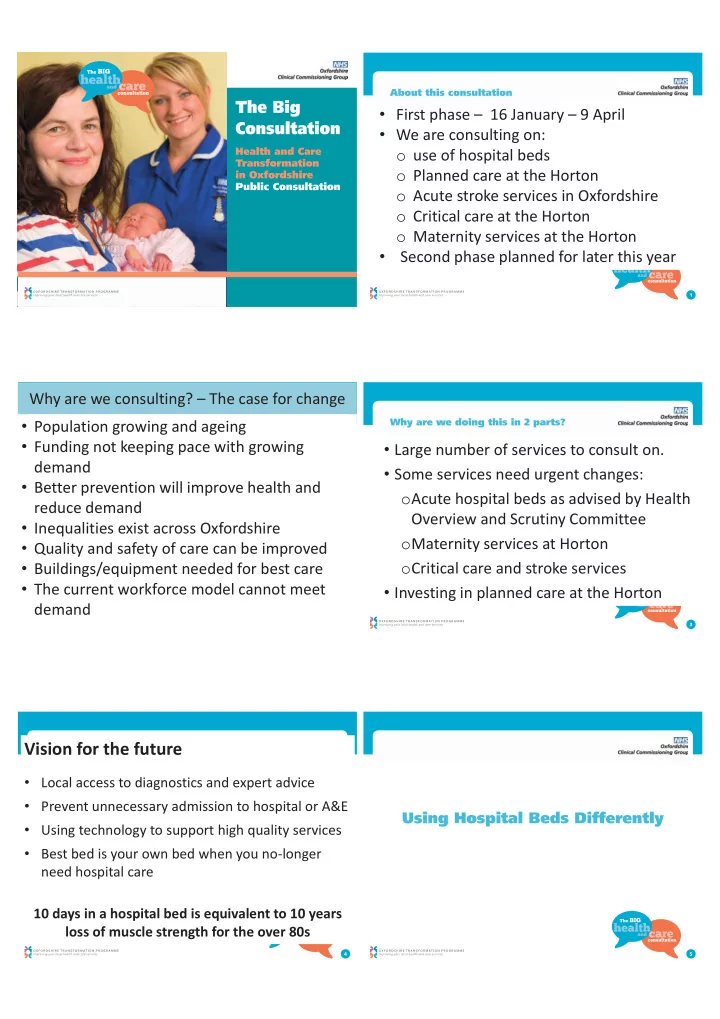
Vision for the future Local access to diagnostics and expert advice - - PDF document

vision for the future
SMART_READER_LITE
LIVE PREVIEW

Vision for the future Local access to diagnostics and expert advice - - PDF document

First phase 16 January 9 April We are consulting on: o use of hospital beds o Planned care at the Horton o Acute stroke services in Oxfordshire o Critical care at the Horton o Maternity services at the Horton Second phase


slide-1
SLIDE 1
  • First phase – 16 January – 9 April
  • We are consulting on:
  • use of hospital beds
  • Planned care at the Horton
  • Acute stroke services in Oxfordshire
  • Critical care at the Horton
  • Maternity services at the Horton
  • Second phase planned for later this year

Why are we consulting? – The case for change

  • Population growing and ageing
  • Funding not keeping pace with growing

demand

  • Better prevention will improve health and

reduce demand

  • Inequalities exist across Oxfordshire
  • Quality and safety of care can be improved
  • Buildings/equipment needed for best care
  • The current workforce model cannot meet

demand

  • Large number of services to consult on.
  • Some services need urgent changes:
  • Acute hospital beds as advised by Health

Overview and Scrutiny Committee

  • Maternity services at Horton
  • Critical care and stroke services
  • Investing in planned care at the Horton

Vision for the future

  • Local access to diagnostics and expert advice
  • Prevent unnecessary admission to hospital or A&E
  • Using technology to support high quality services
  • Best bed is your own bed when you no-longer

need hospital care 10 days in a hospital bed is equivalent to 10 years loss of muscle strength for the over 80s

slide-2
SLIDE 2
  • Patients spend less time in hospital and more

care is delivered closer to home.

  • More investment in ‘out-of-hospital’ care.
  • Patients cared for in the right environments.

Our proposal: 146 hospital beds have been closed as a result and we would like to keep them closed and use resources to support care out of hospital. Using Hospital beds differently

  • More planned appointments, tests, treatment

and surgery at the Horton General Hospital.

  • Increase local provision of modern diagnostics.
  • More investment in facilities.

This will mean -

  • More patients assessed and treated locally –

60,000 outpatients and 30,000 day case and diagnostic appointments each year at the Horton General Hospital.

Planned care at the Horton

  • All stroke patients should be taken to the

Hyper Acute Stroke Unit at the JR.

  • Short term rehabilitation would be

provided at the Horton.

  • The Early Supported Discharge Service

would be extended to be available for all stroke patients in Oxfordshire. Stroke care

slide-3
SLIDE 3
  • Small number of the sickest patients from

north Oxfordshire requiring Level 3 critical care would be treated at the highly specialised Intensive Care Units in Oxford.

  • The Horton General Hospital would continue to

care for patients needing Level 2 critical care.

  • This would provide appropriate care for the

sickest patients and support better outcomes.

  • Specialist team of doctors and nurses would

bring patients to Oxford.

Critical care at the Horton

  • Provision of high quality, safe and sustainable maternity service.
  • Choice maintained for women:
  • Choice of a midwife-led birth in a unit or at home.
  • Obstetric care would be provided at the John Radcliffe (JR) -

Northampton or Warwick hospitals also available.

  • The Special Care Baby Unit for Oxfordshire would be at in Oxford.
  • Emergency gynaecological surgery would be in Oxford.

Our proposal: Oxfordshire would have one obstetric unit in Oxford and a midwife-led unit would be available at the Horton. This would mean always enough staff available and enough births to maintain skills and run a safe service for all Oxfordshire women.

Maternity services at the Horton

  • All consultation documents available on the website:

www.oxonhealthcaretransformation.nhs.uk/

  • Write to us using the freepost address
  • Complete the questionnaire on the website or paper

copy

  • Attend a public meeting

Grove

15 Public meetings are being held. 13 are in Oxfordshire and two are in south Northamptonshire: Thursday 26 January, 7-9pm in Banbury Thursday 2 February, 2pm – 4pm in Chipping Norton Tuesday 7 February, 3pm – 5pm in Wantage Thursday 9 February, 7pm – 9pm in Oxford Monday 13 February, 10am – 12pm in Didcot Thursday 16 February, 6pm – 8pm in Witney Tuesday 21 February, 3pm – 5pm in Bicester Monday 27 February, 10.30am – 12.30pm in Brackley Thursday 2 March, 8pm – 10pm in Henley Monday 6 March, 8pm – 10pm in Wallingford Thursday 9 March, 6pm-8pm in Chipping Norton Tuesday 14 March, 3pm-5pm in Thame Thursday 16 March, 7pm – 9pm in Banbury Tuesday 21 March , 6pm – 8pm in Brackley Thursday 23 March, 6.30pm – 8.30pm in Abingdon

Grove

Consultation so far….

Distribution

  • NHS providers, neighbouring CCGs, county, district and parish councils
  • GP practices, libraries, children’s centres
  • Print and broadcast media, schools newsletter, NHS staff newsletters, email cascade
  • Leaflet drop in north Oxfordshire, south Northamptonshire and south Warwickshire

Public meetings:

  • 15 meetings – 13 in Oxfordshire and 2 in Brackley
  • Public asked to register in advance but meetings are open to the public
  • Busiest meetings have run as plenary – presentation followed with Q&A
  • Smaller meetings have allowed round-table discussion following presentation
  • So far more than 1000 people have attended meetings

Other meetings:

  • Meeting with voluntary organisations attended by 70 representatives
  • Attended meetings of 50+ Network, Older People Network, My Life My Choice,

Carers Responses received so far:

  • Survey: 200+ online responses and 80+ hard copy responses so far
  • Keep the Horton General: 4,900 responses to campaign survey
  • Letters and emails received from public, MPs, organisations and others
slide-4
SLIDE 4

Grove

Engaging seldom heard groups in Banbury area – ongoing

  • Developed a schedule of appointments with various community groups.
  • Documents translated into Urdu, Polish and Easy Read.
  • Attending meetings with:
  • South Asian community.
  • Multi-faith group, where Christian, Bahia, Buddhist and Sikh community

members.

  • Offered to meet with:
  • Local Mosques.
  • African/ Caribbean community groups.
  • Bicester Pastor community group meetings.
  • Chinese Advice Centre with links to the Chinese community in Banbury.
  • Polish community offering to attend an Association meeting after

church.

  • Farming community network.
  • Parents at the Sunshine Centre children’s centre.
  • Qa Research supporting engagement with people from Banbury area:
  • People with disabilities
  • Young people 16-29
  • Ethnic minority groups

Grove

Next steps

  • Complete public meetings
  • Encourage more engagement with the survey, attending

meetings and other responses

  • Continuing to update website with Q&A and audio

recordings.

  • Qa Research to analyse all feedback and produce report
  • n consultation
  • Report on the consultation to be presented to May

OCCG Board meeting with the Integrated Impact Assessment.

  • Decision to be made no earlier than June 2017