Vision 2020 Vision Where all students learn, grow, and succeed - - PDF document

vision 2020
SMART_READER_LITE
LIVE PREVIEW

Vision 2020 Vision Where all students learn, grow, and succeed - - PDF document

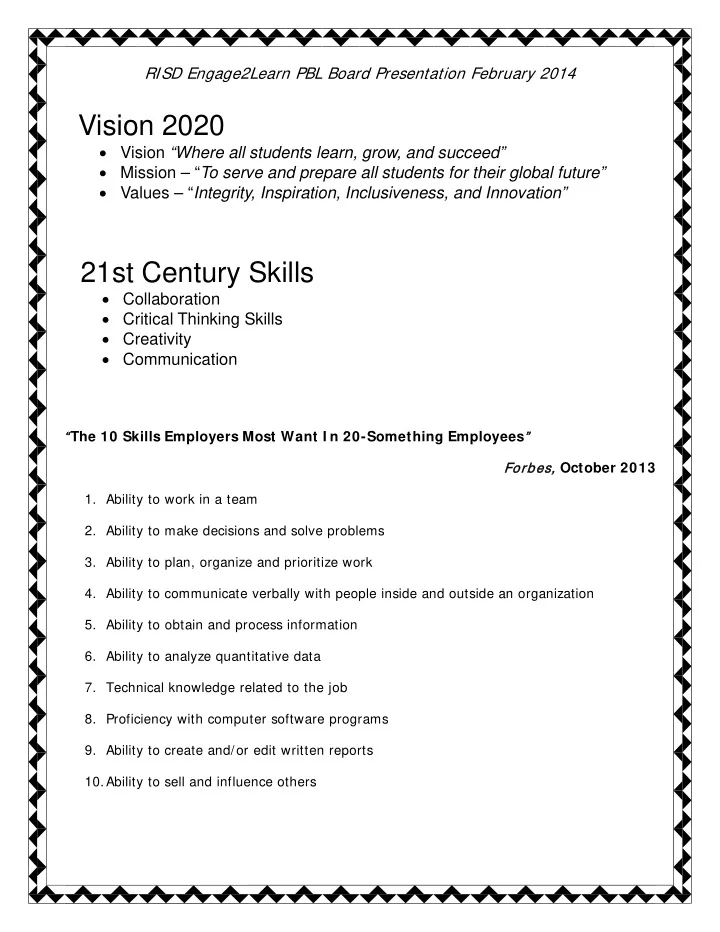
RISD Engage2Learn PBL Board Presentation February 2014 Vision 2020 Vision Where all students learn, grow, and succeed Mission To serve and prepare all students for their global future Values Integrity,


slide-1
SLIDE 1

RISD Engage2Learn PBL Board Presentation February 2014

“ The 10 Skills Employers Most Want I n 20-Something Employees” ” For

  • rbe

bes, , October 2013

  • 1. Ability to work in a team
  • 2. Ability to make decisions and solve problems
  • 3. Ability to plan, organize and prioritize work
  • 4. Ability to communicate verbally with people inside and outside an organization
  • 5. Ability to obtain and process information
  • 6. Ability to analyze quantitative data
  • 7. Technical knowledge related to the job
  • 8. Proficiency with computer software programs
  • 9. Ability to create and/or edit written reports

10. Ability to sell and influence others

Vision 2020

  • Vision “Where all students learn, grow, and succeed”
  • Mission – “To serve and prepare all students for their global future”
  • Values – “Integrity, Inspiration, Inclusiveness, and Innovation”

21st Century Skills

  • Collaboration
  • Critical Thinking Skills
  • Creativity
  • Communication
slide-2
SLIDE 2

RISD Engage2Learn PBL Board Presentation February 2014

slide-3
SLIDE 3

RISD Engage2Learn PBL Board Presentation February 2014

Engage2Learn Protocols

Launch/ Team

Launch:

  • 1. Hook
  • 2. Challenge Brief
  • 3. Rubric

Team:

  • 1. Create team name
  • 2. Agree on team roles
  • 3. Project Leader facilitates team as they create team norms
  • 4. Team members sign team contract
  • 5. Communication Manager posts check mark

Plan

  • 1. Project Leader facilitates team in analyzing challenge.
  • 2. Team identifies driving question and audience and records on

project plan.

  • 3. Team identifies project requirements and records on project plan.
  • 4. Team analyzes rubric and establishes team goal for project.
  • 5. Team completes know/need to know list based on problem

analysis and needs assessment.

  • 6. Team adds resources to need to know (N2K) list and pre-

assessment

  • 7. Team creates research questions and then research task list

utilizing all of the above and the project calendar to note desk crit dates and progress checks.

  • 8. Workshop Manager requests workshops.
  • 9. Individuals create to-do list based on team tasks and pre-

assessment.

  • 10. Communication Lead posts check mark.

Research/ Work

  • 1. Project Leader facilitates daily opening huddle.
  • 2. Team members check to-do lists and report tasks complete.
  • 3. Time manager informs team of any upcoming progress checks.
  • 4. Team adjusts task list and adds any new need to

knows/resources/research questions.

  • 5. Workshop manager makes any workshop requests or signs up for

any applicable workshops.

  • 6. Individuals create and work on to-do list for the day.
  • 7. Workshop Manager attends workshops or sends a team member.
  • 8. Project Leader facilitates daily closing huddle and adjustments to

task list.

  • 9. Team members report any research findings and record on

research summary.

  • 10. Workshop Manager shares information from workshop with team.
slide-4
SLIDE 4

RISD Engage2Learn PBL Board Presentation February 2014

Create/ Critique

  • 1. Brief plan protocol again.
  • 2. Request critique or feedback from peers, your teacher, and even

your real audience early and often during the create phase following steps 3-9 below for the critique process.

  • a. Team A shares ideas using a mind-map or other draft visual.
  • b. Team B asks clarifying questions.
  • c. Team A clarifies and asks for feedback (use rubric).
  • d. Team B provides warm feedback based on rubric and team

A's question.

  • e. Team B provides cool feedback based on rubric and team

A's question.

  • f. Team A asks any clarifying questions.
  • g. Team A & B reflect on process.
  • 3. Following critique and resulting changes and refinements, the team

completes a presentation proposal.

  • 4. Communication Manager schedules a critique with the team and

teacher to approve the product/presentation for Share.

Share

  • 1. Facilitator sets audience expectations for listening/evaluating

(use rubric, if applicable).

  • 2. Project Leader introduces team.
  • 3. Another team member shares overview of each of the following:
  • a. Project challenge
  • b. Success criteria
  • c. Procedures
  • d. Constraints
  • 4. Team presents solution.
  • 5. Team reflects on solution.
  • 6. Audience asks clarifying questions.
  • 7. Audience reflects on solution.