SLIDE 1
SLIDE 2
Vish Environment Current Work
› Knotted Torus › Colliding Galaxies
Future Projects
SLIDE 3 Software environment for implementing visualization
algorithms brought to LSU by Dr. Benger.
Vish renders objects and provides an interface to
develop them on. Vish objects may specify input slots such as scalar and vector fields and are created through a parameterized database.
These Vish objects are implemented in the class
- VObject. All VObject's may make use of parameters
which are requested during construction. Such parameters are specified via a textual description and native C++ type.
SLIDE 4
class myObject : public VObject { public:
myObject(const string&name, const VCreatorBase&VC) : VObject(name, VC) { addParam(“size”, 20); } };
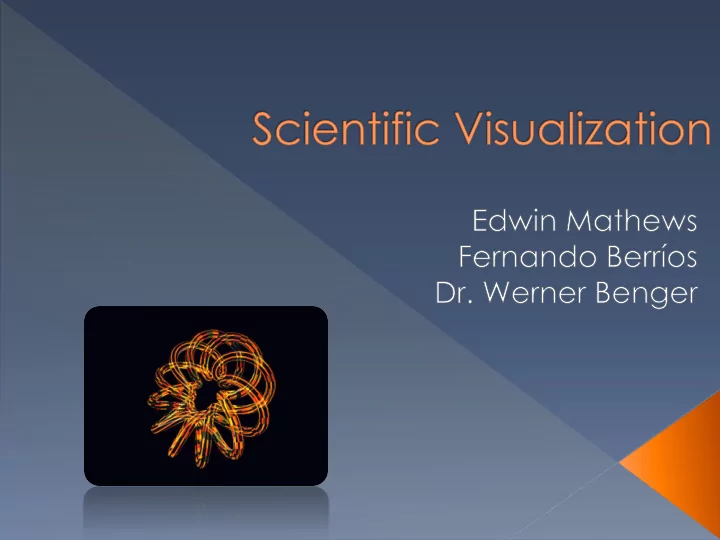
SLIDE 5 A class of knot that is specified by a pair
- f coprime integers p and q.
Given the task of converting a Windows
screensaver display into a Vish Object to create a 3D visualization of a Torus Knot.
Two very different code structures but
both using the OpenGL API
SLIDE 6
SLIDE 7
SLIDE 8
SLIDE 9
SLIDE 10
SLIDE 11
SLIDE 12 Astrophysical data set created at the
University of Innsbruck in Austria
Within the data set are scalar field data
- f particle internal energy, temperature,
potential energy, and others
For this visualization we used vector field
data of particle velocity
SLIDE 13
Using Vish, create a series of
visualizations are both useful for the scientists interpreting the data and visually stimulating for the casual viewer
Make a movie with the colliding galaxies
that captures all of its elements effectively
SLIDE 14
SLIDE 22
Colliding Galaxy Movie Further Working with Torus Knot Gaussian Curvature Module
SLIDE 23
Next step in visualization Need to determine
› Camera movement › Visualization properties › Time scales / Length / Resolution
SLIDE 24
Implementing changes in the object that
can be made directly from the GUI
› Radii, number of knots, coloring, etc.
Using the Torus to create
a 3D visualization of an M.C. Escher artwork
SLIDE 25
Visualization team is currently working
with a CFD model of a stir tank
SLIDE 26
Create a visualization means that could
represent the turbulence of the fluid in the data
Gaussian Curvature could be calculated
along pathlines of fluid particles and color coded in their visualization to illustrate the variance of curvature
SLIDE 27 Once developed, could be used for
- ther data sets where the measure of
curvature is relevant
Would be accessible from the Vish GUI
for any set of data
SLIDE 28 References
Stir Tank Streamline data http://sciviz.cct.lsu.edu/projects/vish/album/stirtankstreamlines/index.html
http://mathworld.wolfram.com/TorusKnot.html
http://sciviz.cct.lsu.edu/projects/vish/
http://www.mcescher.com/Gallery/