VisFlowConnect-IP: A Link-Based Visualization of Netflows for - - PowerPoint PPT Presentation

visflowconnect ip
SMART_READER_LITE
LIVE PREVIEW

VisFlowConnect-IP: A Link-Based Visualization of Netflows for - - PowerPoint PPT Presentation

VisFlowConnect-IP: A Link-Based Visualization of Netflows for Security Monitoring William Yurcik <byurcik@ncsa.uiuc.edu > National Center for Supercomputing Applications (NCSA) University of Illinois at Urbana-Champaign FIRST06


slide-1
SLIDE 1

William Yurcik

<byurcik@ncsa.uiuc.edu>

National Center for Supercomputing Applications (NCSA) University of Illinois at Urbana-Champaign FIRST’06 Baltimore Maryland USA

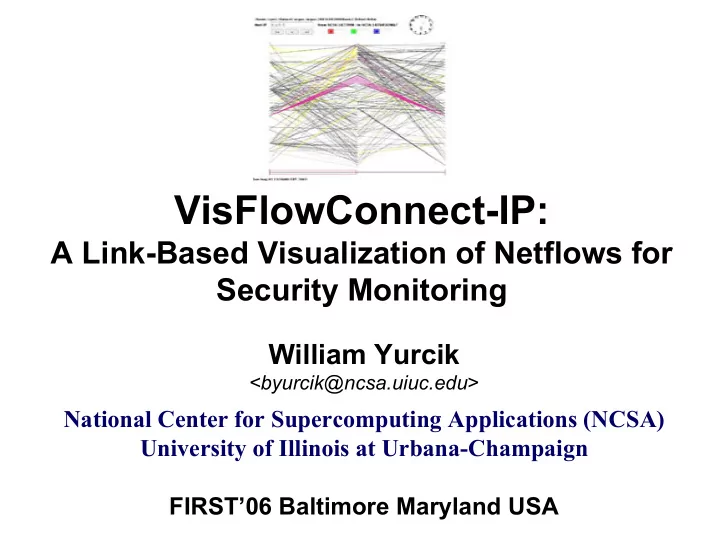
VisFlowConnect-IP:

A Link-Based Visualization of Netflows for Security Monitoring

slide-2
SLIDE 2
  • Motivation
  • Network Visualization for Security
  • Our Approach: VisFlowConnect-IP
  • Use Examples
  • Future Work: Link-Based Clustering
  • Summary

Slide 2/58

slide-3
SLIDE 3
  • Motivation

Motivation

  • Network Visualization for Security
  • Our Approach: VisFlowConnect-IP
  • Use Examples
  • Future Work: Link-Based Clustering
  • Summary

Slide 3/58

slide-4
SLIDE 4
slide-5
SLIDE 5
slide-6
SLIDE 6

More Lessons Learned from Castles

  • Even medieval castles have monitoring

systems for their innermost keeps

  • Internet security should be designed like a

castle, with multiple layers of defenses for an attacker to avoid detection

– Reduces the space of actions that an attacker can take and remain undetected – Components of a security monitoring framework can monitor each other

  • Have clear observation points

– Internet analogy are data source and process

Slide 6/58

slide-7
SLIDE 7

Fort McHenry

slide-8
SLIDE 8

OODA Loop

Slide 8/58

slide-9
SLIDE 9

OODA Loop for Internet Security

Data Sources (empirical, simulation, analytical) Storage (distributed, fast, convenient) Processing (computation, data analysis, discovery) Human Collaboration (virtual presence, transparent)

Inferences for Action Slide 9/58

slide-10
SLIDE 10

Visualization in OODA Loop

Inferences for Action

Processing (computation, data analysis, discovery) Data Sources (empirical, simulation, analytical) Storage (distributed, fast, convenient) Human Collaboration (virtual presence, transparent)

visualization visualization display systems display systems Slide 10/58

slide-11
SLIDE 11

What is Visualization?

1.235 4.351 2.981 7.989 7.112 5.231 9.722 7.111 1.562 7.544

Visual Representation Model Visual Representation Model Data Image Slide 11/58

slide-12
SLIDE 12

Visualization Can Help

Empirical Data: Visual vs Numerical (Visual Wins!)* Visual vs Auditory (Visual Wins)* Visual vs Tactile (Visual Wins)* Visual Spatial vs Visual Color (Visual Spatial Wins!)*

[Chris Wickens, National Academy of Sciences Workshop on Visualizing Uncertainty, March 3, 2005]

Slide 12/58

slide-13
SLIDE 13

Visualization Can Help

Empirical Data: Visual vs Numerical (Visual Wins!)* Visual vs Auditory (Visual Wins)* Visual vs Tactile (Visual Wins)* Visual Spatial vs Visual Color (Visual Spatial Wins!)*

[Chris Wickens, National Academy of Sciences Workshop on Visualizing Uncertainty, March 3, 2005]

How?

1) See Previously Obscured Things 2) See New Things Faster (I never saw that before) 3) Share Insights (Do you see what I mean?)

Slide 13/58

slide-14
SLIDE 14
  • Motivation
  • Network Visualization for Security

Network Visualization for Security

  • Our Approach: VisFlowConnect-IP
  • Use Examples
  • Future Work: Link-Based Clustering
  • Summary

Slide 14/58

slide-15
SLIDE 15

Current Net Vis Security Ops Tools

Slide 15/58

slide-16
SLIDE 16

Etherape by Juan Toledo can be found at http://etherape.sourceforge.net/ screenshot: http://www.solaris4you.dk/sniffersSS.html

Slide 16/58

slide-17
SLIDE 17

Lumeta’s Peacock Diagrams

Slide 17/58

slide-18
SLIDE 18

Caida’s Walrus

Slide 18/58

slide-19
SLIDE 19

Research: Network Viz for Security

  • Host-based

approaches

– Represent each host by a point – Fix each host at a certain position according to its IP – Visualize statistics of each host

  • Link-based approaches

– Represent each host by a point – Fix each host at a certain position according to its IP – Visualize traffic between hosts by linkages

(NVisionIP- NCSA) (Teoh et al, 2004)

Slide 19/58

(Elisha-Teoh et al)

slide-20
SLIDE 20

AT&T’s Graphiz

Slide 20/58

slide-21
SLIDE 21

Graphviz again

Slide 21/58

slide-22
SLIDE 22
  • Motivation
  • Network Visualization for Security
  • Our Approach:

Our Approach: VisFlowConnect VisFlowConnect-

  • IP

IP

  • Use Examples
  • Future Work: Link-Based Clustering
  • Summary

Slide 22/58

slide-23
SLIDE 23

Our Design Goals

  • Traffic dynamics over time
  • Filtering
  • Scalability
  • Expose hidden structures & patterns for

further investigation

Slide 23/58

slide-24
SLIDE 24

System Architecture

Netflow Logs Traffic Statistics

Host 1 Host 2 Host k …… ……

Host Traffic Statistics Visualization

agent

Slide 24/58

slide-25
SLIDE 25

Reading Netflow Logs

  • An agent reads records log (or streaming)

– send record to VisFlowConnect-IP when requested

  • Reorder NetFlow records with record buffer

– records are not strictly sorted by time stamps – use a record buffer

Slide 25/58

slide-26
SLIDE 26

VisFlowConnect VisFlowConnect-

  • IP

IP

Slide 26/58

slide-27
SLIDE 27
  • utside
  • utside

domains domains axis axis inside inside hosts hosts axis axis

  • utside
  • utside

domains domains axis axis

VisFlowConnect VisFlowConnect-

  • IP

IP Main View Main View

Slide 27/58

slide-28
SLIDE 28

Internal Internal network network sources sources Internal Internal network network receivers receivers

VisFlowConnect VisFlowConnect-

  • IP

IP Internal View Internal View

Slide 28/58

slide-29
SLIDE 29

NVisionIP

VisFlowConnect-IP

VisFlowConnect VisFlowConnect-

  • IP

IP Domain View Domain View

see see activity activity within an within an external external network network domain domain Slide 29/58

slide-30
SLIDE 30

Creating Dynamic Animation

  • Visualizing traffic statistics with

time

– update visualization after each time unit

  • How to arrange

domains/hosts?

– 100s of domains/hosts; added/removed in time – fairly stable positioning

  • Solution: sort by IP

– domain/hosts move up or down

Slide 30/58

slide-31
SLIDE 31

Time Window

  • User is usually interested in most recent

traffic (e.g., in last minute or last hour)

  • VisFlowConnect-IP only visualizes traffic

in a user adjustable time window

– Update traffic statistics when

  • A record comes into time window
  • A record goes out of time window

Slide 31/58

slide-32
SLIDE 32

Time Dynamics

time axis time axis time window time window timestamp timestamp Slide 32/58 analog analog clock clock

slide-33
SLIDE 33

Filtering/Highlighting Capability

  • Approach

– Filter out “good” traffic

  • User specifies a list of filters:

+: (SrcIP=141.142.0.0−141.142.255.255), (SrcPort=1−1000) //keep all records from domain 141.142.x.x, from port 1 – 1000 −: (SrcPort=80) −: (DstPort=80) //discard records of http traffic

– Highlight “traffic of interest”

  • traffic colored by port

Slide 33/58

slide-34
SLIDE 34

Highlighting “Traffic of Interest”

highlighted highlighted ports ports File I/O File I/O VCR controls VCR controls Net Net Domain Domain highlighted flow highlighted flow Slide 34/58

slide-35
SLIDE 35

Storing Traffic Statistics

  • Store traffic statistics

involving each domain by a sorted tree

– only necessary information for visualization is stored – statistics for every domain or host can be updated efficiently

Host statistics

Sorted tree

  • f domains

Slide 35/58

slide-36
SLIDE 36

Scalability Experiments

Runtime & Memory wrt records

Slide 36/58

Runtime & Memory wrt time window size

slide-37
SLIDE 37
  • Motivation
  • Network Visualization for Security
  • Our Approach: VisFlowConnect-IP
  • Use Examples

Use Examples

  • Future Work: Link-Based Clustering
  • Summary

Slide 37/58

slide-38
SLIDE 38

Example 1: MS Blaster

  • MS Blaster virus

causes machines to send out 92 byte pakcets to many machines

Slide 38/58

slide-39
SLIDE 39

Example 2: ?

multiple connections to NCSA multiple connections to NCSA cluster from same domain cluster from same domain (scan?, (scan?, DoS DoS?) ?) Slide 39/58

slide-40
SLIDE 40

Example 2: ?

Source: Source: consecutive consecutive IP addresses IP addresses Destination: Destination: consecutive consecutive IP addresses IP addresses multiple connections to NCSA multiple connections to NCSA cluster from same domain cluster from same domain (scan?, (scan?, DoS DoS?) ?) Slide 40/58

slide-41
SLIDE 41

Example 2: Grid Networking

Source: Source: consecutive consecutive IP addresses IP addresses Destination: Destination: consecutive consecutive IP addresses IP addresses cluster cluster-

  • to

to-

  • cluster communications

cluster communications multiple connections to NCSA multiple connections to NCSA cluster from same domain cluster from same domain (scan?, (scan?, DoS DoS?) ?) Slide 41/58

slide-42
SLIDE 42

Example 3: ?

Slide 42/58

slide-43
SLIDE 43

Example 3: ?

NCSA web servers NCSA web servers Slide 43/58

slide-44
SLIDE 44

Example 3: Web Crawlers

muitiple muitiple crawlers indexing NCSA web server content crawlers indexing NCSA web server content NCSA web servers NCSA web servers Web crawlers Web crawlers Slide 44/58

slide-45
SLIDE 45
  • Motivation
  • Network Visualization for Security
  • Our Approach: VisFlowConnect-IP
  • Use Examples
  • Future Work: Link

Future Work: Link-

  • Based Clustering

Based Clustering

  • Summary

Slide 45/58

slide-46
SLIDE 46

Visual Clustering of Hosts

  • Visual clustering of hosts by link analysis

– represent each host by a point – arrange hosts so related hosts are clustered

Slide 46/58

slide-47
SLIDE 47

Relationships between Hosts

  • Direct communications

– traffic intensity between two hosts

  • Indirect communications

– eg two basketball fans

  • Port Activity (Services)

– Eg web servers/surfers, IRC

NBA NCAA ESPN IRC IRC

Slide 47/58

slide-48
SLIDE 48

Initialization of Nodes

Colored points represent internal hosts, and gray points represent external ones. Size

  • f a point is proportional to logarithm of traffic volume involving this host.

Slide 48/58

slide-49
SLIDE 49

Identifying Clusters

  • A cluster is a dense region in the viz space

– divide the space into many small grids – DBSCAN to find such dense grids – highlight dense grids and connect grids

Slide 49/58

slide-50
SLIDE 50

2003-10-3, 1-2pm

These green nodes are from 141.142.44.2x, which should be a cluster. They have much traffic in port 90.

90 Slide 50/58

slide-51
SLIDE 51
  • Motivation
  • Network Visualization for Security
  • Our Approach: VisFlowConnect-IP
  • Use Examples
  • Future Work: Link-Based Clustering
  • Summary

Summary

Slide 51/58

slide-52
SLIDE 52

Summary

  • VisFlowConnect-IP can visualize traffic in near-

realtime for security monitoring purposes

  • VisFlowConnect-IP is being ported to other

specialized security domains

– storage systems, linux clusters, etc.

  • Distribution Website

<http://security.ncsa.uiuc.edu/distribution/VisFlowConnectDownLoad.html>

  • Publications

<http://www.ncassr.org/projects/sift/papers/>

Slide 52/58

slide-53
SLIDE 53

VizSEC Workshops

<http://www.projects.ncassr.org/sift/vizsec/>

Slide 53/58

slide-54
SLIDE 54

References

  • William Yurcik, "Visualizing NetFlows for Security at Line Speed: The SIFT Tool Suite," 19th Usenix

Large Installation System Administration Conference (LISA), San Diego, CA USA, 2005.

  • Xiaoxin Yin, William Yurcik, and Adam Slagell, "VisFlowConnect-IP: An Animated Link Analysis Tool for

Visualizing Netflows," FLOCON - Network Flow Analysis Workshop, Pittsburgh PA USA, 2005.

  • Xiaoxin Yin, William Yurcik, and Adam Slagell, "The Design of VisFlowConnect-IP: a Link Analysis

System for IP Security Situational Awareness," 3rd IEEE Intl. Workshop on Information Assurance (IWIA) University of Maryland USA, 2005.

  • Xiaoxin Yin, William Yurcik, Michael Treaster, Yifan Li, and Kiran Lakkaraju " VisFlowConnect: NetFlow

Visualizations of Link Relationships for Security Situational Awareness," CCS Workshop on Visualization and Data Mining for Computer Security (VizSEC/DMSEC) held in conjunction with 11th ACM Conf. on Computer and Communications Security, 2004.

  • Xiaoxin Yin, William Yurcik, Yifan Li, Kiran Lakkaraju, Cristina Abad, "VisFlowConnect: Providing

Security Situational Awareness by Visualizing Network Traffic Flows," 23rd IEEE Intl. Performance Computing and Communications Conference (IPCCC), 2004.

  • Cristina Abad, Yifan Li, Kiran Lakkaraju, Xiaoxin Yin, and William Yurcik, "Correlation Between NetFlow

System and Network Views for Intrusion Detection," Workshop on Link Analysis, Counter-terrorism, and Privacy held in conjunction with the SIAM International Conference on Data Mining (ICDM), 2004.

Slide 54/58
slide-55
SLIDE 55

VisFlowConnect-IP

<http://security.ncsa.uiuc.edu/distribution/VisFlowConnectDownLoad.html>

Q & A

Slide 55/58

slide-56
SLIDE 56

Disclaimer:

  • This material is, in part, based upon work

supported by the Office of Naval Research.

  • Any opinions, findings, and conclusions or

recommendations expressed in this publication are those of the author(s) and do not necessarily reflect the views of the Office of Naval Research.

Slide 56/58

slide-57
SLIDE 57
slide-58
SLIDE 58

NetFlows for Security

NetFlows can identify connection-oriented attacks like DoS, DDoS, malware distribution, worm scanning, etc…

  • How many users are on the network at any

given time? (upgrades)

  • Top N talkers? Top N destination ports?
  • How long do users surf?
  • Where do they go? Where did they come from?
  • Are users following the security policy?
  • Is there traffic to vulnerable hosts?
  • Can you identify and block bad guys?

Slide 58/58