The Oregon Tech Experience Academic Quality and Student Success - - PowerPoint PPT Presentation

the oregon tech experience
SMART_READER_LITE
LIVE PREVIEW

The Oregon Tech Experience Academic Quality and Student Success - - PowerPoint PPT Presentation

The Oregon Tech Experience Academic Quality and Student Success Committee May 25, 2017 NSSE and the Concept of Student Engagement What is Student Engagement? What students do Time and energy devoted to studies and other educationally


slide-1
SLIDE 1

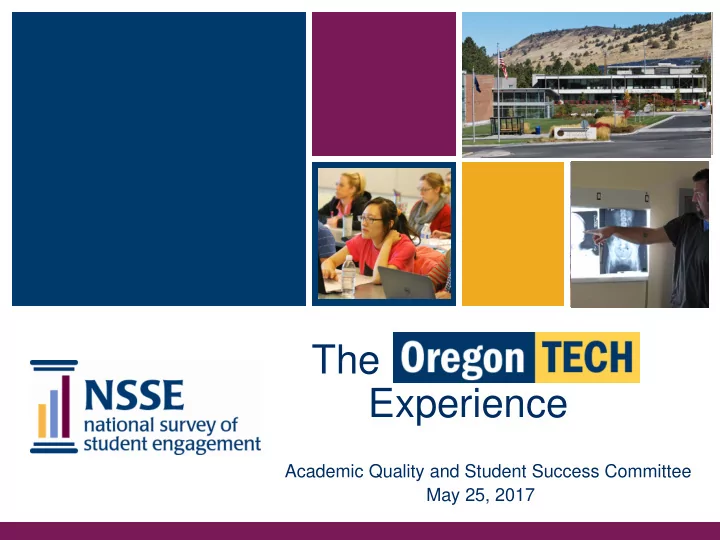
The Oregon Tech Experience

Academic Quality and Student Success Committee May 25, 2017
slide-2
SLIDE 2

NSSE and the Concept of Student Engagement

slide-3
SLIDE 3

What is Student Engagement?

What students do – Time and energy devoted to studies and other educationally purposeful activities What institutions do – Using resources and effective educational practices to induce students to do the right things Educationally effective institutions channel student energy toward the right activities

slide-4
SLIDE 4

Seven Principles of Good Practice in Undergraduate Education

Student-faculty contact Active learning Prompt feedback Time on task High expectations Experiences with diversity Cooperation among students

Chickering, A. W. & Gamson, Z. F. (1987). Seven principles for good practice in undergraduate education. AAHE: Bulletin, 39 (7), 3-7.

slide-5
SLIDE 5

Goals of NSSE Project

  • Focus conversations on

undergraduate quality

  • Enhance institutional

practice and improvement initiatives

  • Foster comparative and

consortium activity

  • Provide systematic national

data on “good educational practices”

slide-6
SLIDE 6

NSSE Survey Content

Engagement in meaningful academic experiences Engagement in High-Impact Practices Student Reactions to College Student Background Information

Student Learning & Development

slide-7
SLIDE 7

NSSE Engagement Indicators

Student – Faculty Interaction

Academic Challenge Experiences with Faculty Learning with Peers Campus Environment

Meaningful Academic Engagement Themes Engagement Indicators

slide-8
SLIDE 8

Selected NSSE Results for Oregon Tech

slide-9
SLIDE 9

NSSE 2015 U.S. Institution Response Rates

Oregon Tech’s response rate = 41% All NSSE 2015 institutions = 29%

NSSE 2015 U.S. Average Institutional Response Rates by Enrollment:

Undergraduate Enrollment Number of Institutions

  • Avg. Institutional

Response Rate 2,500 or fewer 242 35% 2,501 to 4,999 110 28% 5,000 to 9,999 97 22% 10,000 or more 89 20% All institutions 541 29%

slide-10
SLIDE 10

Comparisons

  • Oregon Tech Comparators
  • Majors Reports
  • Location
  • Multi-Year Reports

Areas of Effective Educational Practice Areas for I nstitutional I mprovement

slide-11
SLIDE 11

Engagement Indicators

1

st year

Senior Academic Challenge Higher-Order Learning

  • Reflective & Integrative Learning

Learning Strategies

  • Quantitative Reasoning
  • Learning

with Peers Collaborative Learning ▲

  • Discussions with Diverse Others

  • Experiences

with Faculty Student-Faculty Interaction ▲

  • Effective Teaching Practices
  • Campus

Environment Quality of Interactions

△ △

Supportive Environment

slide-12
SLIDE 12

Highest Performing—First Year

+21 +19 +17 +16 +14

  • 30
  • 20
  • 10

10 20 30 1h. 1f. 1g. 1e. 8b.

Worked with other students on course projects or assignments Explained course material to one or more students Prepared for exams by discussing or working through course material w/other students Asked another student to help you understand course material Discussions with… People from an economic background other than your own

slide-13
SLIDE 13

Highest Performing—Senior

+11 +10 +9 +8 +7

  • 30
  • 20
  • 10

10 20 30 13b. 7. 15a. 4b. 13e.

Quality of interactions with academic advisors Assigned more than 50 pages of writing Spent more than 15 hours per week preparing for class Applying facts, theories, or methods to practical problems or new situations Quality of interactions with other administrative staff and offices

slide-14
SLIDE 14

Lowest Performing—First Year

  • 5
  • 5
  • 6
  • 8
  • 13

14g. 14i. 14f. 2c. 12.

Institution emphasis on helping you manage your non-academic responsibilities Institution emphasis on attending events that address important social/econ./polit. Issues Institution emphasis on providing support for your

  • verall well-being...

Included diverse perspectives (…) in course discussions or assignments About how many courses have included a community-based project (service-learning)?

slide-15
SLIDE 15

Lowest Performing—Senior

  • 10
  • 10
  • 12
  • 12
  • 16

11a. 2c. 12. 14h. 14i.

Participated in an internship, co-op, field exp., student teach., clinical placement. Included diverse perspectives (…) in course discussions or assignments About how many courses have included a community-based project (service-learning)? Institution emphasis on attending campus activities and events (…) Institution emphasis on attending events that address important social/econ./polit. issues

slide-16
SLIDE 16

Perceived Gains

slide-17
SLIDE 17

How do students spend their time?

Percentage spending more than 10 hours per week preparing for class

Class Oregon Tech Comparators First-Year 93% 83% Senior 90% 86%

slide-18
SLIDE 18

How do students spend their time?

Percentage of students spending more than 5 hours per week participating in co-curricular activities

Class Oregon Tech Comparators First-Year 34% 24% Senior 18% 20%

slide-19
SLIDE 19

Satisfaction with Oregon Tech

slide-20
SLIDE 20

Satisfaction with Oregon Tech

slide-21
SLIDE 21

Uses of NSSE Data

slide-22
SLIDE 22

Accreditation

Core Theme 2: Student and Graduate Success

Oregon Tech fosters student and graduate success by providing an intimate, hands-on learning environment, thereby developing graduates that are career-ready. Teaching and support services facilitate students’ personal and academic development.

 Perceived Gains  Academic Challenge  Learning with Peers  Interactions with faculty/staff

slide-23
SLIDE 23

Marketing & Recruiting

For Students and Families: A Pocket Guide to Choosing a College gives questions to ask during a campus visit about what matters to learning. For Institutions: A data report, NSSE 2015 Answers from Students provides results for admissions, orientation, prospective students and families, and websites.

slide-24
SLIDE 24

Curricular Change

Finding: Seniors were less engaged than their peers— general education foundation not sufficiently reinforced throughout the educational experience. Action: Redesign of Oregon Tech’s general education to integrate student learning outcomes through GE and courses in the major.

slide-25
SLIDE 25

Faculty Development

Finding: Needed to increase campus dialogue relevant to student learning among faculty across all disciplines. Action: Creation of transdisciplinary Faculty Learning Communities with the purpose of enhancing teaching and learning and with frequent seminars and activities that build community around Oregon Tech’s ESLOs.

slide-26
SLIDE 26

Questions & Discussion

slide-27
SLIDE 27

.

Contact Information

NSSE Contact: Sandra Bailey sandra.bailey@oit.edu

Center for Postsecondary Research Indiana University School of Education 1900 East Tenth Street, Suite 419 Bloomington, IN 47406-7512 Phone: 812-856-5824 Fax: 812-856-5150 Email: nsse@indiana.edu Web: nsse.iub.edu

slide-28
SLIDE 28

Higher-Order Learning

First-year Students Seniors

Oregon Tech Oregon Tech Comp Oregon Tech Oregon Tech Comp

Percentage responding "Very much" or "Quite a bit" about how much coursework emphasized…

Applying facts, theories, or methods to practical problems or new situations

81 69 88 81

Analyzing an idea, experience, or line of reasoning in depth by examining its parts

72 66 80 77

Evaluating a point of view, decision, or information source

68 65 62 67

Forming a new idea or understanding from various pieces of information

72 64 72 70

slide-29
SLIDE 29

Reflective & Integrative Learning

First-year Students Seniors

Percentage of students who responded that they "Very often" or "Often" …

Oregon Tech Oregon Tech Comp Oregon Tech Oregon Tech Comp

Combined ideas from different courses when completing assignments

57 51 70 71

Connected your learning to societal problems or issues

44 47 49 58

Included diverse perspectives (political, religious, racial/ethnic, gender, etc.) in course discussions or assignments

37 44 37 47

Examined the strengths and weaknesses of your own views on a topic or issue

65 60 57 62

Tried to better understand someone else's views by imagining how an issue looks from his or her perspective

65 61 62 67

Learned something that changed the way you understand an issue or concept

59 62 62 68

Connected ideas from your courses to your prior experiences and knowledge

80 74 79 83

slide-30
SLIDE 30

Collaborative Learning

First-year Students Seniors

Oregon Tech Oregon Tech Comp Oregon Tech Oregon Tech Comp

Percentage of students who responded that they “Very often” or “Often”…

Asked another student to help you understand course material

60 43 46 42

Explained course material to one or more students

68 49 61 61

Prepared for exams by discussing or working through course material with other students

56 39 52 46

Worked with other students on course projects

  • r assignments

66 45 67 65

slide-31
SLIDE 31

Discussions with Diverse Others

First-year Students Seniors

Oregon Tech Oregon Tech Comp Oregon Tech Oregon Tech Comp

Percentage of students who responded that they “Very often” or “Often” had discussions with…

People from a race or ethnicity other than your

  • wn

71 62 68 67

People from an economic background other than your own

81 67 74 71

People with religious beliefs other than your

  • wn

70 64 73 70

People with political views other than your own

74 64 74 69

slide-32
SLIDE 32

Challenging Students to Do Their Best Work

Oregon Tech Oregon Tech Comparators Comparators