Virtual Spherical Lights for Many-Light Rendering of Glossy Scenes - - PowerPoint PPT Presentation

virtual spherical lights
SMART_READER_LITE
LIVE PREVIEW

Virtual Spherical Lights for Many-Light Rendering of Glossy Scenes - - PowerPoint PPT Presentation

Virtual Spherical Lights for Many-Light Rendering of Glossy Scenes Milo Jaroslav Bruce Kavita Haan Kivnek * Walter Bala Cornell University * Charles University in Prague Global Illumination Effects Soft shadows Color bleeding


slide-1
SLIDE 1

Miloš Hašan Jaroslav Křivánek * Bruce Walter Kavita Bala

Cornell University * Charles University in Prague
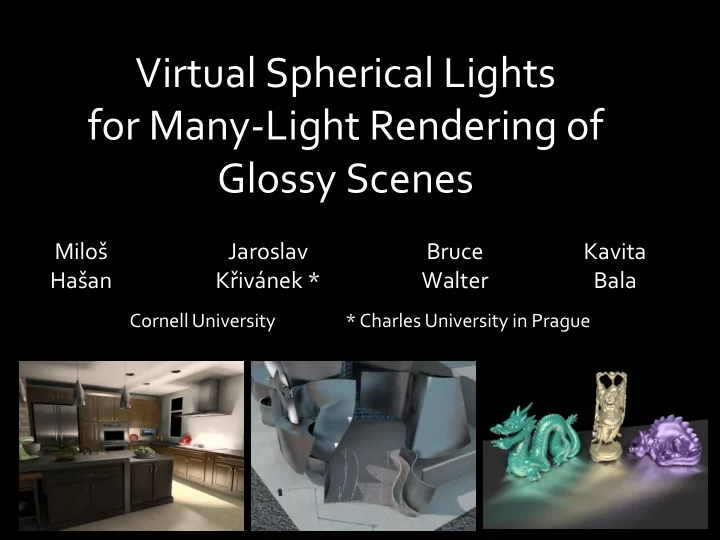
Virtual Spherical Lights for Many-Light Rendering of Glossy Scenes

slide-2
SLIDE 2

Global Illumination Effects

Monte Carlo can handle them all… but is very slow

Soft shadows Color bleeding Caustics Mirror reflection Refraction Glossy inter-reflection

2

slide-3
SLIDE 3

Faster algorithms exist…

But no satisfying solution for glossy inter-reflection

Soft shadows Color bleeding Caustics Mirror reflection Refraction Glossy inter-reflection

3

slide-4
SLIDE 4

Glossy Inter-reflections

4

slide-5
SLIDE 5
  • Unbiased methods

– (Bidirectional) Path tracing

[Kajiya 1985, Lafortune et al. 1993]

– Metropolis Light Transport

[Veach and Guibas 1997]

  • Biased methods

– Photon Mapping

[Jensen 2001]

– Radiance caching

[Křivánek 2005]

Previous Work

5

slide-6
SLIDE 6
  • Virtual Point Lights (VPLs)
  • Very efficient in mostly diffuse scenes

– Real-time global illumination

[Wald et al. 2002, Segovia et al. 2006, 2007, Laine et al. 2007, Ritschel et al. 2008, Dong et al. 2009]

  • Scalability to many lights

[Walter et al. 2005, 2006, Hašan et al. 2007]

6

Previous Work – Instant Radiosity

slide-7
SLIDE 7
  • So far: Instant radiosity & Glossy inter-reflections

Limitations of Instant Radiosity

7

Instant radiosity: illumination loss Reference

slide-8
SLIDE 8
  • Compute the missing components by path

tracing [Kollig and Keller 2004]

  • Glossy scenes

– As slow as path-tracing everything

Previous Work on Compensation

8

Path traced compensation: 3.5 hours Reference

slide-9
SLIDE 9
  • New type of light: Virtual Spherical Light

Our Method

9

Our method: 4 minutes Reference

slide-10
SLIDE 10
  • Problems with Virtual Point Lights (VPLs)
  • Our solution: Virtual Spherical Lights (VSLs)
  • Implementation
  • Results

Outline

10

slide-11
SLIDE 11
  • Problems with Virtual Point Lights (VPLs)
  • Our solution: Virtual Spherical Lights (VSLs)
  • Implementation
  • Results

Outline

11

slide-12
SLIDE 12

Instant Radiosity

12

  • STEP 1

– Trace paths from the light

slide-13
SLIDE 13

Instant Radiosity

13

  • STEP 1

– Trace paths from the light – Treat path vertices as Virtual Point Lights (VPLs)

slide-14
SLIDE 14

Instant Radiosity

14

  • STEP 1

– Trace paths from the light – Treat path vertices as Virtual Point Lights (VPLs)

  • STEP 2

– Render scene with VPLs

slide-15
SLIDE 15
  • Cosine-weighted BRDF lobe at the VPL

location

Emission Distribution of a VPL

15

Glossy Diffuse

slide-16
SLIDE 16

Glossy VPL Emission: Illumination Spikes

Common solution: Only diffuse BRDF at light location

16

slide-17
SLIDE 17

Remaining Spikes

17

slide-18
SLIDE 18
  • Common solution: Clamp VPL contributions

18

Remaining Spikes

x x

  • VPL contribution =

VPL power . BRDF(x) . cos(x) . 1 / || p – x ||2 spike! p As || p – x || → 0, VSL contribution → ∞

slide-19
SLIDE 19

Instant Radiosity: The Practical Version

19

Clamping and diffuse-only VPLs: Illumination is lost!

slide-20
SLIDE 20

Comparison

20

Clamped VPLs: Illumination loss Path tracing: Slow

slide-21
SLIDE 21
  • Problems with Virtual Point Lights (VPLs)
  • Our solution: Virtual Spherical Lights (VSLs)
  • Implementation
  • Results

Outline

21

slide-22
SLIDE 22
  • VPLs: image splotches due to

– Spikes in the VPL emission distibution – 1 / || p – x || term

  • Idea

– Spread VPL energy over a finite surface – Compute contribution as solid angle integral

22

Motivation

slide-23
SLIDE 23

23

VPL to VSL

x p l

Non-zero radius (r)

Ω

Integration over non-zero solid angle

slide-24
SLIDE 24

24

Light Contribution

x p l

Non-zero radius (r)

Ω

Integration over non-zero solid angle

y

slide-25
SLIDE 25

25

Light Contribution

x p l

Non-zero radius (r)

Ω

Integration over non-zero solid angle

y

Problem: Finding y requires ray-tracing

slide-26
SLIDE 26

26

Simplifying Assumptions

x p l

Non-zero radius (r)

Ω

Integration over non-zero solid angle

y

  • Constant in Ω:

– Visibility – Surface normal – Light BRDF

  • Taken from p, the

light location

slide-27
SLIDE 27

27

Light Contribution Updated

x p l

Non-zero radius (r)

Ω

Integration over non-zero solid angle

slide-28
SLIDE 28

28

Virtual Spherical Light

  • All inputs taken from x and p

– Local computation

  • Same interface as any other light

– Can be implemented in a GPU shader

  • Visibility factored from the integration

– Can use shadow maps

slide-29
SLIDE 29
  • Problems with Virtual Point Lights (VPLs)
  • Our solution: Virtual Spherical Lights (VSLs)
  • Implementation
  • Results

Outline

29

slide-30
SLIDE 30
  • Monte Carlo quadrature

Computing the VSL integral

BRDF 1 sampling BRDF 2 sampling Cone sampling Combined sampling

slide-31
SLIDE 31
  • Matrix row-column sampling [Hašan et al. 2007]

– Shadow mapping for visibility – VSL integral evaluated in a GPU shader

  • Need more lights than in diffuse scenes
  • VSL radius proportional to local VSL density

– determined by k-NN queries

31

Implementation

slide-32
SLIDE 32
  • Problems with Virtual Point Lights (VPLs)
  • Our solution: Virtual Spherical Lights (VSLs)
  • Implementation
  • Results

Outline

32

slide-33
SLIDE 33

Results: Kitchen

  • Most of the scene lit

indirectly

  • Many materials glossy

and anisotropic

Clamped VPLs 34 sec (GPU) – 2000 lights New VSLs: 4 min 4 sec (GPU) – 10000 lights Path tracing: 316 hours (8 cores)

33

slide-34
SLIDE 34

Results: Disney Concert Hall

  • Curved walls with no

diffuse component

  • Standard VPLs

cannot capture any reflection from walls

Clamped VPLs: 22 sec (GPU) – 4000 lights New VSLs: 1 min 26 sec (GPU) – 15000 lights Path tracing: 30 hours (8 cores)

34

slide-35
SLIDE 35

Results: Anisotropic Tableau

  • Difficult case
  • Standard VPLs

capture almost no indirect illumination

Clamped VPLs: 32 sec (GPU) – 1000 lights New VSLs: 1 min 44 sec (GPU) – 5000 lights Path tracing: 2.2 hours (8 cores)

35

slide-36
SLIDE 36

36

Error Images (Indirect Only)

Ground truth VPL error (previous work) VSL error (our method)

slide-37
SLIDE 37

Limitations: Blurring

  • VSLs can blur illumination
  • Converges as number of lights increases

5,000 lights - blurred

37

1,000,000 lights - converged

slide-38
SLIDE 38
  • Some remaining corner darkening
  • Computation overhead

Other Limitations

38

slide-39
SLIDE 39
  • Virtual Spherical Lights

– No spikes, no clamping necessary – Address illumination loss

  • Many-light methods + VSLs:

– A step to solve the glossy inter-reflection problem

  • Future Work

– More lights: improve scalability

Conclusion

39

slide-40
SLIDE 40
  • Recall: Integration over paths, use Monte Carlo
  • The contribution f(xi) contains:

– Inverse distance-squared term – Material term at surface location – Material term at VPL location

  • What if f(xi) becomes locally large?

– “Spikes”

The Problem, Numerically

40

slide-41
SLIDE 41

The Problem Revision

Path tracer Instant radiosity Difference image

41

slide-42
SLIDE 42

Another Example

Path tracer Instant radiosity Difference image

42

slide-43
SLIDE 43

The Missing Components

Missing energy Missing due to diffuse VPLs Missing due to clamping

43