Video http://www.youtube.com/watch?v=5E5ssMKEBHs Overview Radiation - - PowerPoint PPT Presentation

video
SMART_READER_LITE
LIVE PREVIEW

Video http://www.youtube.com/watch?v=5E5ssMKEBHs Overview Radiation - - PowerPoint PPT Presentation

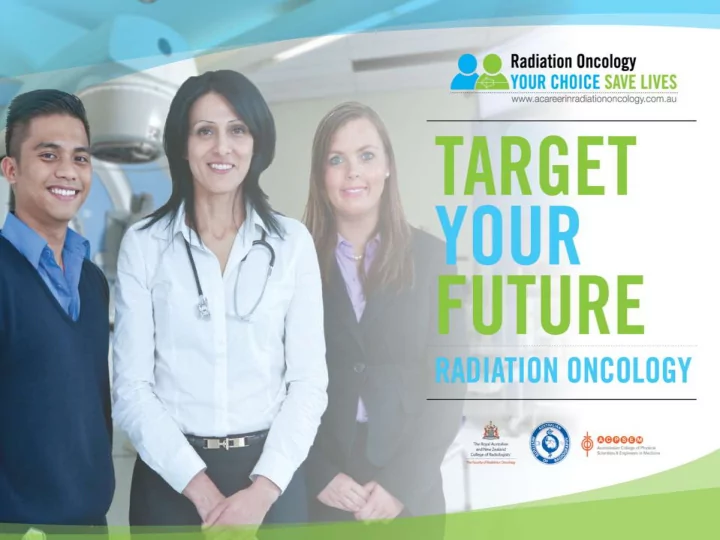
Video http://www.youtube.com/watch?v=5E5ssMKEBHs Overview Radiation Oncology - a world class cancer treatment Career choices that Help Save Lives Radiation oncologists (RANZCR) Radiation therapists (AIR) Medical physicists


slide-1
SLIDE 1
slide-2
SLIDE 2

Video

http://www.youtube.com/watch?v=5E5ssMKEBHs

slide-3
SLIDE 3

Overview

  • Radiation Oncology - a

world class cancer treatment

  • Career choices that Help

Save Lives

  • Radiation oncologists

(RANZCR)

  • Radiation therapists

(AIR)

  • Medical physicists

(ACPSEM)

  • More information and

feedback

slide-4
SLIDE 4

Cancer Affects Thousands

  • f Families
  • Risk of being diagnosed with cancer before age of 85yrs:

1 in 2 for males and 1 in 3 for females

  • Incidence of cancer rose 27% between 1982 and 2007,

from 383 to 485 per 100,000

  • Growth due mainly to ageing population
  • A small increase in the underlying cancer incidence rate

is projected

  • Different types of cancer

Source: “Cancer in Australia: an overview, 2010” – AIHW/AACR 4

slide-5
SLIDE 5

Towards a World Class System of Cancer Care

  • Australian government: investing over $2

billion in Cancer Services

  • Significant investment by state/territory

governments

  • Working in partnership with the

professions

  • Training for cancer professionals
  • Radiation Oncology (Tripartite)
  • Planning for future Radiation Oncology services

5

slide-6
SLIDE 6

Improving Access in Regional Areas

REGIONAL CANCER CENTRES

  • Cairns (QLD)
  • Toowoomba (QLD)
  • Townsville (QLD)
  • Bundaberg (QLD)
  • Orange (NSW)
  • Lismore (NSW)
  • Shoalhaven (NSW)
  • Tamworth (NSW)
  • Darwin (NT)
  • Launceston (TAS)
  • Bunbury (WA)
  • Burnie (TAS)

6

slide-7
SLIDE 7

What is Radiation Oncology?

  • Treatment of cancer patients

with radiation therapy treatment

  • Multi-disciplinary teams work

together to deliver care

  • Rapidly changing technology
  • State-of-the-art technology

used by trained professionals

  • Exciting and changing field of

medicine

7

slide-8
SLIDE 8

What is Radiation Oncology?

Radiation Therapy

  • An essential part of cancer treatment and

care

  • Involves accurate and precise delivery of

high doses of radiation to damage or destroy cancer cells

  • Delivered in controlled measures usually
  • ver a number of weeks
  • Personalised treatment for each patient
  • Strict quality control measures

8

slide-9
SLIDE 9

Radiation Oncology Professions

9

Radiation Therapists Radiation Oncologists

Radiation Oncology Medical Physicists

slide-10
SLIDE 10

Radiation Oncologists

The Faculty of Radiation Oncology (FRO), The Royal Australian and New Zealand College of Radiologists (RANZCR)

10

slide-11
SLIDE 11

Role of the Radiation Oncologist

  • A doctor who has post-graduate training in

managing patients with cancer, in particular, using radiation therapy

  • Works closely with other medical

specialists, radiation therapists and radiation oncology medical physicists as part of a multi-disciplinary team caring for patients with cancer

  • Determine the prescription for radiation

therapy treatment

11

Radiation Oncologists

(FRO, RANZCR)

slide-12
SLIDE 12

Radiation Oncologists

(FRO, RANZCR)

Skills Required to be a Radiation Oncologist

  • High level inter-personal and communication skills
  • Ability to work as part of team
  • Compassion
  • Interest in practical application of science and technology

12

slide-13
SLIDE 13

Radiation Oncologists

(FRO, RANZCR)

Educational pre-requisites

  • Medical degree
  • Two years general medical training as an intern
  • r resident in the hospital setting
  • Medical Registration

13

slide-14
SLIDE 14

Radiation Oncologists

(FRO, RANZCR)

Training required to be a Radiation Oncologist

  • RANZCR Training Program
  • 5 year training program undertaken while employed in a registrar position

in an accredited Radiation Oncology department

  • Phase I (18 – 24 months)
  • In-training (formative) assessment
  • Summative assessment
  • Phase II
  • Exit Exam

14

slide-15
SLIDE 15

Radiation Therapists

Australian Institute of Radiography (AIR)

15

slide-16
SLIDE 16

Radiation Therapists

(AIR)

Role of the Radiation Therapist

  • Responsible for the design, calculation (planning)

and delivery of a prescribed radiation dose over a course of treatment to the patient

  • Create a treatment plan to deliver optimum dose

to the tumour, specific to each patient and their diagnosis whilst minimising dose delivered to healthy tissue

  • Accurately deliver the planned treatment to the

patient

16

slide-17
SLIDE 17

Skills required to be a Radiation Therapist

  • Compassion
  • Strong interpersonal skills
  • Excellent communication skills
  • Very hands-on teamwork

approach

  • Technology

17

Radiation Therapists

(AIR)

slide-18
SLIDE 18

Radiation Therapists

(AIR)

Educational Pre-requisites

  • Undergraduate degree - Current

Year 12 prerequisite

  • Chemistry or biology
  • English and
  • Mathematical methods and
  • Physics or specialist mathematics
  • Postgraduate degree
  • Bachelor degree – type depends on

University

18

slide-19
SLIDE 19

Radiation Therapists

(AIR)

Radiation Therapy university courses fall under the category of Medical Radiations Science offered at;

  • Queensland University of Technology (QLD)
  • University of Newcastle (NSW)
  • RMIT University (Victoria)
  • Monash University (Victoria)
  • University of South Australia (SA)

19

slide-20
SLIDE 20

Radiation Therapists

(AIR)

Training required to become a Radiation Therapist

  • Training includes both Academic &

Clinical components

  • Some courses also conclude with one

year of paid structured supervised practice under the NPDP (National Professional Development Programme)

20

slide-21
SLIDE 21

RO Medical Physicists

Australasian College of Physical Scientists and Engineers in Medicine (ACPSEM)

21

slide-22
SLIDE 22

RO Medical Physicists

(ACPSEM)

Role of the Radiation Oncology Medical Physicist

  • Responsible for implementation, safe operation and quality
  • f systems used for treating patients
  • Provides advice for the best use of medical radiation for

treatment and also radiation protection

  • Ensures that all equipment meets international and national

standards

22

slide-23
SLIDE 23

RO Medical Physicists

(ACPSEM)

Skills required to be a Radiation Oncology Medical Physicist

  • High level inter-personal and

communication skills

  • Ability to work as part of team
  • Logical thinking
  • Problem solving
  • Interest in practical application of

science and technology

23

slide-24
SLIDE 24

RO Medical Physicists

(ACPSEM)

Educational pre-requisites

  • Undergraduate degree in Science

with majors in;

  • Physics or
  • Medical Physics or
  • Engineering (with large component of physics)
  • A strong base of maths and computer science
  • Some study within biomedical science, including anatomy and

physiology is an advantage

  • An Honours degree in Physics is a definite advantage

24

slide-25
SLIDE 25

Postgraduate study is undertaken after completion of a degree:

  • a Masters degree in Medical Physics (coursework and/or research) OR
  • a PhD in Medical Physics

Medical Physics postgraduate courses:

  • Queensland University of Technology (QLD)
  • University of Newcastle (NSW)
  • University of Sydney (NSW)
  • Wollongong University (NSW)
  • RMIT (Victoria)
  • University of Adelaide (SA)
  • University of Western Australia (WA)

25

RO Medical Physicists

(ACPSEM)

slide-26
SLIDE 26

RO Medical Physicists

(ACPSEM)

Training required to be a Radiation Oncology Medical Physicist

  • ACPSEM Training Program (TEAP)
  • 3-5 years paid training within an accredited training hospital
  • Postgraduate study is completed during this time if not

undertaken prior

  • Attendance at training days and national/international

conferences

  • Final process is to undertake a certification exam

26

slide-27
SLIDE 27
slide-28
SLIDE 28

Is a career in Radiation Oncology Safe?

  • Safe environment
  • Controlled and

monitored safety measures

  • Radiation safety

training

  • Monitor patient from
  • utside the room
slide-29
SLIDE 29

Patient Journey

(Radiation Oncology)

29

slide-30
SLIDE 30

Workplace Benefits/Perks

  • Stimulating and at times adrenaline filled working

environment

  • Meet and assist people on their road to recovery
  • Cutting edge technology and high standards for optimal

patient care

  • Travel opportunities interstate and overseas
  • Variety of work settings, tasks and challenges
  • Teamwork and Leadership skills
  • Variable working hours e.g. Part time

30

slide-31
SLIDE 31

Is a Career in Radiation Oncology for me?

A Radiation Oncology professional will generally have:

  • An interest and ability for sciences

– biology and/or physics

  • An interest in healthcare
  • Logical thinking
  • Problem solving skills
  • Good communication skills
  • A focus on patient care in both

children and adults

  • Enjoy working in a teamwork

environment

  • An interest in using state of the art

technology

31

slide-32
SLIDE 32

My Career Story

slide-33
SLIDE 33

How do you find out more?

  • Jobs Guide (for Years 10,11 & 12)
  • Good Universities Guide (for students to inform choice of

university courses)

  • National workforce training projects
  • Career information brochures through the professions –

RANZCR, AIR and ACPSEM

  • Website www.acareerinradiationoncology.com.au
  • Visit a department
  • Visit a university
  • Work experience

33

slide-34
SLIDE 34

More Information and Feedback

For more information, visit: www.acareerinradiationoncology.com.au For general information and feedback, please email: info@acareerinradiationoncology.com.au

34

slide-35
SLIDE 35

Acknowledgements

  • RANZCR, AIR and ACPSEM
  • ‘A Career in Radiation Oncology’ Steering Committee
  • Liverpool Cancer Therapy Centre and Sunshine Hospital Radiation Therapy

Centre for the use of their facilities

  • The Radiation Oncology professionals involved in the production of the

resource materials

  • Images courtesy of Brainlab Australia Pty Ltd, Elekta Pty Ltd, Varian Medical

Systems Australasia Pty Ltd, Royal Brisbane and Women’s Hospital Radiation Oncology Department, University of Sydney VERT lab, Calvary Mater Newcastle Radiation Oncology Department, ACPSEM, Maja Baska Photography, Mel Grand, and iStock Photography.

  • Brochure and PPP template designed by sevdesign sevdesign@bigpond.com.

The ‘A Career in Radiation Oncology’ Project is supported by funding from the Australian Government Department of Health and Ageing.