
SLIDE 1
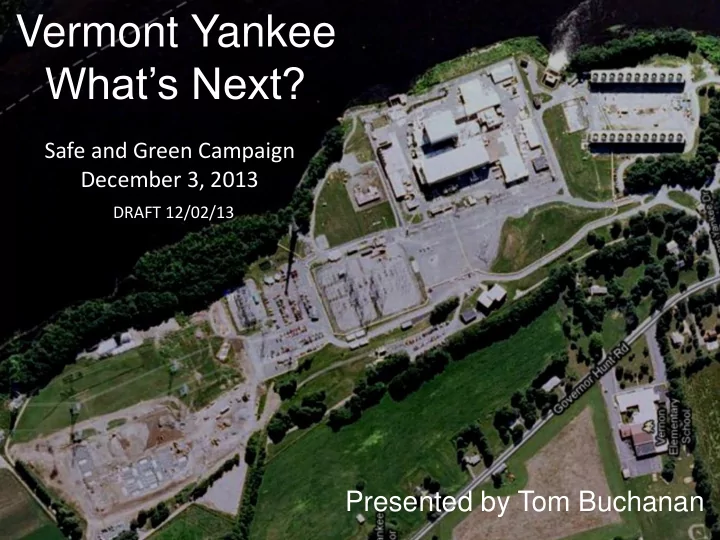
Vermont Yankee What’s Next?
Presented by Tom Buchanan
Safe and Green Campaign December 3, 2013
DRAFT 12/02/13
Vermont Yankee Whats Next? Safe and Green Campaign December 3, 2013 - - PowerPoint PPT Presentation
Vermont Yankee Whats Next? Safe and Green Campaign December 3, 2013 DRAFT 12/02/13 Presented by Tom Buchanan Tom Buchanan Windham Regional Commission (WRC) Commissioner representing Town of Londonderry Chair VY Study
Vermont Yankee What’s Next?
Presented by Tom Buchanan
Safe and Green Campaign December 3, 2013
DRAFT 12/02/13
2
Tom Buchanan
3
Overview Virtual Tour Standards Timing Trust Fund Options Influence
and Site Restoration
4
Overview Virtual Tour Standards Timing Trust Fund Options Influence
6
Vermont Yankee Property (~148 acres)
Connecticut River Governor Hunt Road
Main Entrance
7
Vermont Yankee Property (~148 acres)
Connecticut River Governor Hunt Road
Cooling Towers Switchyard Main Facility
8
Vermont Yankee Property (~148 acres)
Connecticut River
Reactor Building Turbine Building
9
Vermont Yankee Property (~148 acres)
Connecticut River
Intake Structure Discharge Structure
10
Vermont Yankee Property (~148 acres)
Connecticut River
ISFSI Spent Fuel Storage
12
important take-away…
The VY site is not very large, but if the decommissioning is managed well, much of the site can eventually be returned to productive economic use.
13
Overview Virtual Tour Standards Timing Trust Fund Options Influence
14
NRC Regulates Radiological Decommissioning Only: 25 millirem + ALARA
16
Vermont Standard
“Site restoration shall mean that, once the VYNPS site is no longer used for nuclear purposes or non-nuclear commercial, industrial, or similar uses consistent with the
will be restored by removal of all structures and, if appropriate, regarding and reseeding the land.”
Source: Docket 6545 MOU, paragraph 3 (2002 sale from VYNPC to ENVY)
18
important take-away…
The NRC only requires radiological
site is a state requirement, and the specific terms are in dispute.
19
Overview Virtual Tour Standards Timing Trust Fund Options Influence
20
decommissioning be completed within 60 years.* This part of the process is called DECON.
radiological decommissioning. The period of delay is called SAFSTOR.
in the spent fuel pool for at least five years before being moved to casks.
*The 2012 Vermont Yankee PSDAR assumes a 54 year period of SAFSTOR
21
Timing
Entergy must submit several reports to the NRC within two years of shutdown (by December 2016):
Report (PSDAR).
Estimate
22
Timing
to decommissioning and timing, and show how it will be funded.
The NRC is generally deferential to the licensee, but can be influenced by public comments and governmental policy.
2014 2074 60 Years
DECON
23
Timing
to decommissioning and timing, and show how it will be funded.
The NRC is generally deferential to the licensee, but can be influenced by public comments and governmental policy.
2014 2074 60 Years
DECON SAFSTOR
24
Timing
to decommissioning and timing, and show how it will be funded.
The NRC is generally deferential to the licensee, but can be influenced by public comments and governmental policy.
2014 2074 60 Years
DECON SAFSTOR
25
Timing
to decommissioning and timing, and show how it will be funded.
The NRC is generally deferential to the licensee, but can be influenced by public comments and governmental policy.
2014 2074 60 Years
DECON SAFSTOR DECON
26
Timing
2014 2074 60 Years
DECON SAFSTOR A period of SAFSTOR appears inevitable… The best we can hope for is probably a short period of SAFSTOR followed promptly by complete decommissioning.
29
important take-away…
Entergy will file a decommissioning plan with the NRC within two years of shutdown, and the public will be given an opportunity to comment.
30
Overview Virtual Tour Standards Timing Trust Fund Options Influence
31
Trust Fund
The value of the Decommissioning Trust Fund on October 31, 2013 was:
Source: Entergy advisory email to DPS, 11/7/13 (Malmquist to Commons)
32
Trust Fund
Source: Various filings, dockets 7440 &7862
Value dropped to $359 million on 3/31/09 $0 $100,000,000 $200,000,000 $300,000,000 $400,000,000 $500,000,000 $600,000,000 $700,000,000 07/01/02 05/01/03 03/01/04 01/01/05 11/01/05 09/01/06 07/01/07 05/01/08 03/01/09 01/01/10 11/01/10 09/01/11 07/01/12 05/01/13 Value (millions of dollars) 2002-2013 Amount
Decommissioning Trust Fund was valued at approximately $310 million.
33
Trust Fund
Source: Various filings, dockets 7440 &7862
$0 $100,000,000 $200,000,000 $300,000,000 $400,000,000 $500,000,000 $600,000,000 $700,000,000 07/01/02 05/01/03 03/01/04 01/01/05 11/01/05 09/01/06 07/01/07 05/01/08 03/01/09 01/01/10 11/01/10 09/01/11 07/01/12 05/01/13 Value (millions of dollars) 2002-2013 Amount
when in SAFSTOR it must grow faster than inflation plus the cost of site maintenance.
35
Trust Fund
Example: Shutdown in 2032, all fuel off site in 2082 DECON SAFSTOR License Termination (DECON) $566.7m $622.5m Spent Fuel Management $365.3m $397.2m Site Restoration $ 47.8m $ 47.7m Total Cost $979.9m $1.06b
Source: Decommissioning Cost Analysis, February 2012, scenarios 4/6, 2011 dollars, truncated (Other SAFSTOR scenario maximums: Total $1.159b, Lic termination $653.1m, SF Mgt $502.9m)
site, managing the fuel (with some reimbursement from DOE), and restoring the site.
37
Trust Fund
Entergy Corporation Entergy Nuclear Vermont Yankee (ENVY) Entergy Nuclear Operations (ENO) The Decommissioning Trust Fund and the VY Station are owned by and Entergy subsidiary called Entergy Nuclear Vermont Yankee (ENVY)
3 1
38
Trust Fund
Entergy Corporation Entergy Nuclear Vermont Yankee (ENVY) Entergy Nuclear Operations (ENO) The Decommissioning Trust Fund and the VY Station are owned by and Entergy subsidiary called Entergy Nuclear Vermont Yankee (ENVY)
3 1
39
important take-away…
The decommissioning trust fund has performed well in real terms and relative to inflation, but it may never be sufficient to fully restore the site. Unless additional funding sources are secured, any additional costs charged to the decommissioning fund will delay the point at which the site can be decommissioned and restored.
40
Overview Virtual Tour Standards Timing Trust Fund Options Influence
41
DECON vs. SAFSTOR
productive economic use sooner than if decommissioning is delayed.
42
DECON vs. SAFSTOR
economic and employment profile.
Source: Docket 7862, A.WRC:EN.1-27.1 and A.WRC:EN.1-27.2, graphics provided by Entergy
43
DECON vs. SAFSTOR
workforce with legacy knowledge.
44
DECON vs. SAFSTOR
uncertainties associated with the Decommissioning Trust Fund, and the risk of inflation.
Source: Various filings, dockets 7440 &7862
45
DECON vs. SAFSTOR
Example: Shutdown in 2032, all fuel off site in 2082 DECON SAFSTOR License Termination (DECON) $566.7m $622.5m Spent Fuel Management $365.3m $397.2m Site Restoration $ 47.8m $ 47.7m Total Cost $979.9m $1.06b
Source: Decommissioning Cost Analysis, February 2012, scenarios 4/6, 2011 dollars, truncated (Value of Decommissioning Fund on 7/31/13~$582 million, source: Entergy press release, WRC-X)
SAFSTOR under every scenario pairing.
46
DECON vs. SAFSTOR
Entergy Corporation Entergy Nuclear Vermont Yankee (ENVY) Entergy Nuclear Operations (ENO)
assurance of corporate responsibility.
3 1
47
DECON vs. SAFSTOR
nuclear waste (or the same amount of waste).
“Given the levels of radioactivity and spectrum of radionuclides expected from thirty to forty years of plant
contaminated upon final shutdown will become releasable due to the decay period alone, i.e., there is no significant reduction in waste volume in delaying decommissioning. In fact, SAFSTOR estimates can show a slight increase in the total projected waste volume, due primarily to initial preparation activities for placing the unit in safe-storage, as well as from follow-up housekeeping tasks over the caretaking period for the station.”
Source: DCA, 2001, section 2, page 16
49
DECON vs. SAFSTOR
provides for disposal
a facility in Andrews, Texas.
the Andrews facility for 15 years, expires in 2024. Extensions are possible in 10 year increments.
50
DECON vs. SAFSTOR
facilities exist now for transport of low level
in the future.
decommissioning provides greater assurance of low level waste disposal.
51
DECON vs. SAFSTOR
state regulatory and oversight costs (taxes):
52
DECON vs. SAFSTOR
decommissioning eases the burden of
management throughout the tri-state region.
53
DECON vs. SAFSTOR
decommissioning allows the state, region, and municipality to put distance between the contentious protests of present day, and the future redevelopment of the property.
Image from: http://blogs.gonomad.com/roundworldphoto/2012/03/ vermont-yankee-protest-vigil.html 54
DECON vs. SAFSTOR
The Kindergarten Rule: Clean up your own mess…before nap time.
for remediation, and not leave that task to our grandchildren’s generation.
Intergenerational Equity
56
important take-away…
The best available option is prompt and complete decommissioning without the use of SAFSTOR, or alternatively the shortest period
57
Overview Virtual Tour Standards Timing Trust Fund Options Influence
58
reasonably expected decommissioning expenses. …and then
without the use of SAFSTOR, or alternatively, with the shortest period of SAFSTOR possible.
Work Together Define the Objective
Tom Buchanan
PO Box 261, Londonderry, VT., 05148 802.824.4243 email.tom.buchanan@gmail.com