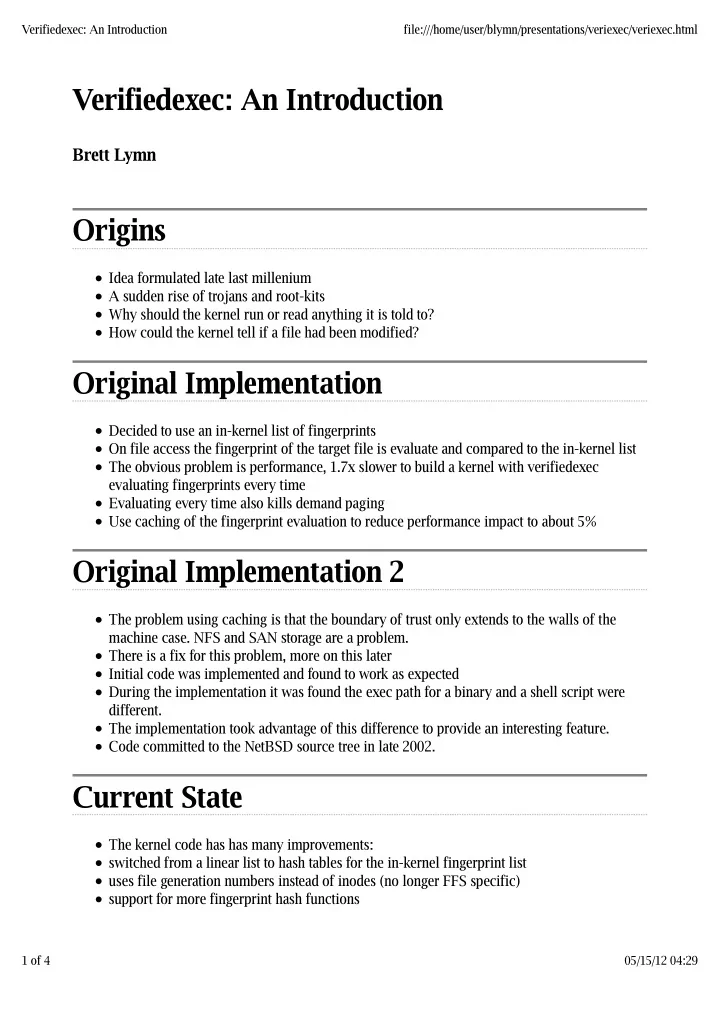

SLIDE 1
Verifiedexec: An Introduction
Brett Lymn
Origins
Idea formulated late last millenium A sudden rise of trojans and root-kits Why should the kernel run or read anything it is told to? How could the kernel tell if a file had been modified?
Original Implementation
Decided to use an in-kernel list of fingerprints On file access the fingerprint of the target file is evaluate and compared to the in-kernel list The obvious problem is performance, 1.7x slower to build a kernel with verifiedexec evaluating fingerprints every time Evaluating every time also kills demand paging Use caching of the fingerprint evaluation to reduce performance impact to about 5%
Original Implementation 2
The problem using caching is that the boundary of trust only extends to the walls of the machine case. NFS and SAN storage are a problem. There is a fix for this problem, more on this later Initial code was implemented and found to work as expected During the implementation it was found the exec path for a binary and a shell script were different. The implementation took advantage of this difference to provide an interesting feature. Code committed to the NetBSD source tree in late 2002.
Current State
The kernel code has has many improvements: switched from a linear list to hash tables for the in-kernel fingerprint list uses file generation numbers instead of inodes (no longer FFS specific) support for more fingerprint hash functions
Verifiedexec: An Introduction file:///home/user/blymn/presentations/veriexec/veriexec.html 1 of 4 05/15/12 04:29