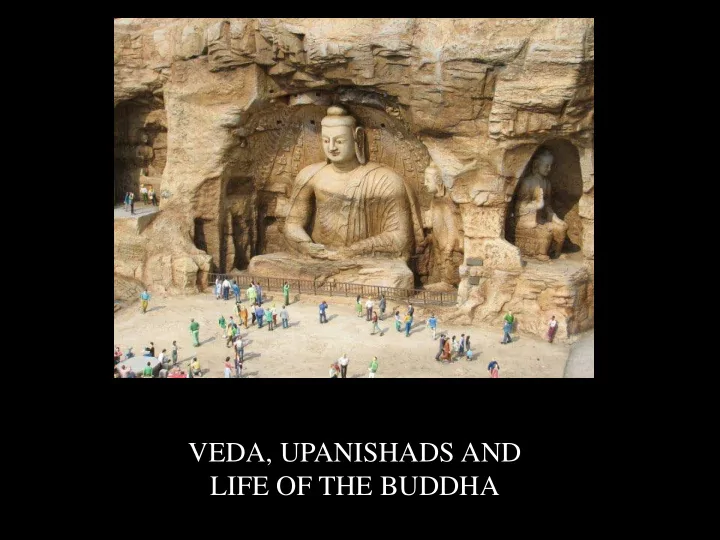
SLIDE 1
VEDA, UPANISHADS AND LIFE OF THE BUDDHA
SLIDE 2 RELIGIOUS LANDSCAPE IN 600 B.C.E
VEDAS
Indra – God of Thunder, king of the gods Brahmanaspati /Brahma– God of the Creative Word Surya – Sun God (Mitra, Vishnu – solar gods, sun cult) Agni – God of Fire Varuna – God of Ocean, also solar god Aditi – Mother of the Gods Saraswati – river goddess of inspiration Prithvi – earth goddess
- Symbolic language
- Caste system – hereditary and hierarchical
(brahmin, kshatriya, vaishya, sudra, achyuta)
SLIDE 3 RELIGIOUS LANDSCAPE IN 500 B.C.E
VEDAS (cont’d)
- Fire Sacrifices – brahmin mediated offerings of
libations, grains and animals
- Recognition of practitioners of extremism (Vratyas,
Keshins) – ascetic and middle path, shraman and brahmin
SLIDE 4 RELIGIOUS LANDSCAPE IN 500 B.C.E
UPANISHADS 7th c. B.C.E.
- Vedic reformism; proto-philosophic texts
- Concern with ultimate reality as Unitary
(Brahman)
- Bliss (Ananda) as basis of reality
- Idea of self-division of Brahman as an
appearance through power of Maya
- Individualized self-appearances of Brahman
= Atman
- Affirmation of reincarnation
- Emphasis on experience of Brahman through
meditation
- Privileging of shramanic/monastic (muni)
existence
- Freedom from cycle of rebirths (moksha /
jivanmukti)
SLIDE 5
SLIDE 6
SLIDE 7
Conception of the Buddha – Maya’s white elephant dream Bharhut Mahastupa, c. 2nd c. B.C.E.
SLIDE 8
Birth of Buddha at Lumbini, Gandhara, c. 2nd c. C.E.
SLIDE 9
Conception and Birth, Sarnath style, c. 6th c. C.E
SLIDE 10 Seer Asita’s prediction, Gandhara, 3rd – 4th c. C.E. – play of king and shraman ideas
- idea of the philosopher-king
SLIDE 11 Gautama as a young adult meditating under a jambu tree, Gandhara,
- c. 6th c.
- Spontaneous meditation
- Prelude to his bodhi
meditation
SLIDE 12 Gautama Encounters the Four Signs, Thailand, 20th c.
suffering as incapacity
suffering as pain
as non- existence
a way out
SLIDE 13
Gautama departs from his palace, Gandhara, 4th c. C.E.
SLIDE 14 The Great Departure, Abanindranath Tagore,
At age 29, Gautama departs on his horse Kanthaka to find the solution to the problem of suffering
SLIDE 15
Gautama releases his horse and servant and shears his hair, Borobudur, 9th c. C.E.
SLIDE 16 From Rajagriha, Gautama studied with two teachers, Arada Kalama and Udaraka
- Ramaputra. Having mastered
their meditation practices, he did not find the answer to his question on eradicating
- suffering. He joined a band
- f 5 wandering shramans and
came near Uruvela, trying to
practices. Gautama as an Ascetic, Gandhara, Sikri Stupa,
SLIDE 17 Liang Kai. Shakyamuni Descending from the
- Mountains. Hanging
- scroll. Ink and color on
silk, China, early 13th c. He remembers his spontaneous meditation and affirms the middle path – a Vedic choice
SLIDE 18
Gautama is attacked by the hordes of Mara, Mogao cave 428, N. Zhou, 6th c. C.E.
SLIDE 19
Gautama reaching Enlightenment, black schist, Nalanda monastery, 10th – 11th c. C.E.
SLIDE 20
Buddha teaches his first sermon, “turning the wheel of the Law (dharmachakra pravartana)”, Sarnath, 5th c. C.E.
SLIDE 21
THE FIRST SERMON (DHARMACHAKRA PRAVARTANA – TURNING THE WHEEL OF THE LAW)
SLIDE 22
Return to Kapilavastu, Rahula becomes a monk, Wat Chiang Man, Chiang Mai, c. 1926 .
SLIDE 23
Parinirvana of The Buddha, Kongobu-ji, Koyosan, 1086