SLIDE 1
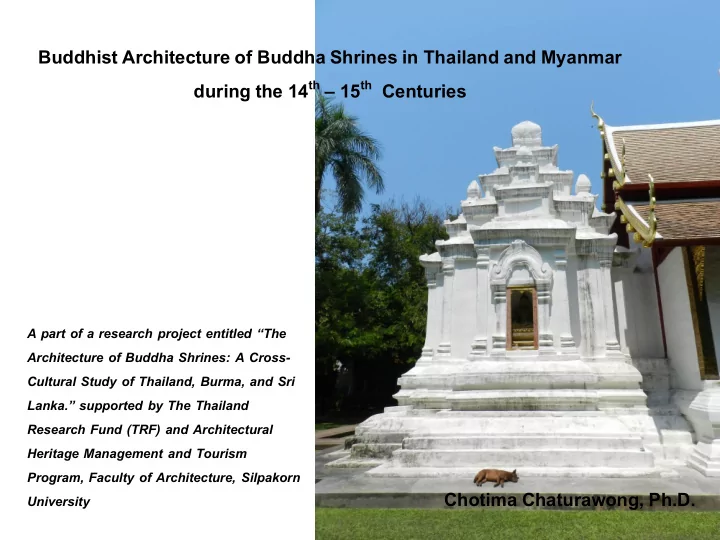
A part of a research project entitled “The Architecture of Buddha Shrines: A Cross- Cultural Study of Thailand, Burma, and Sri Lanka.” supported by The Thailand Research Fund (TRF) and Architectural Heritage Management and Tourism Program, Faculty of Architecture, Silpakorn University
Buddhist Architecture of Buddha Shrines in Thailand and Myanmar during the 14th – 15th Centuries Chotima Chaturawong, Ph.D.
SLIDE 2 ที่มา: โชติ กัลยาณมิตร, พจนานุกรมสถาปัตยกรรมและศิลปเกี่ยวเนื่อง
This paper aims to compare the architecture of Buddha shrines in Thailand and Myanmar during the 14th to 15th centuries when Theravada Buddhism was widespread in Southeast Asia.
Photos: Chot Kanlayanamitra, Dictionary
- f Architecture and Related Art.
SLIDE 3
Photo: A. B. Griswold, Wat Pra Yun Reconsidered.
The comparison will focus on the architecture of Buddha shrines known as mondops and viharas in Sukhothai and Chiang Mai, Thailand; and cave temples, tazaungs (a pavilion established near a pagoda), wuts (an image shrine), hpaya-hsaungs (Buddha hall), and dhammasalas (a preaching hall) in Myanmar. Mondop
SLIDE 4
Martaban
(13th-14th centuries)
Pagan
(11th-13th centuries)
Pegu
(14th-16th centuries)
Chiang Mai
(13th-16th centuries)
Si Satchanalai Sukhothai
(13th-15th centuries)
Maps of Thailand and Myanmar
SLIDE 5
Mandapa garbha graha
Hindu Temple, Orissa Parashurameshwara Temple, Orissa (dated 7th century)
Mandapa, a Sanskrit term, means a pillared outdoor hall or a pavilion for public rituals in Indian architecture. Mandapa can be established next to an image shrine, garbha grha; or precede an antechamber of an image shrine; or be separate from a temple. Mandapa can be enclosed totally with walls or partly with walls or without any walls.
Mandapa
SLIDE 6
Banteay Srei (first half of the 12th century)
antarala (a front room) prasat mandapa
The architecture of mandapa in Southeast Asia also shares similarities to that in India; for instance, mandapas in Cambodia and Vietnam. These had a rectangular floor plan, were the site of ritual ceremonies, and were located to the front of an image shrine.
SLIDE 7 ที่มา: โชติ กัลยาณมิตร, พจนานุกรมสถาปัตยกรรมและศิลปเกี่ยวเนื่อง
However, the term, mondop in Thai architecture referred to a square building enshrining a Buddha image or sometimes multiple images. It is likely created later and developed from the term mandapa. Its role was parallel to an image shrine (garbha grha) of Hindu and Buddhist architecture in India and Sri Lanka.
Photos: Chot Kanlayanamitra, Dictionary
- f Architecture and Related Art.
SLIDE 8 Wat Suan Kaeo Utayan Noi, Si Satchanalai Mondops were found in both Sukhothai and Si Satchanalai, the twin city
- f Sukhothai. Si Satchanalai was located to the north of Sukhothai and
was emerged before Sukhothai was founded.
SLIDE 9
Wat Sa Patum, Si Satchanalai
Vihara [assembly hall] mondop stupa
SLIDE 10
- 1. Wat Si Chum
- 2. Wat Chetuphon
- 3. Wat Traphang Thong Lang
- 4. Wat Ko Mai Daeng
- 5. Wat Si Thon
- 6. Wat Tuk
1. 6. 5. 4. 3. 2.
SLIDE 11
Wat Si Chum, Sukhothai
SLIDE 12
Mondop, Wat Si Chum, Sukhothai
SLIDE 13
Buddha Shrine, Wat Chetuphon, Sukhothai
Mondops, Wat Si Chum and Wat Chetuphon = equivalent to cetiya [memorial], the oldest term for a stupa, which can refer to other objects of worship, a bodhi tree and a Buddha image. During the Anuradhapura period, Buddha images were popular among Mahayanists; however, image houses became more popular in period of Polonnaruwa (11th-13th cent).
SLIDE 14
Vihara Lai Kham, Wat Pha Sing, Chiang Mai
Source: Chaiyot Itwaraphan and others, Vihara Lai Kham, Wat Pha Sing.
khong phachao, khong prasat
vihara
Chiang Mai in northern Thailand or Lanna also had mondop called khong or khong prasat or khong phachao Khong refers to boundary or area or a shrine of a Buddha image; phachao means a Buddha image parallel to the term hpaya in Burmese. The term khong probably shares the same root with the words khon-lwa in Mon and khan-wa in Burmese meaning abode or dwelling place.
SLIDE 15
Source: Chaiyot Itwaraphan and others, Vihara Lai Kham, Wat Pha Sing.
khong phachao, khong prasat
Furthermore, it likely relates to the term khan and a-khan in Burmese and a-khan in Mon influenced by the Burmese referring to a room or a chamber. Thai and Khmer also have a term a-khan meaning a building.
SLIDE 16 Source: Chaiyot Itwaraphan and others, Vihara Lai Kham, Wat Pha Sing.
khong phachao, khong prasat
vihara
hpaya
After Pierre Pichard, “Ancient Burmese Monasteries.”
A Buddha shrine called hpaya-khan at a Burmese brick Buddhist monastery in Pagan is likely parallel to khong phachao in Lanna, they refer to a chamber or a shrine of a Buddha image.
SLIDE 17
Khong Phachao as a miniature shrine
SLIDE 18 Butsabok (small so that only one person
prasat
(with porticos)
Butsabok, prasat, mondop, traditional Thai architecture crowned by a pyramidal roof
SLIDE 19
mondop (without porticos) pyathat gu-hpaya; bhut or wut; tazaung; hpaya-hsaung; and dhammasala
SLIDE 20 Naga-yon Temple
- 1. hall
- 2. gandhakuti taik
- 3. circumambulation
path 1 2 3 3 2 1
Myinkaba Kubyauk-gyi Temple (Gu-hpaya, cave temple), Pagan (dated 11th century) Pahto-tha-mya Temple Abe-ya-dana Temple
3 3 2 2 1 1
SLIDE 21
Abeyadana Myinkaba
SLIDE 22
Bhut, Kado Taik Kyaung, Kado Village, Moulmein
Bhut or Wut
SLIDE 23
Bhut or Wut, Myatheindan Pagoda, Martaban
SLIDE 24
Tazaung was usually built to the front or surround a stupa as a place to worship a stupa and to protect devotees from the sun and rain.
SLIDE 25
Tazaungs later enshrine Buddha images or a bell or a Buddha footprint.
SLIDE 26
Hpaya-hsaung, Buddha hall
Taikdaw Monastery, Mandalay (19th century)
SLIDE 27
Hpaya-hsaung, Taikdaw Monastery, Mandalay (19th century)
SLIDE 28
Wat Traphang Thong Lang A Sukhothai mondop and a vihara or a pillared pavilion to the front were like a brick monastery of Pagan.
SLIDE 29 Shin Arahat Monastery, Pagan
brick structure pavilion
rebuilt
A brick monastery of Pagan included a small brick dwelling for a monk with an attached
- pen pillared pavilion to the
front to receive guests and deliver dharma.
SLIDE 30 Jetavana Monastery in India during the Buddha time also had mandapas; for example, Karerimandapa [Kareri pavilion], a mandapa made from Kareri (varuna) trees. It was built next to the front door of Karerikutika, which was named after the
- mandapa. Karerimandapa to the front of Karerikuti probably was its
reception area as Karerikuti was small.
SLIDE 31
Dhammasala of Minnathu Le-myet-hna Monastery, Pagan
Figures: Pierre Pichard, “Entre Ajanta et Mandalay, L’ Architecture Monastique de Pagan.”
pavilion
1
1: a-ley-hpaya khan [central Buddha shrine]
SLIDE 32
Dhammasala of Minnanthu Le- Myet-Hna Monastery completed in 1223. The term dhammsa appeared on the inscription of the Minnanthu, derived from dhammasala and originated from dhammamandapa. The inscription described the dhammasa as a hall built of brick for people to listen to dharma.
SLIDE 33 Minnanthu Le-Myet-Hna Monastic complex
1 2 3 4
- 1. Le-myet-hna gu-hpaya
- 2. Ordination hall
- 3. Monastery for the chief monk or
senior monks
dhammamandapa
library
After Pierre Pichard, Inventory of Monuments at Pagan, vol. 2
SLIDE 34 Big Buddhist monasteries of Pagan had a separate building called dhammasa or trya em [house of dharma] or trya kyaung [school of dharma] for dharma preaching held on every sabbath day during the Buddhist lent, once in the morning and again in the evening.
Drawing: Pierre Pichard, Inventory
- f Monuments at Pagan, vol. 2
SLIDE 35 Dhammasala have also been found in Sri Lanka dating from the Anuradhapura period (c. 250 B. C. E. to 1029 C. E.). It was known as dhammamandapa, which later became dhammasala. It was a pavilion
- r a hall where dharma was delivered and located either at a monastery
- r a public area.
Dhammamandapascontinued to be constructed during the Polonnaruva period, King Parakramabahu I (c. 1153 – 1186) erected five dhammamandapas in Polonnaruva; however, none have survived.
SLIDE 36
Dhammasala still exist at present Sri Lanka and Myanmar; in the former, it is a multi-purpose building for dharma preaching, the paritta chanting ceremony, and sometimes as a monastery school. In Myanmar, dhammasala is called dhammayoun, which becomes a community hall for religious purposes, including dharma preaching, and is erected at several monasteries, pagoda compounds, and villages and towns.
SLIDE 37
The comparison study of Buddha shrines in Thailand and Myanmar can provide indigenous architectural characteristics as well as links to the history, culture, and religion among the people in two countries. It can lead to better understanding of traditional Thai architecture as well as that of the Burmese and Mon and the history of architecture in Southeast Asia as the whole when Sinhalese Buddhism replaced Buddhism from India after the collapse of Pagan, when the Mon in Lower Burma gained independence, and Sukhothai emerged in the 13th century.
Wat Pha Sing, Chiang Mai