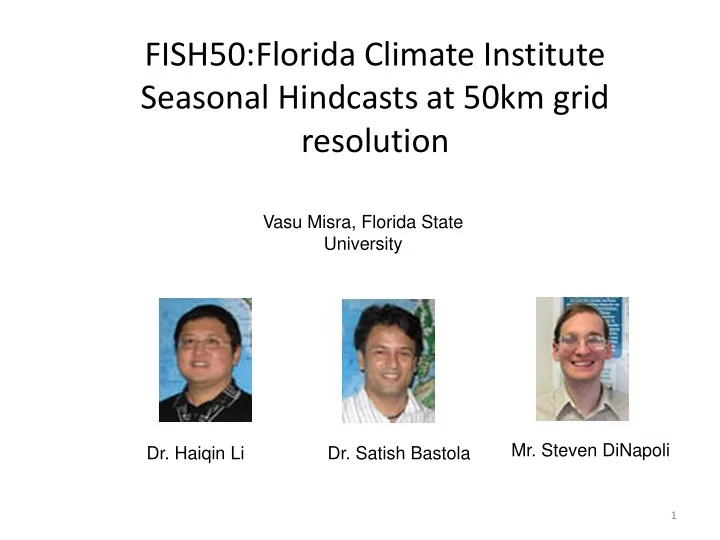
FISH50:Florida Climate Institute Seasonal Hindcasts at 50km grid resolution
Vasu Misra, Florida State University
- Dr. Haiqin Li
- Dr. Satish Bastola
- Mr. Steven DiNapoli
1
Vasu Misra, Florida State University Mr. Steven DiNapoli Dr. - - PowerPoint PPT Presentation
FISH50:Florida Climate Institute Seasonal Hindcasts at 50km grid resolution Vasu Misra, Florida State University Mr. Steven DiNapoli Dr. Haiqin Li Dr. Satish Bastola 1 Objectives What is FISH50? Deterministic forecast results
Vasu Misra, Florida State University
1
2
3
4
1982 2007
Nov
Nov
Nov
Nov
Nov
Nov
Boreal Summer/Fall (1982- 2008) SST climatology from
CFSv2 and CCSM3 relative to
6
ERSSTv3 climatology (1955-1981) in JJA and SON
7
Climatological SST bias (1982- 2008) in JJA (at zero lead) and SON (one season lead) from FISH50. SSTF=SSTOLF+SSTAMME SSTF: is used in FISH50 SSTOLF: is the observed low pass filtered SST used to replace the model climatology SSTAMME: is the multi-model forecast SST anomaly from CFSv2 and CCSM3
8
Observed climatology of precipitation in JJA and SON, and the RMSE of ensemble mean precipitation from FISH50, CFSv2 and CCSM3.
9
RMSE 1 N (M i Oi)2
i1 N(27years)
Observed climatology of surface temperature in JJA and SON, and the RMSE of ensemble mean precipitation from FISH50, CFSv2 and CCSM3.
10
3-D evolution of the 2 trajectories starting at two initial points Initial conditions were different by only by 10-5 in the x-coordinate. The divergence of the solutions happen because a) The model is non-linear b) The model is imperfect c) The initial conditions from when the model is started is imperfectly known If any of the above conditions are not met then divergence of solution will occur. But if you have have non-linear model but the model is perfect and initial conditions are known that the blue and yellow trajectories will be indistinguishable.
11
“The flap of a butterfly wing in the Amazon could cause a hurricane in the Atlantic” Dr. Ed Lorenz, Father of CAOS
The signal to noise ratio of precipitation for JJA and SON from FISH50, CFSv2 and CCSM3.
12
The correlation of ensemble mean precipitation for JJA and SON from FISH50, CFSv2 and CCSM3.
13
The signal to noise ratio of surface temperature for JJA and SON from FISH50, CFSv2 and CCSM3.
14
The correlation of ensemble mean surface temperature for JJA and SON from FISH50, CFSv2 and CCSM3.
15
16
Contingency Table
So if area under the curve exceeds 0.5 then it is better than climatology (represented by the diagonal).
17
This column represents the number
ensemble members
forecast the event for the JJA season for a particular grid point.
Example: There are 6 ensemble members for 9 seasons (83-90) and the event we are trying to verify our forecasts for, is JJA rainfall anomaly in the upper quartile.
18
Area under ROC for precipitation forecast for……….
Global Oceans Tropical Oceans Global Land Tropical Land
19
How do we stack up with the rest of NMME Area under ROC for precipitation forecast
CFSv1 is decommissioned by NCEP ECHAM-Anom has some future information used— “cheating”
20
FISH50 CFSv2 CCSM3
Lower tercile Middle tercile Upper tercile
JJA SON JJA SON JJA SON Area under the ROC for seasonal mean precipitation
21
Area under ROC for surface temperature forecast for……….
Global Land Tropical Land
22
How do we stack up with the rest of NMME Area under ROC for surface temperature forecast
23
FISH50 CFSv2 CCSM3
Lower tercile Middle tercile Upper tercile
JJA SON JJA SON JJA SON Area under the ROC for seasonal mean temperature
24
How do we stack up with the rest of NMME for the Southeastern US Remember any color that appears in this picture suggests that model forecast is better than climatology. Absence of any color also means that models are poorer than climatology.
25
AROC for extreme quartiles AROC for intermediate quartiles Appearance of bubble means that the forecast from FISH50 is better than climatology for that watershed.
27
28