Varieties of positive interior algebras: operation . The two - - PowerPoint PPT Presentation

varieties of positive interior algebras
SMART_READER_LITE
LIVE PREVIEW

Varieties of positive interior algebras: operation . The two - - PowerPoint PPT Presentation

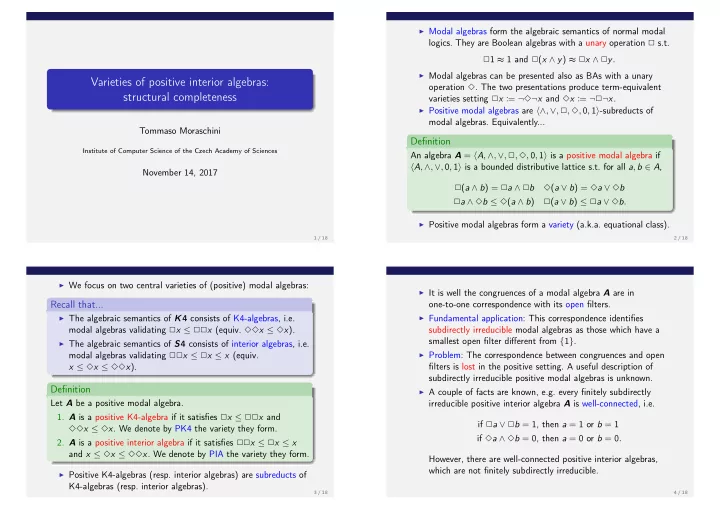
Modal algebras form the algebraic semantics of normal modal logics. They are Boolean algebras with a unary operation s.t. 1 1 and ( x y ) x y . Modal algebras can be presented also as BAs with a unary


slide-1
SLIDE 1

Varieties of positive interior algebras: structural completeness

Tommaso Moraschini

Institute of Computer Science of the Czech Academy of Sciences

November 14, 2017

1 / 18

◮ Modal algebras form the algebraic semantics of normal modal

  • logics. They are Boolean algebras with a unary operation ✷ s.t.

✷1 ≈ 1 and ✷(x ∧ y) ≈ ✷x ∧ ✷y.

◮ Modal algebras can be presented also as BAs with a unary

  • peration ✸. The two presentations produce term-equivalent

varieties setting ✷x := ¬✸¬x and ✸x := ¬✷¬x.

◮ Positive modal algebras are ∧, ∨, ✷, ✸, 0, 1-subreducts of

modal algebras. Equivalently...

Definition

An algebra A = A, ∧, ∨, ✷, ✸, 0, 1 is a positive modal algebra if A, ∧, ∨, 0, 1 is a bounded distributive lattice s.t. for all a, b ∈ A, ✷(a ∧ b) = ✷a ∧ ✷b ✸(a ∨ b) = ✸a ∨ ✸b ✷a ∧ ✸b ≤ ✸(a ∧ b) ✷(a ∨ b) ≤ ✷a ∨ ✸b.

◮ Positive modal algebras form a variety (a.k.a. equational class).

2 / 18

◮ We focus on two central varieties of (positive) modal algebras:

Recall that...

◮ The algebraic semantics of K4 consists of K4-algebras, i.e.

modal algebras validating ✷x ≤ ✷✷x (equiv. ✸✸x ≤ ✸x).

◮ The algebraic semantics of S4 consists of interior algebras, i.e.

modal algebras validating ✷✷x ≤ ✷x ≤ x (equiv. x ≤ ✸x ≤ ✸✸x).

Definition

Let A be a positive modal algebra.

  • 1. A is a positive K4-algebra if it satisfies ✷x ≤ ✷✷x and

✸✸x ≤ ✸x. We denote by PK4 the variety they form.

  • 2. A is a positive interior algebra if it satisfies ✷✷x ≤ ✷x ≤ x

and x ≤ ✸x ≤ ✸✸x. We denote by PIA the variety they form.

◮ Positive K4-algebras (resp. interior algebras) are subreducts of

K4-algebras (resp. interior algebras).

3 / 18

◮ It is well the congruences of a modal algebra A are in

  • ne-to-one correspondence with its open filters.

◮ Fundamental application: This correspondence identifies

subdirectly irreducible modal algebras as those which have a smallest open filter different from {1}.

◮ Problem: The correspondence between congruences and open

filters is lost in the positive setting. A useful description of subdirectly irreducible positive modal algebras is unknown.

◮ A couple of facts are known, e.g. every finitely subdirectly

irreducible positive interior algebra A is well-connected, i.e. if ✷a ∨ ✷b = 1, then a = 1 or b = 1 if ✸a ∧ ✸b = 0, then a = 0 or b = 0. However, there are well-connected positive interior algebras, which are not finitely subdirectly irreducible.

4 / 18

slide-2
SLIDE 2

◮ Some example of simple positive interior algebras: ◮ Obs: The positive interior algebras above contain a non-simple

and non-trivial subalgebra (e.g. any four-element chain).

Corollary

Positive interior algebras do not have the congruence extension property (CEP). Thus they do not have EDPC.

◮ This contrasts with the full signature case, since interior

algebras have EDPC.

5 / 18

◮ The free one-generated

algebra of PK4 is infinite: it contains an infinite descending chain {✷nx : n ∈ ω}.

◮ The free two-generated

positive interior algebra is infinite.

◮ While the free

  • ne-generated algebra of

PIA is finite. This contrasts with the full-signature case. 1• ✸•

  • x•
  • ✸ •✷
  • ✷•

0•

6 / 18

◮ From the knowledge of the structure of the free one-generated

positive interior algebra we can derive all one-generated subdirectly irreducible positive interior algebras: 1• 1• 1• 1• 1• 1• ✸• ✸•

  • 1•
  • ✸•

✷• ✷•

  • ✷•

0• 0• 0• 0• 0• 0• 0• 1• 1• 1• 1• ✸•

  • ✸•
  • ✷•

✸•

  • ✷•

0• 0• 0• 0•

7 / 18

◮ Playing with these one-generated subdirectly irreducible

algebras, we obtain a description of the bottom part of the subvariety lattice Λ(PIA) of positive interior algebras.

Theorem

  • 1. There is a unique minimal subvariety DL of PIA,

term-equivalent to that of bounded distributive lattices.

  • 2. The unique covers of DL in Λ(PIA) are the ones generated by
  • ne of the following algebras D3, C a

3, C b 3 and D4:

1• 1• 1• 1• ✸•

  • ✸•

✷• ✷• 0• 0• 0• 0•

  • 3. If K is a subvariety of PIA such that DL K, then K includes
  • ne of the covers of DL.

8 / 18

slide-3
SLIDE 3

◮ To climb higher (from bottom to top) in the lattice Λ(PIA),

we need the following:

Definition

Let K be a variety. A subdirectly irreducible A ∈ K is a splitting algebra in K if there is a largest subvariety of K excluding A.

Lemma (McKenzie)

If a congruence distributive variety is generated by its finite members, then its splitting algebras are finite.

Corollary

Splitting algebras in PK4 and in PIA are finite.

◮ Problem: Which finite s.i. algebras are splitting in PK4 and in

PIA? In the full-signature case the answer is all (by EDPC). In the positive case it is unknown.

9 / 18

Typical application: V(D4) has no join-irreducible cover in Λ(PIA).

◮ Consider the positive interior algebras D3, C a 3, C b 3 and D4:

1• 1• 1• 1• ✸•

  • ✸•

✷• ✷• 0• 0• 0• 0•

◮ D3 is splitting in PK4 with splitting identity

✸x ∧ ✷✸x ≤ x ∨ ✷x ∨ ✸✷x. (1)

◮ C a 3 and C b 3 are splitting in PIA, respectively with splitting

identities ✸✷✸x ≈ ✸x and ✷✸✷x ≈ ✷x. (2)

◮ V(D4) is axiomatized by

✷✸x ≈ ✷x and ✸✷x = ✸x. (3)

◮ Since (3) is a consequence of (1, 2), we are done.

10 / 18

◮ The next figure shows the join-irreducible covers of the

varieties generated by D3, C a

3, C b 3 and D4 in Λ(PIA):

11 / 18

Figure: Join-irreducible varieties of depth ≤ 4 in Λ(PIA).

12 / 18

slide-4
SLIDE 4

Definition

Let K be a variety and consider a quasi-equation Φ := ϕ1 ≈ ψ1& . . . &ϕn ≈ ψn → ϕ ≈ ψ.

  • 1. Φ is active in K when there is a substitution σ such that

K σϕi ≈ σψi for every i ≤ n.

  • 2. Φ is passive in K if it is not active in K.
  • 3. Φ is admissible in K if for every substitution σ:

if K σϕi ≈ σψi for every i ≤ n, then K σϕ ≈ σψ.

  • 4. Φ is derivable in K if K Φ.

◮ Observe that passive quasi-equations are vacuously admissible.

13 / 18

Definition

Let K be a variety.

  • 1. K is actively structurally complete (ASC) if every active

admissible quasi-equation is derivable.

  • 2. K is passively structurally complete (PSC) if every passive

(admissible) quasi-equation is derivable.

  • 3. K is structurally complete (SC) if every admissible

quasi-equation is derivable.

  • 4. K is hereditarily structurally complete (SHC) if every

subvariety of K is SC.

◮ Clearly, (ASC) + (PSC) = (SC), and (SHC) implies (SC). ◮ We aim to understand the various structural completeness in

subvarieties of PK4.

14 / 18

Theorem

Let K be a SC variety of positive modal algebras. Either K = V(B2) or there are n, m ≥ 1 such that K ✷x ∧ · · · ∧ ✷nx ≤ x and K x ≤ ✸x ∨ · · · ∨ ✸mx.

Corollary

Let K be a SC variety of positive K4-algebras. Either K = V(B2) or K ⊆ PIA.

◮ Hence, while trying to spot SC subvarieties of PK4, we can

restrict to subvarieties of PIA.

15 / 18

Theorem

Let K be a non-trivial variety of positive interior algebras. TFAE:

  • 1. K is actively structurally complete.
  • 2. K excludes D3, C a

3 and C b 3.

  • 3. K = DL or K = V(D4).
  • 4. K is hereditarily structurally complete.
  • 5. K is structurally complete.
  • 6. K satisfies the equations ✷✸x ≈ ✷x and ✸✷x ≈ ✸x.

Corollary

Let K be a non-trivial variety of positive K4-algebras. TFAE:

  • 1. K is structurally complete.
  • 2. K = V(B2) or K = DL or K = V(D4).
  • 3. K is hereditarily structurally complete.

◮ There are only 3 non-trivial SC subvarieties of PK4.

16 / 18

slide-5
SLIDE 5

◮ Problem: What about ASC and PSC subvarieties of PK4? ◮ For ASC the answer is unknown. ◮ Let C 2 be the two-element positive interior algebra. For PSC

we have:

Theorem

Let K be a non-trivial variety of positive K4-algebras. TAFE:

  • 1. K is passively structurally complete.
  • 2. Either K = V(B2) or (FmK(0) = C 2 and C 2 is the unique

simple member of K).

  • 3. Either K = V(B2) or (FmK(0) = C 2 and K excludes D3).
  • 4. Either K = V(B2) or

K ✸1 ≈ 1, ✷0 ≈ 0, ✸x ∧ ✷✸x ≤ x ∨ ✷x ∨ ✸✷x.

◮ There are infinitely many PSC subvarieties of PIA.

17 / 18

Finally...

...thank you for coming!

18 / 18