Value Chain Analysis SEEP Network Annual General Meeting Pre-Event - - PDF document

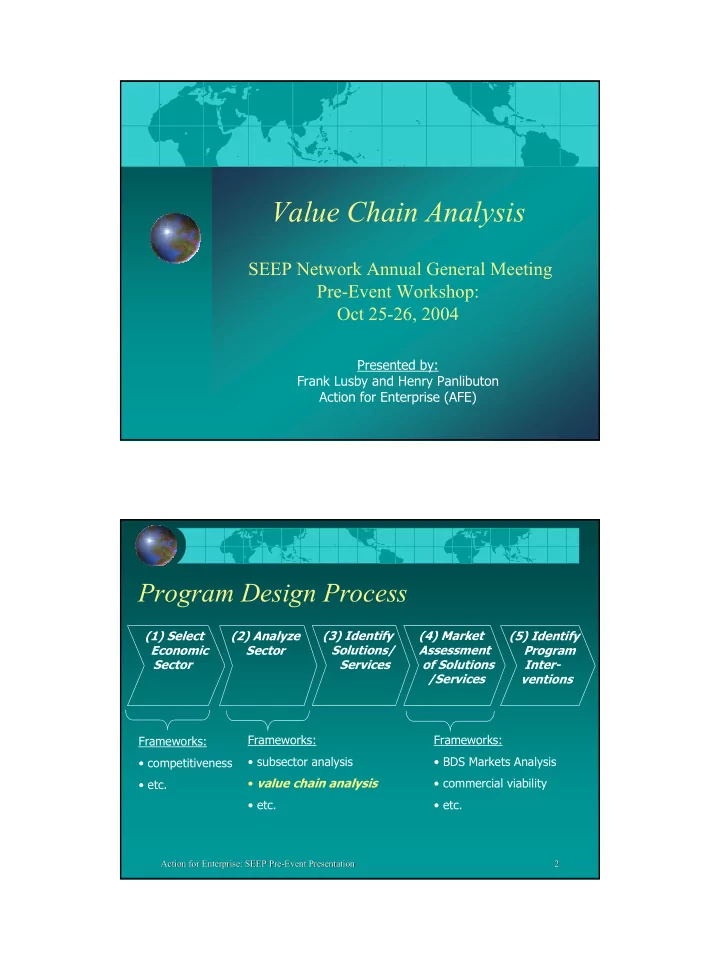
value chain analysis
SMART_READER_LITE
LIVE PREVIEW

Value Chain Analysis SEEP Network Annual General Meeting Pre-Event - - PDF document

Value Chain Analysis SEEP Network Annual General Meeting Pre-Event Workshop: Oct 25-26, 2004 Presented by: Frank Lusby and Henry Panlibuton Action for Enterprise (AFE) Program Design Process (1) Select (2) Analyze (3) Identify (4) Market


slide-1
SLIDE 1

1

Value Chain Analysis

SEEP Network Annual General Meeting Pre-Event Workshop: Oct 25-26, 2004

Presented by: Frank Lusby and Henry Panlibuton Action for Enterprise (AFE)

Action for Enterprise: SEEP Pre Action for Enterprise: SEEP Pre-

  • Event Presentation

Event Presentation 2 2

Program Design Process

(1) Select Economic Sector (2) Analyze Sector (3) Identify Solutions/ Services (4) Market Assessment

  • f Solutions

/Services (5) Identify Program Inter- ventions Frameworks:

  • subsector analysis
  • value chain analysis
  • etc.

Frameworks:

  • BDS Markets Analysis
  • commercial viability
  • etc.

Frameworks:

  • competitiveness
  • etc.
slide-2
SLIDE 2

2

Action for Enterprise: SEEP Pre Action for Enterprise: SEEP Pre-

  • Event Presentation

Event Presentation 3 3

Presentation Outline

1. What is Value Chain Analysis? 2. How to gather Value Chain information? 3. Why is Value Chain Analysis important?

Action for Enterprise: SEEP Pre Action for Enterprise: SEEP Pre-

  • Event Presentation

Event Presentation 4 4

Subsector and Value Chain Analysis

value chain analysis is complementary to subsector analysis provides additional analytical elements that can improve the program design process builds on the foundation of a subsector analysis framework

slide-3
SLIDE 3

3

Action for Enterprise: SEEP Pre Action for Enterprise: SEEP Pre-

  • Event Presentation

Event Presentation 5 5

Services/Solutions to upgrade MSEs Subsector Analysis Value Chain Analysis

Subsector and Value Chain Analysis

Action for Enterprise: SEEP Pre Action for Enterprise: SEEP Pre-

  • Event Presentation

Event Presentation 6 6

What is a Subsector?

Definition:

– range of activities required to bring a product or service to the final consumer – includes producers, processors, input suppliers, exporters, retailers, etc. – includes both vertical and horizontal linkages – can be defined by a particular finished product or service

  • e.g. wood furniture, green beans for export, etc.

** the same definition can be applied to Value Chains

slide-4
SLIDE 4

4

Action for Enterprise: SEEP Pre Action for Enterprise: SEEP Pre-

  • Event Presentation

Event Presentation 7 7

Elements of Subsector Analysis

1) Understanding Product Markets and Market Trends 2) Relationships between Participants

– describes functions, participants, and relationships among participants

3) Identification of Constraints and Opportunities

– including: technology, market access, organization, policy, finance, input supply, etc.

Action for Enterprise: SEEP Pre Action for Enterprise: SEEP Pre-

  • Event Presentation

Event Presentation 8 8

4) Subsector mapping

– graphic presentation of inter-relationships; – can help to identify participants to interview

slide-5
SLIDE 5

5

Baskets (for Export) Subsector Map

Individual Producers Production Subcontractors Broker Subcontractors Regional Traders Export Companies Export Agents Regional Export Market International Export Market

Production Trading Export

Action for Enterprise: SEEP Pre Action for Enterprise: SEEP Pre-

  • Event Presentation

Event Presentation 10 10

Elements of Value Chain Analysis

1) Geographic Coverage

– value chain analysis reviews activities at all levels (national, regional, global)

2) Global Benchmarking

– benchmarking (with competing countries) – learning from buyers – use of star diagrams

slide-6
SLIDE 6

6

1 2 3 4 5

Quality Price Resp Time Punctuality Flex Small Orders Flex Large Orders Innov Design India Italy

FOOTWEAR Performance Comparison: India – Italy

Source: Learning From Global Buyers; H. Schmitz, P. Knorringa (IDS)

Action for Enterprise: SEEP Pre Action for Enterprise: SEEP Pre-

  • Event Presentation

Event Presentation 12 12

3) Inter-firm Cooperation

– level of cooperation among participants in value chain – degree of interaction (beyond buying and selling) – structure of transactions (e.g. subcontracting, etc.)

4) Governance

– who decides what is produced? – how are the rules of trade determined? – what is the nature of relationships between participants?

slide-7
SLIDE 7

7

Action for Enterprise: SEEP Pre Action for Enterprise: SEEP Pre-

  • Event Presentation

Event Presentation 13 13

Types of Value Chain Governance

Market-based

– “arm’s length” transactions between buyers & sellers – little or no formal cooperation among participants

Balanced

– fairly equal decision making among participants – cooperation but no one dominates

Directed

– controlled by firm(s) who determine product specifications, trade rules, etc.

Action for Enterprise: SEEP Pre Action for Enterprise: SEEP Pre-

  • Event Presentation

Event Presentation 14 14

Hierarchy

– vertically integrated enterprise that controls various functions along value chain

** Type of governance may vary within different parts of a single value chain

slide-8
SLIDE 8

8

Integrated Firm

Value Chain Governance Structures

Price Suppliers Buyers Suppliers Buyers

Market Balanced Directed Hierarchy

Major Buyer Suppliers

Source: The Governance of Global Value Chain; Gereffi, Humphrey, Sturgeon

(Tomatoes) (Organic Coffee) (Export Crafts) (Cut Flowers)

Action for Enterprise: SEEP Pre Action for Enterprise: SEEP Pre-

  • Event Presentation

Event Presentation 16 16

Small Group Exercise

Break-out into five groups of 5-6 people each Read the value chain case Discuss and answer the following questions:

– what type of governance structure does it have? – what are the advantages or disadvantages to this governance structure?

slide-9
SLIDE 9

9

Subsector and Value Chain Analysis

Governance Inter-firm Cooperation Global Benchmarking Geographic Coverage Constraints & Opportunities Subsector Mapping Relations Among Participants Market Trends Services/Solutions to upgrade MSEs

Action for Enterprise: SEEP Pre Action for Enterprise: SEEP Pre-

  • Event Presentation

Event Presentation 18 18

Program Design Process

(1) Select Economic Sector (2) Analyze Sector (3) Identify Solutions/ Services (4) Market Assessment

  • f Solutions

/Services (5) Identify Program Inter- ventions Frameworks:

  • subsector analysis
  • value chain analysis
  • etc.

Frameworks:

  • BDS Markets Analysis
  • commercial viability
  • etc.

Frameworks:

  • competitiveness
  • etc.
slide-10
SLIDE 10

10

Action for Enterprise: SEEP Pre Action for Enterprise: SEEP Pre-

  • Event Presentation

Event Presentation 19 19

Presentation Outline

1. What is Value Chain Analysis? 2. How to gather Value Chain information? 3. Why is Value Chain Analysis important?

Action for Enterprise: SEEP Pre Action for Enterprise: SEEP Pre-

  • Event Presentation

Event Presentation 20 20

Information Gathering & Compilation

1) Review Available Data 2) Develop Initial Map 3) Gather Primary Data

slide-11
SLIDE 11

11

Action for Enterprise: SEEP Pre Action for Enterprise: SEEP Pre-

  • Event Presentation

Event Presentation 21 21

Review Available Data

Where can you get data on subsectors/value chains? studies and reports

– government, donors, development projects, etc.

web-based research etc.

Action for Enterprise: SEEP Pre Action for Enterprise: SEEP Pre-

  • Event Presentation

Event Presentation 22 22

Develop Initial Map

Mapping Steps

– identify final markets – identify key functions/activities – identify participants performing each function – map participants according to functions they perform – map inter-relationships between participants

slide-12
SLIDE 12

12

Production Collection/ Bulking Pastuerizing

Smallholder Farmers Traders Medium/Large Dairy Farmers

Channel 1

Cooling Processing Wholesaling

Large/ Medium Dairies Small Dairies

Rural Consumer Urban Consumer

Hawker/Milkbar Caterer/Hotel Small Retailer Large Retailer Poor Rich

Channel 2 Channel 3: Pasteurized Channel 4: Milk Prod.

(625,000) (2,000) (10) (20) (5,000) (10,000) (145,000) (90,000) (10)

Raw Milk

Retailing

Farmer Groups

Milk Subsector/Value Chain Map

Action for Enterprise: SEEP Pre Action for Enterprise: SEEP Pre-

  • Event Presentation

Event Presentation 24 24

Gather Primary Data

guided interviews with key informants and value chain participants focus group discussions stakeholder meetings ** specific details of these tools will be presented at the Tools Workshop (Day 2)

slide-13
SLIDE 13

13

Action for Enterprise: SEEP Pre Action for Enterprise: SEEP Pre-

  • Event Presentation

Event Presentation 25 25

Presentation Outline

1. What is Value Chain Analysis? 2. How to conduct value chain analysis? 3. Why is value chain analysis important?

Action for Enterprise: SEEP Pre Action for Enterprise: SEEP Pre-

  • Event Presentation

Event Presentation 26 26

Value Chain Analysis can help to…

Reveal links between producers, exporters and global markets Identify constraints all along the chain to competing in the marketplace Clarify the relationships in the chain from buyers to producers Highlight the distribution of benefits among buyers, exporters and producers in the chain

slide-14
SLIDE 14

14

Action for Enterprise: SEEP Pre Action for Enterprise: SEEP Pre-

  • Event Presentation

Event Presentation 27 27

understanding of value chains increasingly important for MSE development USAID/AMAP Hypothesis

– greater integration of MSEs into value chains can contribute to:

  • improved enterprise performance,
  • household well-being, and
  • growth and competitiveness of value chain

Link to MSE development

Action for Enterprise: SEEP Pre Action for Enterprise: SEEP Pre-

  • Event Presentation

Event Presentation 28 28

Program Design Process

(1) Select Economic Sector (2) Analyze Sector (3) Identify Solutions/ Services (4) Market Assessment

  • f Solutions

/Services (5) Identify Program Inter- ventions Frameworks:

  • subsector analysis
  • value chain analysis
  • etc.

Frameworks:

  • BDS Markets Analysis
  • commercial viability
  • etc.

Frameworks:

  • competitiveness
  • etc.
slide-15
SLIDE 15

15

Action for Enterprise: SEEP Pre Action for Enterprise: SEEP Pre-

  • Event Presentation

Event Presentation 29 29

Value Chain References and Links

The Manual for Value Chain Research on Home Workers in the Garment Industry

– D. McCormick, H. Schmitz; Nov 2001 – www.ids.ac.uk/ids/global/pdfs/wiegomanualendnov01.pd

Promotion of Commercially Viable Solutions to Subsector and Business Constraints

– F. Lusby, H. Panlibuton; Apr 2004 – www.actionforenterprise.org/paper0404.pdf

Learning From Global Buyers

– H. Schmitz, P. Knorringa – www.ids.ac.uk/ids/bookshop/wp/wp100.pdf