Vaccine-Preventable Diseases 1 2/16/15 I have nothing to disclose - - PDF document

vaccine preventable diseases
SMART_READER_LITE
LIVE PREVIEW

Vaccine-Preventable Diseases 1 2/16/15 I have nothing to disclose - - PDF document

2/16/15 Emerging Issues in Pediatric Infections (focus on Vaccine Preventable Diseases) C A R O L G L A S E R , D V M , M P V M , M D PEDIATRIC INFECTIOUS DISEASES KAISER PERMANENTE OAKLAND & DEPARTMENT OF PEDIATRICS DIVISION OF


slide-1
SLIDE 1

◆ 2/16/15 ◆ 1

C A R O L G L A S E R , D V M , M P V M , M D

PEDIATRIC INFECTIOUS DISEASES KAISER PERMANENTE OAKLAND & DEPARTMENT OF PEDIATRICS DIVISION OF PEDIATRIC INFECTIOUS DISEASES UNIVERSITY OF CALIFORNIA, SAN FRANCISCO

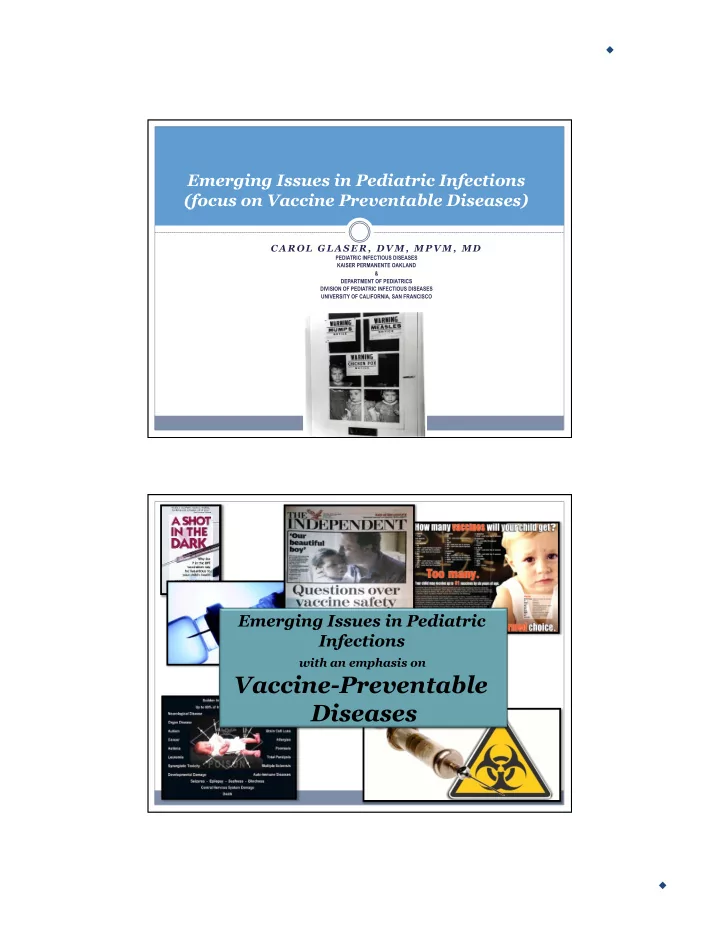
Emerging Issues in Pediatric Infections (focus on Vaccine Preventable Diseases) Emerging Issues in Pediatric Infections

with an emphasis on

Vaccine-Preventable Diseases

slide-2
SLIDE 2

◆ 2/16/15 ◆ 2

I have nothing to disclose

Resurgence of VPDs due to failure to immunize and

what it means to the United States

Measles No indigenous transmission in the U.S., but continued

transmission in many parts of the world, including Europe, means it’s still an issue in the U.S.

The Pertussis Problem Why has the incidence been increasing in the U.S.? Mumps Why are there still cases in the U.S. even though immunization

rates are high?

Other vaccine-preventable diseases

slide-3
SLIDE 3

◆ 2/16/15 ◆ 3

About vaccines

Childhood vaccination rates plummeted in Europe

following a 1998 study that falsely claimed MMR was linked to autism

Although results of the 1998 study have been shown

to be false, fears about vaccine safety have remained

In some parts of Europe, MMR

vaccination rates are <80%

Case 1

slide-4
SLIDE 4

◆ 2/16/15 ◆ 4

Case 1

3 year old female with

6/28: Onset of fever 6/29 runny nose 7/2 rash around mouth 7/3 erythematous mp rash spread from face to whole

body

Case 1

Exam

Irritable child in mothers arms with prominent cough + Conjunctivitis, +/- cervical LN Erythematous MP rash whole body, most pronounced on

trunk.

No palmar erythema, no puffy hands/feet

Labs;

CRP=2, ESR=36 CBC unremarkable AST slight increase, ALT nl U/A with pyuria

slide-5
SLIDE 5

◆ 2/16/15 ◆ 5

Case 1

Social History

This child comes from a family with several

children—the 5 oldest have had vaccines , this child and 5 y/o sibling have not been vaccinated Exposure

Just returned from the Philippines (became ill on

plane)

Case 1

Exam Irritable child in mothers arms with prominent cough + Conjunctivitis, +/- cervical LN Erythematous MP rash whole body, most pronounced on

trunk.

No palmar erythema, no puffy hands/feet Labs; CRP=2, ESR=36 CBC unremarkable AST slight increase, ALT nl U/A with pyuria

slide-6
SLIDE 6

◆ 2/16/15 ◆ 6

Lab testing

Measles PCR throat positive

slide-7
SLIDE 7

◆ 2/16/15 ◆ 7

Measles

Background & Epidemiology

slide-8
SLIDE 8

◆ 2/16/15 ◆ 8

Measles

Highly contagious viral illness Near universal infection of childhood in pre-

vaccination era

Frequent and often fatal in developing areas Humans are only natural host

Potential for eradication (by 2020?) Several factors work in favor of measles eradication: humans are

the only hosts, measles vaccine is highly efficacious, and immunity resulting from infection and/or vaccination is very durable

Measles in the Prevaccine Era – United States, 1950s

Annually:

3-4 million cases

~ 500,000 reported cases

Severe complications

4,000 encephalitis cases 150,000 respiratory complications (PNA)

48,000 hospitalizations 450 deaths

slide-9
SLIDE 9

◆ 2/16/15 ◆ 9

Vaccine Licensed 1963

Measles – United States, 1950-200o

Resurgence Measles US 1989-1991

55,000 cases nationally

11,000 hospitalizations 123 deaths

slide-10
SLIDE 10

◆ 2/16/15 ◆ 10

Measles Resurgence California-1989-1991

  • 18,000 reported cases (30% national cases)
  • 3,500 hospital admissions
  • 70 deaths

Because of resurgence measles (late 80s-early 90s) United States

Introduction of 2nd dose of vaccine in 1989 and

federal “Vaccines for Children” program in 1993

2000: “Measles is no longer endemic in the

United States”

Record low annual total in 2004 (37 total cases in

US)

Elimination of endemic measles in North and South

America was achieved in 2002

slide-11
SLIDE 11

◆ 2/16/15 ◆ 11

Vaccine Licensed 1963

Measles – United States, 1950-2005

2nd dose

1989 Endemic transmission interrupted Measles declared eliminated

Global epidemiology 2000-current

Currently, most U.S. measles cases are related to international travel or contact with ill travelers

Africa, Asia, Pacific Rim countries and…

Europe

Several different countries with large outbreaks including 15,000 cases

in France in 2011

Romania, Ireland, the UK, France, Italy, and Spain also with outbreaks

slide-12
SLIDE 12

◆ 2/16/15 ◆ 12

◆ D

5

◆ D

5

◆ D

4

◆ D

4

Measles Importations, U.S. 2008

◆ D

4

Measles Transmission

Highly contagious viral illness – 90% of

susceptible persons who are exposed to measles will become ill

Measles is transmitted via the airborne route Measles patients are infectious 4 days prior to

rash onset and 4 days after rash onset

Persons who share the same air space at the same

time or up to two hours* after an infectious person leaves a setting are considered exposed (*for contact tracing CDPH-one hour)

slide-13
SLIDE 13

◆ 2/16/15 ◆ 13

Measles Ro vs. other diseases

  • 1. Fine P. Herd Immunity: History, Theory,
  • Practice. Epidemiologic Reviews 1993;15(2):

265-302.

  • 2. Anderson RM and May RM. Vaccination and

Herd Immunity to Infectious Diseases. Nature 1985;318:323-9.

  • 3. Anderson RM and May RM. Immunization and

Herd Immunity. Lancet 1990;335:341-45.

Measles Airborne and probably the most infectious communicable disease: R0 =12-18

Measles Transmission

Measles transmission has been documented in:

Physician offices Emergency rooms Hospital wards Schools Airplanes Theme parks

Highest Ro of all communicable diseases

slide-14
SLIDE 14

◆ 2/16/15 ◆ 14

Implications of those exposed

Postexposure Prophylaxis (PEP)

MMR vaccine can be given to exposed, susceptible contacts

within 72 hours of exposure

Immunoglobulin (IG) can be given to exposed, susceptible

contacts < 6 days of exposure

MMR is preferred for persons >12 months IG is preferred for infants (IM), pregnant women (IV) Quarantine is not indicated for persons who receive PEP in

the recommended time frame…HOWEVER….for “high risk” individuals this is not true/need to be quarantined

A high-risk contact is defined as an exposed person who is at high-risk of measles

infection or complications (pregnant or immunocompromised) or who works in a sensitive setting (healthcare personnel of any age) or works in or attends a setting with known unvaccinated persons (e.g., school/childcare) or who had significant exposure to the case (household contact).

slide-15
SLIDE 15

◆ 2/16/15 ◆ 15

Quarantine

Persons considered susceptible after assessment

who did not receive PEP should be quarantined from day 5 through day 21 after exposure

Quarantine can be accomplished by:

Verbal instructions communicated to the exposed person, or A legal order of quarantine issued by the health officer

Active symptom monitoring, particularly for people

who may be noncompliant, can be considered

Quarantined people should be contacted at the end of the

quarantine period to determine their status

In the last few years in US and in California

slide-16
SLIDE 16

◆ 2/16/15 ◆ 16

Measles in the United States, 2013

Of 159 cases (Jan-Aug 2013)

157 (99%) import-associated 42 (26%) directly from 18 countries 21 (50%) from WHO European Region Imported cases resulted in outbreaks Some of these were quite large outbreaks

New York: 58 cases

  • Index case; unvaccinated 17 year old returned from London, UK to New York

City, 6 generations of measles, none had been vaccinated, contact investigation=3500!!

North Carolina: 23 cases

  • Index case: unvaccinated, travel to India

Texas: 21 cases

  • Index case: adult with unknown measles vaccination history, travel to Indonesia

◆ CDC, MMWR, Sept 2013

Measles in the United States, 2013

Total of 189 cases reported

At that time, 2nd largest number in US since measles

eliminated in 2000

Most occurred in unvaccinated persons

slide-17
SLIDE 17

◆ 2/16/15 ◆ 17

And then in 2014 …..

610 cases, 20 outbreaks

[by comparison 189 cases in 2013]

California 2014

January 1-April 18, 2014

58 cases

54 (93%) import associated 13 directly imported Of the 13 imported

Philippines (8), India (2), Singapore (1), Vietnam (1), West

Europe (1)

Genotyping data

  • 39 patients: 32 (80%) B3, 7 (20%) D8
  • B3 is genotype currently circulating in Philippines
  • Notes from Field, MMWR, April 2014
slide-18
SLIDE 18

◆ 2/16/15 ◆ 18

Late 2014-early 2015

Ca ses in California linked to travel to Disneyland Dec 2014-Jan 2015 Additional cases in other states—Utah, Texas, Colorado, Washington

  • Currently in 3rd-4th wave/4th generation transmission.

Will now see several cases without Disneyland exposure

Measles Outbreak Epi Curve

  • 39 cases primary Disney
  • 1 case who reports visiting Disney outside of initial

time period

slide-19
SLIDE 19

◆ 2/16/15 ◆ 19

Vaccination Status Among Measles Cases with Vaccine Documentation (n=53) Genotyping data and 2015 Outbreak

Measles genotype information was available from 9 measles cases; all were genotype B3 and all sequences linked to this outbreak are identical. The sequences are also identical to the genotype B3 virus that caused a large outbreak in the Philippines in 2014. During the last 6 months, identical genotype B3 viruses were also detected in at least 14 countries and at least 6 U.S. states, not including those linked to the current outbreak.

slide-20
SLIDE 20

◆ 2/16/15 ◆ 20

Of 9 cases genotyped All B3 Same as strain

Philippines outbreak Last 6 months:

Also 14 countries 6 other states

Genotyping data and 2015 Outbreak 2015

What will the rest of the year bring?

Particularly problematic when measles introduced in pockets

  • f unvaccinated persons

May see clusters geographically and socially

slide-21
SLIDE 21

◆ 2/16/15 ◆ 21

Clinical Features

Time line

slide-22
SLIDE 22

◆ 2/16/15 ◆ 22

3Cs-Cough, Coryza & Conjunctivitis

Measles clinical features

Rash

2-4 days after prodrome, 14 days after

exposure

Maculo-papular, becomes confluent Begins on face and head and moves downward Persists 5-6 days Fades in order of appearance[copper] color

slide-23
SLIDE 23

◆ 2/16/15 ◆ 23

Koplik spots

Look like "grains of salt on a wet background" (Wikipedia)

Modified Measles

slide-24
SLIDE 24

◆ 2/16/15 ◆ 24

Modified measles

Occurs in partially immune individuals

Those who received IG (e.g., exposed infants), < 9 months of

age (because of maternal antibodies), occasionally in someone previously vaccinated/failure of vaccine (secondary vaccine failure) Characterized by milder illness than typical measles,

follows regular sequence of events

Prodrome shorter > regular measles Cough and coryza minimal Koplick spots-not present or only transient rash-same progression as regular measles but doesn’t become

confluent

Modified Measles rash

slide-25
SLIDE 25

◆ 2/16/15 ◆ 25

Modified Measles Rash Modified Measles 2009 – no transmission in these case reports

Journal of Infectious Disease 2011 Two case studies of modified measles in vaccinated physicians exposed to primary measles cases: high risk of infection but low risk of transmission. Rota JS1, Hickman CJ, Sowers SB, Rota PA, Mercader S, Bellini WJ.

In 2009, measles outbreaks in Pennsylvania and Virginia resulted in the exposure and apparent infection of 2 physicians, both of whom had a documented history of vaccination with >2 doses of measles-mumps-rubella vaccine. These physicians were suspected of having been infected with measles after treating patients who subsequently received a diagnosis of measles. The clinical presentation was non classical in regard to progression, duration, and severity. It is hypothesized that the 2 physicians mounted vigorous secondary immune responses typified by high avidity measles immunoglobulin G antibody and remarkably high neutralizing titers in response to intense and prolonged exposure to a primary measles case patient. Both of the physicians continued to see patients, because neither considered that they could have measles. Despite surveillance for cases among contacts, including unvaccinated persons, no

additional cases were identified.

slide-26
SLIDE 26

◆ 2/16/15 ◆ 26

However in 2011 in New York City……. Outbreak of measles among persons with prior evidence of immunity, New York City, 2011: Index case 22 year old female in NY city, 2 MMRs,

Developed classic measles [88 contacts] Four Secondary cases that had 2 MMRs and/or + serology

  • Modified measles

First report of measles transmission from person with two MMRs

  • Rosen JB, Clin Infect Disease, 2014

Atypical Measles

Different syndrome than modified measles Generally occurs in previously immunized persons

after they have been exposed to natural measles

Most occur in those who received inactivated/

killed vaccine (used 1963-1967)

Often starts with fevers and HA, dry cough Rash-starts distal and progresses in cephalad

direction

Respiratory distress with dyspnea common -PNA

and hilar adenopathy, pleuritic chest pain

Presumably due to delayed hypersensitivity to killed vaccine

slide-27
SLIDE 27

◆ 2/16/15 ◆ 27

Complications

Even without complications— miserable infection

slide-28
SLIDE 28

◆ 2/16/15 ◆ 28

Measles complications

Condition Percent reported Diarrhea 8% Otitis Media 7% Pneumonia 6% (viral or secondary bacterial) Encephalitis 0.1 Hospitalization 18% Death 0.2 (most often associated with pneumonia in children,

encephalitis in adult)

◆ Based on 1986-1992 surveillance data

Measles Complications by Age Group

slide-29
SLIDE 29

◆ 2/16/15 ◆ 29

Global morbidity and mortality

Still one of the leading causes of death among young

children

Global estimates:

20 million cases worldwide 150,000 deaths per year

A rare but dreaded long term consequence

slide-30
SLIDE 30

◆ 2/16/15 ◆ 30

Subacute Sclerosing Panencephalitis

“Slow virus” of brain

Considered ‘rare’ Latency between acute measles and first symptoms of SSPE

~4-10 years Four disease stages

1st stage: Changes in personality and behavior, school failure 2nd stage: repetitive and frequent myoclonic jerks, seizures

and/or dementia

3rd stage: rigidity, extrapyramidal symptoms, Last stage: vegetative state, autonomic failure or akinetic

mutism

Survival period: 1-3 years ◆ Modlin JF, Pediatrics, 1977

Measles and SSPE in Germany

  • Schonberger K, PLOS One, 2013
slide-31
SLIDE 31

◆ 2/16/15 ◆ 31

SSPE: more cases of this fatal disease prevented by measles than previously recognized (JID 2005)

  • BACKGROUND: The most severe sequela of measles virus infection is subacute sclerosing

panencephalitis (SSPE), a fatal disease of the central nervous system that generally develops 7-10 years after infection. From 1989 through 1991, a resurgence of measles occurred in the United States, with 55,622 cases of measles reported. The purpose of the present study was to identify cases of SSPE that were associated with the resurgence of measles and to calculate the risk of developing SSPE.

  • METHODS: Brain tissue samples obtained from 11 patients with a presumptive diagnosis of SSPE

were tested for the presence of measles virus RNA. Measles virus genotypes were determined by reverse-transcription polymerase chain reaction (RT-PCR) and by analysis of the sequences of the PCR

  • products. A search of the literature was conducted to identify reports of cases of SSPE in persons

residing in the United States who had measles during 1989-1991.

  • RESULTS: The measles virus sequences derived from brain tissue samples obtained from 11 patients

with SSPE confirmed the diagnosis of SSPE. For 5 of the 11 patients with SSPE who had samples tested by RT-PCR and for 7 patients with SSPE who were identified in published case reports, it was determined that the development of SSPE was associated with the measles resurgence that occurred in the United States during 1989-1991. The estimated risk of developing SSPE was

10-fold higher than the previous estimate reported for the United States in 1982.

  • Current estimated Risk: 4-11/100,000 measles cases (vs. prior estimate of 1/100,000)

2000 4000 6000 8000 10000 12000 14000 1986 1988 1990 1992 1994 1996 1998 2000 2002 2004 2006 2008 2010 2012

Reported measles and SSPE cases, California 1988-2013 (CEP data)

From California

  • utbreak 89-91

Thailand Mexico Mexico Iraq Philippines India

slide-32
SLIDE 32

◆ 2/16/15 ◆ 32

Laboratory Diagnosis

Specimens for Measles Testing

Blood Urine Nasopharyngeal or throat swab In California-many public health labs

have measles PCR testing

slide-33
SLIDE 33

◆ 2/16/15 ◆ 33

Measles Laboratory Diagnosis

Specimens should be collected and tested promptly after

rash onset, preferable at a public health laboratory

Positive serologic test for measles IgM antibody

Blood collected ≤ 72 hours of rash onset will have detectable IgM

in ~80% of measles cases

Nearly all measles cases with blood collected > 72 hours of rash

  • nset will have detectable IgM

Detection of measles nucleic acid by polymerase

chain reaction (PCR) in respiratory or urine specimens

Nucleic acid can be detected on the same day as rash onset in

respiratory specimens and as late as 10 days in urine

Treatment

No specific antiviral therapy available WHO recommends vitamin A for all children with

measles regardless of their country of residence (low serum concentrations of vitamin A have been found in U.S. children):

Vitamin A is administered once daily for two days, at the following doses: 50,000 IU for infants <6 months of age 100,000 IU for infants 6 to <11 months of age 200,000 IU for children >12 months of age

  • - CDPH IZB quicksheet, 2015
slide-34
SLIDE 34

◆ 2/16/15 ◆ 34

1st dose of MMR 12-15 months, 2nd dose at 4-6

years (but ok to give 2nd dose earlier as long as 28 days after 1st dose)

2%-5% of recipients do not respond to the first

dose

  • Caused by antibody, damaged vaccine, record errors
  • Most persons with vaccine failure respond to 2nd dose

Two doses of MMR vaccine offer >99%

protection from disease; however, requires very high population immunity to interrupt transmission (92-95%)

Prevention

Vaccine “failures”

Primary vaccine failures

No sero-conversion; no response to vaccine at all, individuals

will have typical measles course

~2-5% of individuals with first dose MMR, this is reason we

give 2nd dose MMR Secondary vaccine failures

Sero-conversion; develop measles but milder course (e.g.

modified measles)

slide-35
SLIDE 35

◆ 2/16/15 ◆ 35

Infection Control

Mask patients immediately Do not allow in waiting room/common area All HCW need to wear N95 (CalOSHA) Do not use room > one hour after patient leaves If possible, schedule end of day Inform office/facility prior to entering facility

Case 2

slide-36
SLIDE 36

◆ 2/16/15 ◆ 36

Case 2

Previously healthy, Hispanic male 6 weeks of age

Developed upper respiratory tract symptoms Seen in clinic for “stuffy nose” and told to use nasal saline

drops

During next 8 days had 2 additional visits to PMD and an ER

visit

2nd ER visit admitted to floor and within a few hours

transferred to PICU with pulmonary HTN

Died the following day: pulmonary HTN and WBC >130,000

Case 2

Ultimately diagnosed with Bordetella pertussis

infection (whooping cough)

Several family members ill with “cold-like”

illness in prior few weeks

slide-37
SLIDE 37

◆ 2/16/15 ◆ 37

Pertussis (whooping cough)

Caused by Bordetella pertussis, a gram negative, fastidious,

pleomorphic bacillus

Primarily a toxin-mediated disease; bacteria attach to cilia

  • f respiratory epithelial cells

Most severe disease and death occurs in infants <4 months

  • f age

Highly infectious during catarrhal phase and first two

weeks of cough

R0 estimated to be 15-17 (similar to measles)

slide-38
SLIDE 38

◆ 2/16/15 ◆ 38

Background

Humans are the only host Transmitted by short-range respiratory aerosols Not thought to be transmitted by fomites Incubation period ~7-10 days (5-21) Occurs year-round but some seasonal peaks in late

summer-fall in the U.S.

Neither infection nor immunization confers life-long

immunity

Epidemiology

Prior to vaccine era, >200,000 cases

per year in U.S. - most common childhood illness

Still a major problem in developing countries,

(among the 10 leading causes of childhood mortality)

Outbreaks in the U.S. have “ballooned” in specific

regions in the last few years “breaking records”

CA experienced pertussis epidemic in 2010;

incidence declined in 2011-2012 but increased again in 2013, and epidemic numbers again 2014…

slide-39
SLIDE 39

◆ 2/16/15 ◆ 39

Epidemiology

Nearly all other states experienced peaks in disease

incidence in 2011-2012

Nationally in 2012

Highest number of cases for >50 years 18 deaths

U.S. Pertussis Cases: 1922-2011*

DTP Tdap DTaP

◆ SOURCE: CDC, National Notifiable Diseases Surveillance System and Supplemental Pertussis Surveillance System and 1922-1949, passive reports to the

Public Health Service ◆ *2011 data have not been finalized and are subject to change. 2011 data were accessed on July 5, 2012.

slide-40
SLIDE 40

◆ 2/16/15 ◆ 40

Pertussis in CA, 1946-2014 Europe also experiencing increase

slide-41
SLIDE 41

◆ 2/16/15 ◆ 41

Clinical

(outside neonatal period) 3 stages: catarrhal, paroxysmal, and convalescence Classical presentation

coryza; no pharyngitis

paroxysmal cough, posttussive vomiting and “whoop” no systemic illness and no fever

Cough often quite prolonged and severe Adults with pertussis often report sweating episodes

and feeling as if they’re choking on something

Child with broken blood vessels in eyes, bruising on face (20 to cough)

slide-42
SLIDE 42

◆ 2/16/15 ◆ 42

Pertussis in young infants (<6 months of age)

Infant initially looks deceptively well; coryza, no or

minimal fever, mild or no apparent cough

Later:

Gagging, gasping Bradycardia or apneic episodes Cyanosis (parents may report red or purple face) Posttussive emesis

Infants can develop very high WBC with lymphocytosis Adenovirus or RSV co-infection can occur

Other complications in infants

Pneumonia Seizures Respiratory distress Encephalopathy Death

slide-43
SLIDE 43

◆ 2/16/15 ◆ 43

Pertussis diagnostics

Culture: considered gold standard and very specific but

insensitive, not timely

PCR: increased sensitivity > culture, more rapid

Ct cut off values are important; contamination of NP swabs with pertussis

vaccine DNA can lead to false positives*

Serology: useful for adolescents & adults in the later stages of

the disease, but is not currently considered valid laboratory confirmation for surveillance purposes

*See: http://www.cdc.gov/pertussis/clinical/diagnostic-testing/diagnosis-pcr-bestpractices.html

Exchange transfusion as management for infants with pertussis

Study from Argentina

41 infants with pertussis; 9 infants with ET 4 before 2011, considered “rescue Rx”; all died 5 done “preemptively” (WBC>95k), 4 of these infants survived

  • Taffarel P, Arch Argent Ped, 2012
slide-44
SLIDE 44

◆ 2/16/15 ◆ 44

Exchange transfusion as “treatment” for infants with pertussis

◆ The Pediatric Infectious Disease Journal

Volume 32, Number 6, June 2013

Why has there been a U.S. pertussis resurgence since the 1990s?

slide-45
SLIDE 45

◆ 2/16/15 ◆ 45

Vaccine “refusals” and pertussis Is this the reason for resurgence?

slide-46
SLIDE 46

◆ 2/16/15 ◆ 46

Whole-cell pertussis vaccine and the anti-vaccine movement

The birth of the modern American anti-vaccine

movement is credited to a one hour documentary called "DPT: Vaccine Roulette," that was shown on NBC TV in Washington DC on April 19, 1982

The documentary contended that the whole-cell

pertussis vaccine caused brain damage in some children who received it

Concerns about the safety of whole cell pertussis

vaccine led to the development of acellular pertussis vaccines

Pertussis vaccines

In the U.S., whole-cell pertussis (wP) vaccines were phased out in the

1990s due to vaccine safety concerns; in 1992 acellular pertussis (aP) vaccine was recommended for the 4th and 5th doses of the childhood series and in 1997 aP vaccine was recommended for the entire series

Acellular vaccines (subunit, purified inactivated components) are less

reactogenic than whole-cell vaccines

DTaP (pediatric formulation) 6 weeks-7 years (2,4,6 months, 15-18 months, 4-6 years) Tdap (adolescent and adult formulation) >10 years (Boostrix) >11 years (Adacel)

  • Since 1990s (time of introduction of aP); gradual increase in cases
slide-47
SLIDE 47

◆ 2/16/15 ◆ 47

“The pertussis problem”

Immunity wanes rapidly after aP* vaccine booster at

4-6 years and the pre-adolescent dose

Vaccine effectiveness is high for only ~2 years

following vaccine

wP* vaccine induces Th1 and Th2 response (and

possibly Th17) vs. aP Th2 response

Retrospective data

1 dose wP in infancy confers better protection vs. later

exposure vs. aP (Klein N, NEJM, 2012)

*aP=acellular pertussis vaccine, wP=whole cell pertussis vaccine

  • Plotkin SA, Clin Inf Dis 2013

“The pertussis problem”

What is the role of unvaccinated people?

They probably play only a minor role Other causes are more likely:

Strain changes (change in circulating organisms, in alleles for

each antigen, replacement of older promoters of PT allele, pertactin-deficient strains)

aP* less efficacious than wP* aP has predilection to induce Th2 response (rather than Th1) ?aP protects against disease, but not infection, in a baboon

model permitting infected people to transmit the bacteria

*aP=acellular pertussis, wP=whole cell pertussis vaccine Plotkin S, Clin Inf Dis 2013
slide-48
SLIDE 48

◆ 2/16/15 ◆ 48

Why has there been a U.S. pertussis resurgence since the 1990s?

General availability of more

sensitive laboratory tests (PCR)

More rapid waning of vaccine-

induced immunity from acellular vaccines

Genetic changes in B.

pertussis?

Treatment and prophylaxis

Treatment effective for limiting infectivity, but

useful for ameliorating symptoms only if started very early in course of disease (catarrhal stage)

Prophylaxis

Identifying contacts difficult Long infectious period Large Ro One strategy is to target prophylaxis to those at highest risk

  • f severe disease (infants <1 year of age) and those in contact

with infants

slide-49
SLIDE 49

◆ 2/16/15 ◆ 49

Tdap in pregnancy

ACIP and ACOG recommend that all pregnant

women receive Tdap vaccine during each pregnancy, preferably in the third trimester, regardless of their Tdap vaccination history

Antibodies to pertussis (PT, FHA, PRN, FIM) are actively

transported across the placenta to the fetus1,2 CDC feels this is the most important strategy to

prevent infection in infants who are too young to be vaccinated

◆ 1. de Voer RM, et al. Seroprevalence and placental transportation of maternal antibodies specific for

Neisseria meningitidis serogroup C, Haemophilus influenzae type B, diphtheria, tetanus, and pertussis. Clin Infect Dis. 2009 Jul 1;49(1):58-64.

◆ 2. Gall SA, et al. Maternal immunization with tetanus-diphtheria-pertussis vaccine: effect on maternal and

neonatal serum antibody levels. Am J Obstet Gynecol 2011;204

Tdap in pregnancy – safe and effective

Data from Australia indicate that infants born to women

who received Tdap either during or after pregnancy had reduced risk of disease (OR 0.60)1

Data from UK’s recently implemented Tdap program for

pregnant women2

VE ~90% in preventing disease in infants up to 2 months of age Vaccine coverage among pregnant women now ~60% No increase in pregnancy adverse events

  • 1. McIntyre. The cocoon strategy to prevent early pertussis – Australian experience. June 2013 ACIP

meeting.

  • 2. Salisbury. Pertussis vaccination programme for pregnant women in the UK. June 2013 ACIP meeting.
slide-50
SLIDE 50

◆ 2/16/15 ◆ 50

Case 3

Case 3

14 month old male presents with ~1 week+ of fever,

headache, fatigue and loss of appetite

And ~2 days of progressive swelling and tender

salivary glands

slide-51
SLIDE 51

◆ 2/16/15 ◆ 51

Case 3

Past medical history

Previously healthy UTD on all vaccines including MMR Serology was drawn and respiratory sample collected Mumps IgM “positive” Respiratory sample: PCR positive for parainfluenza virus type 3 So…is this mumps or not?

Mumps

Caused by mumps virus, a paramyxovirus Symptoms typically appear 16-18 days after exposure

(12-25 days)

Typical course

Fever, headache, muscle aches, fatigue, and decrease appetite A few days later, salivary gland enlargement (unilateral or

bilateral) - aka “chipmunk cheeks”

slide-52
SLIDE 52

◆ 2/16/15 ◆ 52

Mumps

RNA virus in the Paramyxoviridae family

  • same family as measles, RSV, parainfluenza,

Hendravirus Modes of transmission

Transmitted by contact with respiratory secretions

  • r

Droplets from the respiratory tracts of infected

persons, e.g., sneezing, coughing, kissing, talking, breathing…

Mumps epidemiology

slide-53
SLIDE 53

◆ 2/16/15 ◆ 53

Mumps

Exposure definition

Face-to-face (<3 feet) contact with an infectious person

for at least 5 minutes

Incubation period

Usually 16 to 18 days, but cases may occur 12 to 25 days

after exposure

Period of communicability

Highly infectious R0 = 10-12 90-92% needed for herd immunity Communicability is highest from 2 days before to 5 days

after onset of parotitis; mumps virus has been isolated in saliva from 7 days before through 9 days after onset of swelling

Mumps differential

Only cause of epidemic parotitis Sporadic parotitis can be caused by:

Cytomegalovirus Parainfluenza virus types 1 and 3 Influenza A virus Coxsackieviruses and other enteroviruses Lymphocytic choriomeningitis virus Human immunodeficiency virus Staphylococcus aureus Nontuberculous Mycobacterium

slide-54
SLIDE 54

◆ 2/16/15 ◆ 54

Journal Infect Dis, 2013 What they found; 101 specimens (all) [<18 years] EBV (23)[8] HHV-6B (10)[8] HPIV-2 (3)[3] HPIV-3 (1)[0]

Human bocavirus (1)[1]

No mumps or EV

Parotitis in the United States Mumps: clinical

Up to 20% of infections asymptomatic 40-50% of infections may have nonspecific or respiratory

symptoms only

Prodromal symptoms are nonspecific

Myalgia, anorexia, malaise, headache and low-grade fever

Most common manifestation is unilateral or bilateral

swelling of one or more of the salivary glands, usually the parotid glands (parotitis), which occurs in 30%-40% of infected persons

Parotitis tends to occur within the first 2 days and may be first noted

as earache and tenderness on palpation of the angle of the jaw

Symptoms decrease after 1 week and usually resolve after 10 days

slide-55
SLIDE 55

◆ 2/16/15 ◆ 55

Complications

Central nervous system (CNS) involvement is

common(15%)

Meningitis Encephalitis

Other rare complications include arthritis, mastitis,

glomerulonephritis, myocarditis, endocardial fibroelastosis, thrombocytopenia, cerebellar ataxis, transverse myelitis, ascending polyradiculititis, and hearing impairment.

Pancreatitis (2-5%) Orchitis (testicular swelling) is a common complication and

may occur in as many as 30-50% of postpubertal males

Females can develop inflammation of ovaries, tender

abdomen

slide-56
SLIDE 56

◆ 2/16/15 ◆ 56

Diagnosis

Mumps infection can be laboratory-confirmed by:

Mumps serum IgM positivity; OR Four-fold rise between acute and convalescent

titers in mumps IgG antibody; OR

Isolation of mumps virus; OR Detection of viral RNA by reverse transcription

polymerase chain reaction (RT- PCR) – preferred method (buccal swab)

Diagnosis

Specimen collection

Collection of a serum specimen for serologic detection of mumps

antibody in conjunction with obtaining a buccal swab for molecular determination is helpful in the laboratory confirmation of a mumps case

IgM/IgG testing

Collect 7-10 ml of blood in a red top or serum separator tube (SST). Serum should be collected as soon as possible after onset of parotitis

for IgM testing or as the acute-phase specimen for determining seroconversion

If initial testing is negative and mumps is strongly suspected, a

convalescent serum sample should be collected 2-3 weeks after symptom onset

slide-57
SLIDE 57

◆ 2/16/15 ◆ 57

Diagnosis - serology can be problematic…

In vaccinated persons:

IgM may be falsely negative in infected persons

May be transient, late occurring, or missing in persons

who have had any doses of mumps-containing vaccine

Presence of IgG prior to infection does not

necessarily indicate immunity

In unvaccinated persons:

IgM antibody detectable within 5 days of onset, reaches a

maximum level about a week after onset, and remains elevated for several weeks or months False positive mumps IgM results can occur from:

parainfluenza virus 1, 2, and 3, Epstein-Barr virus, adenovirus,

and human herpesvirus 6 infections

Back to the case…

This case had no known contact with other known

mumps cases and probably wasn’t mumps.

Parainfluenza positive probably more likely

explanation

However, there have been recent cases and

  • utbreaks of mumps…
slide-58
SLIDE 58

◆ 2/16/15 ◆ 58

Recent outbreaks

Midwest outbreak 2006

6,584 cases in 11 states Predominantly Midwestern college students, especially those

living in dorms.

Most (90%) had a history of 2 MMRs 79% had received 2nd MMR >10 years prior

New York/New Jersey outbreak 2009-2010

>2,700 cases Primarily Hasidic Jewish communities

Both outbreaks were likely sparked by person who

had traveled to Europe and become infected

Mumps in Europe (and beyond)

slide-59
SLIDE 59

◆ 2/16/15 ◆ 59

Choosing Not to Vaccinate

I S I T R E A L L Y O N L Y A P E R S O N A L D E C I S I O N ? W H A T I S T H E I M P A C T O N O T H E R S ?

To Protect His Son, A Father Asks School To Bar Unvaccinated Children

KQED January 2015

Rhett Krawitt, 6, outside his school in Tiburon, Calif. Seven percent of the children in his school are not vaccinated. Courtesy of Carl Krawitt

slide-60
SLIDE 60

◆ 2/16/15 ◆ 60

To Protect His Son, A Father Asks School To Bar Unvaccinated Children

Carl Krawitt has watched his son, Rhett, now 6, fight

leukemia for the past 4 1/2 years…. Last year he finished chemotherapy, and he is in remission.

Rhett cannot be vaccinated…..it may be months

before he can receive all his vaccines……… until then, he depends on everyone around him for protection — what's known as herd immunity.

To Protect His Son, A Father Asks School To Bar Unvaccinated Children

But Rhett lives in Marin County, Calif., a county with

the dubious honor of having the highest rate of "personal belief exemptions" in the Bay Area and among the highest in the state. This school year, 6.45 percent of children in Marin* have a personal belief exemption, which allows parents to lawfully send their children to school unvaccinated against communicable diseases like measles, polio, whooping cough and more. *state average is 2.5%

slide-61
SLIDE 61

◆ 2/16/15 ◆ 61

To Protect His Son, A Father Asks School To Bar Unvaccinated Children

At his child’s school board meeting someone

reminded parents not to send peanut products to school, since a child or children had an allergy.

"It's really important your kids don't bring

peanuts, because kids can die," Kawitt recalls the group being told…….

Questions?

slide-62
SLIDE 62

◆ 2/16/15 ◆ 62

Appendix

Summary

  • 1. Currently outbreak of measles in California and
  • ther states
  • 2. Highly contagious virus
  • 3. Clinically measles is fairly predictable in terms of

incubation, clinical course (3 Cs and rash)

  • 4. PCR is excellent method for detection
  • 5. Vaccine if 97-99% effective
slide-63
SLIDE 63

◆ 2/16/15 ◆ 63

Reference for reproduction numbers

  • 1. Fine P. Herd Immunity: History,

Theory, Practice. Epidemiologic Reviews 1993;15(2):265-302.

  • 2. Anderson RM and May RM.

Vaccination and Herd Immunity to Infectious Diseases. Nature 1985;318:323-9.

  • 3. Anderson RM and May RM.

Immunization and Herd Immunity. Lancet 1990;335:341-45.

Worldwide polio issues

◆ Endemic in Pakistan

Nigeria and Afghanistan

slide-64
SLIDE 64

◆ 2/16/15 ◆ 64

Reported polio cases, 2013 Measles Case Counts by Jurisdiction since December 2014

slide-65
SLIDE 65

◆ 2/16/15 ◆ 65

Update Measles California

January 26, 2014 (from CDPH IZB website)

Local Health Epi link to Disney No Epi link Total Alameda 3 2 5 San Mateo 2 2 Santa Clara 2 2 Los Angeles 9 2 11 Long Beach 2 2 Orange 12 11 23 Pasadena 2 2 Riverside 4 4 San Bernardino 4 4 San Diego 13 13 Ventura 1 4 5 Total 73

Measles Outbreak Epi Curve

  • 39 cases primary Disney
  • 1 case who reports visiting Disney outside of initial

time period

slide-66
SLIDE 66

◆ 2/16/15 ◆ 66

Background Measles in California (~1960s)

Before widespread immunization for measles, there were

~14-30 measles deaths per year in California, most in infants and young children

First measles vaccine was licensed in 1963 By 1966, ~24% of California children <10 years of age

had been vaccinated

Intensive vaccination campaigns occurred in 1966-1967 School law in 1968

Contact investigation (from San Diego case 2008)

Contact investigation ensued

839 potentially exposed 11 additional measles cases resulted Mostly in unvaccinated infants and children 10 months - 9 years

2 were unvaccinated siblings of patient 5 were unvaccinated school contacts 4 were children exposed in pediatrician’s office (3 of these were

infants <12 months of age)

  • One infant hospitalized x 2 days for dehydration
  • Another infant traveled by plane to Hawaii while infectious and

infant and family had to stay ‘quarantined’ in hotel room while in Hawaii

slide-67
SLIDE 67

◆ 2/16/15 ◆ 67

“Epi-Curve” for measles outbreak Age distribution of Confirmed Measles Cases

slide-68
SLIDE 68

◆ 2/16/15 ◆ 68

Exchange transfusion for management of pertussis

slide-69
SLIDE 69

◆ 2/16/15 ◆ 69

Baboon study and pertussis vaccine

Non-human primate model (baboons) Disease in baboons very similar to severe clinical

pertussis in humans

2 week ‘heavy respiratory colonization’ WBC 30-80k Paroxysmal cough illness (average >2 weeks but < children) Characterization of airborne transmission of B. pertussis from

infected naïve animals Test hypothesis: aP fails to prevent B. pertussis

colonization (thus enabling transmission)

  • -Warfel JM, PNAS, 2013

What did baboon study tell us about acellular pertussis vaccine?

Conclusion from baboon study

aP vaccine protects against severe disease However, it does not protect against carriage/infection

Implications for humans

Need additional study but this suggests “Plausible” explanation for resurgence No ‘herd immunity’ and therefore vaccinated individuals could

be infected (and not know it) and transmit it…

(Potential) implications for Cocooning strategy Healthcare workers Still too soon to know

  • -Warfel JM, PNAS, 2013
slide-70
SLIDE 70

◆ 2/16/15 ◆ 70

Mechanism for pathogenesis of pulmonary hypertension in infants with pertussis

◆ Paddock C, Clin Infect Dis, 2008

Stages of disease in weeks

◆ -3 ◆ 0 ◆ 2 ◆ 12 ◆ 8

◆ Symptom Onset ◆ Incubation Period ◆ Catarrhal Stage ◆ Paroxysmal Stage

◆ Convalescent

Stage ◆ Communicable Period