V is for Algorithmic Paradigms Huffman Compression Virtual Memory - - PowerPoint PPT Presentation

v is for
SMART_READER_LITE
LIVE PREVIEW

V is for Algorithmic Paradigms Huffman Compression Virtual Memory - - PowerPoint PPT Presentation

Compsci 201 V is for Algorithmic Paradigms Huffman Compression Virtual Memory Part 1 of 4 When 4Gb becomes the cloud Virtual Reality IRL isn't cutting it? Susan Rodger April 15, 2020 4/15/2020 Compsci 201, Spring 2020 1


slide-1
SLIDE 1

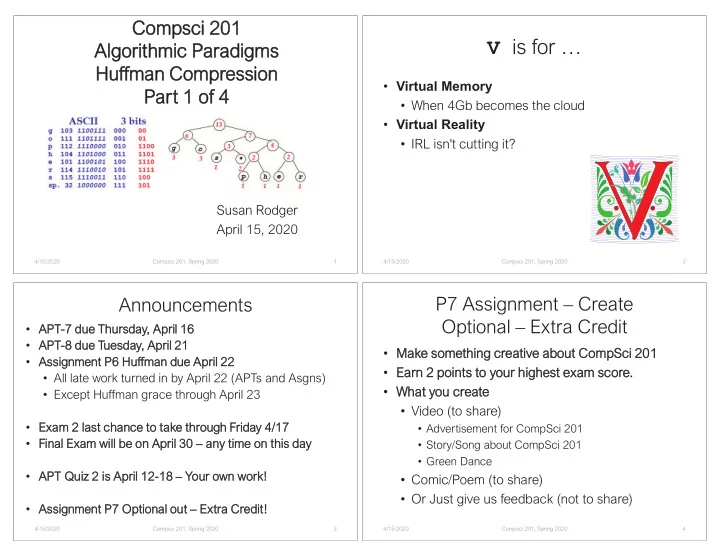
Compsci 201 Algorithmic Paradigms Huffman Compression Part 1 of 4

4/15/2020 Compsci 201, Spring 2020 1

Susan Rodger April 15, 2020

V is for …

  • Virtual Memory
  • When 4Gb becomes the cloud
  • Virtual Reality
  • IRL isn't cutting it?

4/15/2020 Compsci 201, Spring 2020 2

Announcements

  • APT-7 due Thursday, April 16
  • APT-8 due Tuesday, April 21
  • Assignment P6 Huffman due April 22
  • All late work turned in by April 22 (APTs and Asgns)
  • Except Huffman grace through April 23
  • Exam 2 last chance to take through Friday 4/17
  • Final Exam will be on April 30 – any time on this day
  • APT Quiz 2 is April 12-18 – Your own work!
  • Assignment P7 Optional out – Extra Credit!

4/15/2020 Compsci 201, Spring 2020 3

P7 Assignment – Create Optional – Extra Credit

  • Make something creative about CompSci 201
  • Earn 2 points to your highest exam score.
  • What you create
  • Video (to share)
  • Advertisement for CompSci 201
  • Story/Song about CompSci 201
  • Green Dance
  • Comic/Poem (to share)
  • Or Just give us feedback (not to share)

4/15/2020 Compsci 201, Spring 2020 4

slide-2
SLIDE 2

Sample Create 5 From CompSci 101

4/15/2020 Compsci 201, Spring 2020 9

Plan for the Day

  • Algorithm Paradigms via APTs
  • Backtracking Algorithms
  • Greedy Algorithms
  • Next week: more algorithmic paradigms
  • Huffman Compression
  • Quintessential 201 (and greedy) assignment?
  • Greedy, trees, arrays, recursion, priority queues,

reading files, writing files, bits, bytes, oh my!

4/15/2020 Compsci 201, Spring 2020 10

Backtracking Summary

  • Enumerate all possible moves/choices
  • Nqueen? Each column and each row in column
  • Blob-fill? Each neighbor: fill, and unfill
  • GridGame: try a move, follow it, undo/repeat
  • State/Board often two-dimensional array/grid
  • Not efficient, but thorough: try it all

4/15/2020 Compsci 201, Spring 2020 11

GridGame Backtracking Redux

  • Helper method: do and undo

4/15/2020 Compsci 201, Spring 2020 12

".X.X" "X.X." ".X.." "...." ".X.X" "..X." ".X.." "...." ".X.X" "X.X." ".X.X" "...."

slide-3
SLIDE 3

Collaborative APT Solving

  • http://www.cs.duke.edu/csed/newapt/ratroute.html
  • How many paths to reach cheese? 3 below
  • E,E,S,S,S,S
  • S,S,S,S,E,E
  • S,S,E,E,S,S: always closer, never further to goal

4/15/2020 Compsci 201, Spring 2020 14

E – moves east S – moves south

BackTrackRat

  • http://www.cs.duke.edu/csed/newapt/ratroute.html
  • Take a step toward the cheese, try every step …
  • If that works? Add +1 to total
  • If that doesn't work? back-track
  • Create Grid
  • Remember cheese goal
  • Take steps and count

4/15/2020 Compsci 201, Spring 2020 18

Backtracking APTs

  • Often use grid[][] to store state/moves
  • In Java this is actually an array of arrays
  • int[][] a = new int[4][4] for example
  • What is a[0]? What is a[0][0]?
  • Often move must be explicitly undone
  • Sometimes just try everything

4/15/2020 Compsci 201, Spring 2020 19

Rat/Transform input to grid

["X..X.X.", "XX.C.X.", ".......", "..X.X..", ".......", "R.XX..." ]

  • Input: String[], transform to char[][]
  • [0][0] is upper left, 0th row/column
  • Start at rat and ...
  • Try each step closer to cheese

4/15/2020 Compsci 201, Spring 2020 20

X..X.X. XX.C.X. ....... ..X.X.. ....... R.XX...

slide-4
SLIDE 4

Transform, Initialize, Solve

  • State and

behavior: local or instance variables

  • Scope?
  • Rectangle?
  • loop

bounds

4/15/2020 Compsci 201, Spring 2020 21

Base cases for cheese-finding

  • Off the grid? No paths to cheese
  • On an 'X'? No paths to cheese
  • On the cheese? One path to cheese

4/15/2020 Compsci 201, Spring 2020 23

Try every possible step that …

  • Closer to the cheese only, see line 50
  • What do we return? Recursive help

4/15/2020 Compsci 201, Spring 2020 24

WOTO

http://bit.ly/201spring20-0415-1

4/15/2020 Compsci 201, Spring 2020 26

slide-5
SLIDE 5

Lynn Conway

11/16/2018 Compsci 201, Fall 2018, DFS+BFS+Thinking 27

See Wikipedia and http://lynnconway.com

  • Joined Xerox Parc in 1973
  • Revolutionized VLSI design
  • with Carver Mead
  • NAE '89, IEEE Pioneer '09
  • Dynamic scheduling early '60s IBM
  • Transgender, fired in '68

We’ve come so far, so fast, that ever so many others could begin shedding old habits

  • too. After all, freedom isn’t just an external concept, framed by our laws. It’s a gift of the

spirit that we must give ourselves, in this case by going towards brighter shades of ‘out’. Bottom line: If you want to change the future, start living as if you’re already there.

https://www.huffingtonpost.com/lynn-conway/the-many-shades-of-out_b_3591764.html

Compsci 201 Algorithmic Paradigms Huffman Compression Part 2 of 4

4/15/2020 Compsci 201, Spring 2020 28

Susan Rodger April 15, 2020

Greedy Algorithm: Huff Prelude

  • Optimization: Best choice, maximal or minimal
  • Make a choice that looks good locally
  • But local best leads to global optimum
  • In later courses: prove greedy is optimal
  • Canonical example? Change with minimal # coins
  • Change for $0.63, change for $0.32
  • What if we're out of nickels, change for $0.32?

4/15/2020 Compsci 201, Spring 2020 29

Greedy Algorithms

  • In change making with US coins: minimize # coins
  • Choose highest denomination. Repeat
  • Works with infinite number of each coin
  • Example with $0.32 and no nickels?
  • Shortest path algorithm: choose "closest" point,

move there: overall best. Careful on "closest"

  • Huffman Compression: optimal per-character
  • Can't compress better one-char-at-a-time

4/15/2020 Compsci 201, Spring 2020 30

slide-6
SLIDE 6

Greedy APTs

  • https://www2.cs.duke.edu/csed/newapt/olympic.html
  • How is Olympic Candles greedy?
  • What candle should be lit on first night? Why?
  • https://www2.cs.duke.edu/csed/newapt/voterigging.html
  • How is VoteRigging greedy?
  • From whom should a vote be taken? Why?

4/15/2020 Compsci 201, Spring 2020 31

Olympic Candles APT

  • Given (different) heights of N-candles
  • Day one: light one, Day two: light two, …
  • When lit? Burns one inch of height
  • How many days until candles out?
  • [2,2,2] --- 3 nights
  • [1,2,2], [0,1,2], XXX, not greedy doesn’t work
  • [1,2,2], [1,1,1], [0,0,0]
  • [5,2,2,1] --- 3 nights
  • [4,2,2,1], [3,1,2,1], [2,0,1,1]

4/15/2020 Compsci 201, Spring 2020 32

Greedy Olympic Solution

  • On night N, which candles chosen to burn?
  • The tallest N candles, decrement each, repeat
  • N = 1,2,3,… until you don't have enough
  • How to determine tallest N candles?
  • What's complexity here?
  • Worst-case? Re-sort each time, repeat N times
  • Final result? O(N2 log N), why?

4/15/2020 Compsci 201, Spring 2020 33

Candle Pseudo-code

  • Can we sort in reversed order?
  • Comparator.reverseOrder()? no!

4/15/2020 Compsci 201, Spring 2020 34

slide-7
SLIDE 7

Algorithmic Processes that Scale

  • What is the 'A' in APT?
  • Typically efficiency is NOT an issue here?
  • What about in a tech/job interview?
  • Consider Olympic candles, what candles burn?
  • Have to burn N2 candles in worst-case
  • Find "best" better than log(n) per candle? no
  • What does efficiency mean for algorithms?
  • Is O(N2) ok for sorting?

4/15/2020 Compsci 201, Spring 2020 35

Huffman is a greedy algorithm

http://bit.ly/201spring19-april12-huff

4/15/2020 Compsci 201, Spring 2020 36

https://www.youtube.com/watch?v=aV8Wey9Ixj0

Compsci 201 Algorithmic Paradigms Huffman Compression Part 3 of 4

4/15/2020 Compsci 201, Spring 2020 37

Susan Rodger April 15, 2020

Overview of Huffman Lossy v Lossless Compressoin

  • RAW format compared to JPEG format
  • Tradeoffs – another example of "it depends"
  • Why do you ZIP files/folders?
  • Upload to Dropbox/Box/Google Drive
  • What are advantages of MP3
  • You were 0-3 years old

4/15/2020 Compsci 201, Spring 2020 38

slide-8
SLIDE 8

Huffman is Optimal

  • We create an encoding for each 8-bit character
  • Can’t do better than this on per-character basis
  • Normally ‘A’ is 65 and ‘Z’ is 90 (ASCII/Unicode)
  • A is 01000001 and Z is 01011010
  • Why does this make sense? 8- or 16-bit/char
  • Why doesn’t this make sense?
  • Unicode and images/sound, use all 8 bits

4/15/2020 Compsci 201, Spring 2020 39

Leveraging Redundancy

  • If there are 1,000 “A” and 10 “Z” characters …
  • Use fewer bits for “A” and more bits for “Z”
  • Huffman treats all A’s equally, no context
  • We use fewer bit for 'A', but are all A's equal?
  • Could use context: more than 8-bits at a time
  • Other compression techniques can do better
  • Faster and better compression, more complex

4/15/2020 Compsci 201, Spring 2020 40

Aside: Bit Interpretation

  • What can we tell from file extensions
  • Foo.class, bar.jpg, file.txt, coolness.mp3
  • How does OS know how to open these?

4/15/2020 Compsci 201, Spring 2020 41

0000000: cafe babe 0000 0034 001d 0a00 0600 0f09 .......4........ 0000010: 0010 0011 0800 120a 0013 0014 0700 1507 ................ 0000020: 0016 0100 063c 696e 6974 3e01 0003 2829 .....<init>...() 0000000: ffd8 ffe0 0010 4a46 4946 0001 0200 0064 ......JFIF.....d 0000010: 0064 0000 ffec 0011 4475 636b 7900 0100 .d......Ducky... 0000020: 0400 0000 5d00 00ff ee00 0e41 646f 6265 ....]......Adobe 0000000: 4944 3303 0000 0000 0048 5458 5858 0000 ID3......HTXXX.. 0000010: 001a 0000 0045 6e63 6f64 6564 2062 7900 .....Encoded by. 0000020: 4d79 7374 6572 7920 4d65 7468 6f64 5452 Mystery MethodTR

PicassoGuernica.jpg

  • Viewed using "open .." and via "xxd .."
  • Wikimedia "knows" how to display?

4/15/2020 Compsci 201, Spring 2020 42

0000000: ffd8 ffe0 0010 4a46 4946 0001 0100 0001 ...JFIF...... 0000010: 0001 0000 ffdb 0043 0008 0606 0706 0508 ....C........ 0000020: 0707 0709 0908 0a0c 140d 0c0b 0b0c 1912 .............

slide-9
SLIDE 9

Huffman: Better Encoding

  • Rather than 8 or 16 bits for every character
  • Fewer bits for frequently occurring characters
  • “go go gophers”: from 13*3 = 39 to 37. Wow!

ASCII 3 bits

g 103 1100111 000 ??

  • 111 1101111 001 ??

p 112 1110000 010 h 104 1101000 011 e 101 1100101 100 r 114 1110010 101 s 115 1110011 110

  • sp. 32 1000000

111

ASCII 3 bits

g 103 1100111 000 00

  • 111 1101111 001 01

p 112 1110000 010 1100 h 104 1101000 011 1101 e 101 1100101 100 1110 r 114 1110010 101 1111 s 115 1110011 110 100

  • sp. 32 1000000

111 101

4/15/2020 Compsci 201, Spring 2020 43

Create and Use Huffman Tree

  • Create Tree, Create Encodings, Compress file
  • Read file to create tree, read file to compress
  • In tree: left is 0 and right is 1: example of Trie
  • Frequently occurring characters close to root

4/15/2020 Compsci 201, Spring 2020 44

ASCII 3 bits

g 103 1100111 000 00

  • 111 1101111 001 01

p 112 1110000 010 1100 h 104 1101000 011 1101 e 101 1100101 100 1110 r 114 1110010 101 1111 s 115 1110011 110 100

  • sp. 32 1000000

111 101

3 2

p

1

h

1 2

e

1

r

1 4

s

1

*

2 7

g

3

  • 3

6 13

Huffman Compress Steps

  • Read file and count every occurrence
  • Map of "char" to frequency, or a[c] += 1
  • Create Tree using greedy algorithm
  • Use priority queue until one root left
  • Create encodings based on tree
  • Every root-to-leaf path is encoding: character in

leaf, path is encoding: store in map

  • Read file and write new encoding for each char
  • Careful attention to indicate end of file

4/15/2020 Compsci 201, Spring 2020 46

Greedy: create tree from counts

  • All weighted nodes in PQ
  • Remove two smallest
  • Put together, add back
  • Heavy chosen late

ASCII 3 bits

g 103 1100111 000 ??

  • 111 1101111 001 ??

p 112 1110000 010 h 104 1101000 011 e 101 1100101 100 r 114 1110010 101 s 115 1110011 110

  • sp. 32 1000000

111 g

  • e

r s *

3 3

h

1 2 1 1 1 2

p

1

h

1 1

p

slide-10
SLIDE 10

Finishing go go gophers

  • Tree -> Encodings
  • 0 left/1 right
  • How many bits? 37!!
  • More chars, more saving

ASCII 3 bits

g 103 1100111 000 00

  • 111 1101111 001 01

p 112 1110000 010 1100 h 104 1101000 011 1101 e 101 1100101 100 1110 r 114 1110010 101 1111 s 115 1110011 110 100

  • sp. 32 1000000

111 101

3

s

1

*

2 2

p

1

h

1 2

e

1

r

1 4

g

3

  • 3

6 3 2

p

1

h

1 2

e

1

r

1 4

s

1

*

2 7

g

3

  • 3

6 13

From Trie to Encodings

  • Compress: create encodings for each char/leaf
  • Similar to LeafTrails APT
  • Each 8-bit chunk/char mapped to encoding,

e.g., in an array with codings[‘p’] == “1010”

  • We have 256 different 8-bit chunks, but have

encodings for as many as 257 "characters"!

  • "character" is any 8-bit chunk, pixel to ASCII
  • PSEUDO_EOF is sentinel value, not real, but …

4/15/2020 Compsci 201, Spring 2020 50

Benchmarking Huff with kjv10.txt

4/15/2020 Compsci 201, Spring 2020 51

Encoding Length # values with this length 3 1,159,124 4 1,487,471 5 712,325 6 485,333 7 261,611 8 84,107 9 81,467 10 48,019 11 21,065 12 1,863 Encoding Length # values with this length 13 1,108 14 664 15 476 16 225 17 71 18 44 19 22 20 11 21 3 22 6 23 6

How does this make sense?

4/15/2020 Compsci 201, Spring 2020 52

  • Length 3? 4 characters
  • Length 1? 3 characters
  • Four different characters!
slide-11
SLIDE 11

Compsci 201 Algorithmic Paradigms Huffman Compression Part 4 of 4

4/15/2020 Compsci 201, Spring 2020 53

Susan Rodger April 15, 2020

Reading bits: BitInputStream

  • Classes that interface with java.io classes
  • Read 1-32 bits at-a-time, return int

int bit = in.readBits(1);

  • What can the value of bit be here?
  • No more bits to be read and you try to read?
  • Return -1, no exception thrown

4/15/2020 Compsci 201, Spring 2020 54

Huff Challenges

  • Your code will read and write bits-at-a-time
  • You'll benefit from "shadow-printing" so you can

"see" what your code does

  • Write decompress first: we give you test files
  • You can compress and decompress to test your

final program

  • One program depends on the other to work

4/15/2020 Compsci 201, Spring 2020 55

Huff Constants – HuffProcessor.java

  • These cannot be changed (final) hence constants
  • How many bits to read for counting? 8 or …
  • How big is the "alphabet"? 2^8 or …
  • What is magic number? HUFF_TREE or …

4/15/2020 Compsci 201, Spring 2020 56

slide-12
SLIDE 12

Writing bits: BitOutputStream

  • Classes that interface with java.io classes
  • Write 9-bits representing 'A'
  • ut.writeBits(9,65);

4/15/2020 Compsci 201, Spring 2020 57

Decompression with Huffman

  • We need the trie to decompress
  • 000100100010011001101111
  • As we read a bit, what do we do?
  • Go left on 0, go right on 1
  • When do we stop? What to do?
  • How do we get the tree/trie to decompress?
  • Could store 256 counts/frequencies, use same code
  • Could store trie: read and write: saves space!

4/15/2020 Compsci 201, Spring 2020 58

Huffman Decompression Steps

  • (must write header/tree/trie when compressing)
  • First read tree from compressed file
  • Then read compressed data one-bit-at-a-time
  • Go left or right, zero or one
  • If reach a leaf? Write out character, reset to root
  • Careful with knowing when to stop
  • Not when out of bits, reaching PSEUDO_EOF

4/15/2020 Compsci 201, Spring 2020 60

Decompress

4/15/2020 Compsci 201, Spring 2020 61

slide-13
SLIDE 13

You can't write just 31 bits

  • Generally files are written in chunks or blocks
  • Don't write one bit at a time or even 16
  • Efficiency concerns accessing slower memory
  • Generally read/write 8 or 16 or 32 .. bits-at-a-time
  • In compressed file: could store # bits at beginning
  • Then read that many bits, stop when done
  • In compressed file: could store sentinel at end
  • Then read until sentinel value read, stop

4/15/2020 Compsci 201, Spring 2020 62

PSEUDO_EOF

  • Not actually the end-of-file
  • A bit-sequence that does not occur in actual file

being compressed

  • How do we encode this?
  • Create HuffNode(PSEUDO_EOF,1)
  • Add to PQ, create encoding, 01010111
  • Last bits written: might write 01010111000
  • Read until PSEUDO_EOF found, stop

4/15/2020 Compsci 201, Spring 2020 63

Huff WOTO

http://bit.ly/201spring20-0415-2

4/15/2020 Compsci 201, Spring 2020 64

https://www.youtube.com/watch?v=aV8Wey9Ixj0

Out Takes from GoGoGophers

  • FIU, UNSW, UCB, UIUC, StackOverflow, …
  • Why is this Google-able? Why CourseHero
  • Many papers build on this example

4/15/2020 Compsci 201, Spring 2020 65