
SLIDE 1
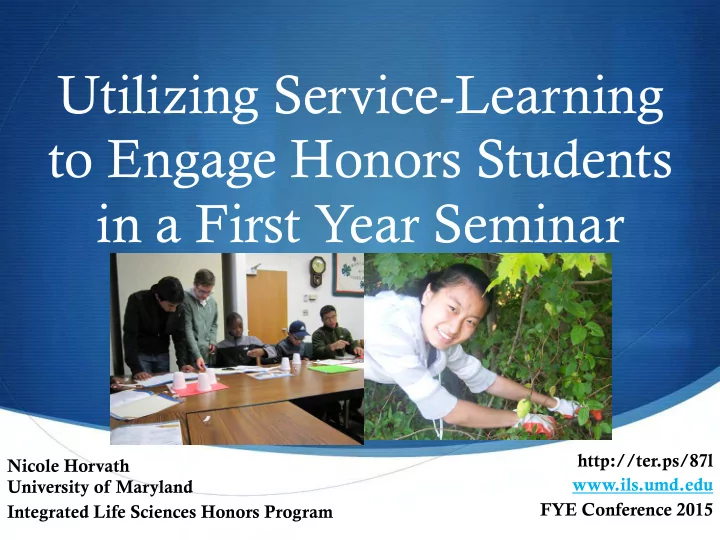
Utilizing Service-Learning to Engage Honors Students in a First Year Seminar
Nicole Horvath University of Maryland Integrated Life Sciences Honors Program http://ter.ps/87l www.ils.umd.edu FYE Conference 2015
Utilizing Service-Learning to Engage Honors Students in a First - - PowerPoint PPT Presentation
Utilizing Service-Learning to Engage Honors Students in a First Year Seminar http://ter.ps/87l Nicole Horvath www.ils.umd.edu University of Maryland FYE Conference 2015 Integrated Life Sciences Honors Program Whos in the Room? Nicole
Nicole Horvath University of Maryland Integrated Life Sciences Honors Program http://ter.ps/87l www.ils.umd.edu FYE Conference 2015
Nicole Horvath - Assistant Director, ILS Peace Corps Volunteer 2005-2007 MS Sustainable Development 2 pups rule my house
University of Maryland
education is needed.
Cooperation, Collaboration, Service, and Lifelong Learning
year students
Biology or Bioengineering
Science, Computer Science, and Public Health
dentistry, pharmacy, veterinary medicine, biological research, academia
University of North Dakota- http://und.edu/provost/fye.cfm
UNIV100 course
seminar ~20 students per class
Topics Discussed
take advantage of invited guests and panels.
point of the class.
sciences.
Immortal Life of Henrietta Lacks
1. Facilitate meaningful connections between students and improve social skills. 2. Improve student attitudes toward self, school, and learning. 3. Increase student civic engagement. 4. Increase academic performance. 5. Provide space for students to develop critical thinking and reflection skills.
( Celio et al., 2011; Bordelon & Phillips, 2006; Brown, 2011; Burrows et al., 1999)
“non-academic” way. (Association of American College, 1991; Lima, 2000; Kinnell, 2000)
communities.
(Jacoby, B. 1996. Service Learning in Higher Education)
questioning one’s experience within a broad context of issues and content knowledge.
them to be critical of their views, policies, etc.
https://julianstodd.wordpress.com/2014/07/10/rewriting-the- code-time-for-reflection/
For students to be able to:
the community surrounding UMD.
identifying personal areas of improvement.
provided during week 2.
are placed in one.
Finding Service Partners
needs, and SL content and goals
service
Working with Service Partners
content covered
report more comfort in the following areas:
responsibility to make their communities stronger.
to replicate. I enjoyed the independence we were given, the immediate impact we had on the community, and the connection to content discussed during class.”
difference as well as the importance of teamwork and most importantly, humility.” - Arun, 2013.
course and should never be removed. I really liked that I was able to make connections with other students who I normally wouldn’t hang out with.”
growth as individuals in society and exposed us to new situations.”
the world outside of campus.”
learn on my own the responsibilities of being an adult.” - Joe 2014
development’, I can’t think of a more effective way to accomplish this than through service.”- Robel, 2013
partners.
If you’d like to know more details about our course contact me at nhorvath@umd.edu
Campus Compact http://www.compact.org/resources-for-community- serviceservice-learning-staff/ Jacoby, B. (2014). Service-Learning Essentials: Questions, Answers, and Lessons Learned. ISBN-10 1118627946 Zlotkowski, E. (Ed.). (2002). Service-Learning and the First-Year Experience: Preparing Students for Personal Success and Civic Responsibility (Monograph No. 34). Columbia, SC: University of South Carolina, National Resource Center for The First-Year Experience and Students in Transition.
Association of American Colleges. (1991). Reports from the field. Washington, DC. Bordelon, T. D., & Phillips, I. (2006). Service-learning What students have to say. Active Learning in Higher Education, 7(2), 143-153. Brown, M. A. (2011). Learning from service: The effect of helping on helpers' social dominance orientation. Journal of Applied Social Psychology, 41(4), 850-871. Burrows, M. S., Chauvin, S., Lazarus, C. J., & Chehardy, P. (1999). Required service learning for medical students: Program description and student response. Teaching and Learning in Medicine, 11(4), 223-231. Celio, C. I., Durlak, J., & Dymnicki, A. (2011). A meta-analysis of the impact of service-learning on students. Journal of Experiential Education, 34(2), 164-181.
Eyler, J., Giles, Jr., D. E., & Schmiede, A. (1996). A practitioner’s guide to reflection in service-learning: Student voices and
Kinnell, J. C. (2000). Educational benefits associated with service-learning projects in biology curricula. In D. C. Brubaker & J. H. Ostroff (Eds.), Life, learning, and community: Concepts and models for service learning in biology, (pp. 7-23). Washington DC: American Association for Higher Education. Jacoby, B. (1996). Service-Learning in Higher Education: Concepts and Practices. The Jossey-Bass Higher and Adult Education Series. Jossey-Bass Publishers, 350 Sansome St., San Francisco, CA 94104 Lima, M. (2000). Service-learning: A unique perspective on engineering education. In E. Tsang (Ed.), Projects that matter: Concepts and models for service-learning in engineering, (pp. 109-117). Washington D. C.: American Association for Higher Education.